The telephone industry is changing. Not long ago, the standard setup for most companies was an in-house PBX system managing dozens, hundreds or thousands of phones. For outside calls, the most cost effective approach has been to bring in ISDN PRI trunk lines with 23 local and/or long distance lines each. Even small companies chose key telephone systems that can handle two to six outside lines. Those setups are changing fast.
There are two strong trends in the industry right now. One is cloud based hosted PBX telephone and the other is SIP trunking. They work perfectly together, but you can also have SIP trunking without cloud services.
A telephone trunk is a number of telephone lines all bundled together. This can be a wire bundle, such as a multi-line copper cable. It can also be an electrical bundle on a single line. ISDN PRI trunks, for instance, bundle 23 separate phone lines plus Caller ID and switching on a single T1 line. A SIP trunk is a telephone trunk line designed specifically to work with IP phones in VoIP telephone systems. SIP or Session Initiation Protocol is the switching technology used in VoIP in lieu of SS7, which is used in traditional switched circuit telephony.
So, why are SIP trunks such a hot item right now? It’s because a SIP trunk can be connected directly to your network or IP PBX to bring in multiple lines from your VoIP carrier. On a converged local area network, you are already running SIP. Why go to the trouble to converting to another protocol just to gain access to the public telephone network?
SIP trunks are also how you connect to a hosted PBX system as a cloud service. Companies are rapidly discovering that the per-seat cost of a cloud based telephone service is less than they pay now when you count the personnel, operating and maintenance costs of an in-house phone system. With hosted PBX, you no longer have to invest in new hardware every few years and your system is always being maintained and upgraded by the service provider.
It stands to reason that SIP trunking providers want your telephone business, but why do they want your bandwidth?
The reason that your carrier wants to provide you with both telephone lines and Internet bandwidth is so they can guarantee the quality of your phone calls. With traditional telephony, the telephone and computer networks are kept completely separate and cannot possibly interfere with each other. One of the cost saving advantages of enterprise VoIP solutions is that they use the corporate data network for everything. To make that work, you need to prioritize voice packets so that your phone conversations don’t distort or break up no matter what the computers are doing.
When your SIP trunking provider delivers both telephone and Internet service on your trunk line, they prioritize packets using CoS or Class of Service tags. These tags tell all equipment that recognizes them how to handle different types of traffic to ensure service quality. Not all bandwidth providers do this, so if you mix various line services you can wind up undoing your carefully engineered network quality.
There’s also a cost advantage, especially for small businesses who get both telephone and broadband on one line instead of two. You don’t even need IP phones to take advantage of this service. The provider will install an Integrated Access Device (IAD) that can connect to conventional analog phones and your broadband router.
Not sure if it's a good thing or a bad thing that our local checks (cheques) are so boring. What do you think?
Over in the United States, checks need not be issued by banks unlike our banking system requirement here. Folks in the U.S. can order their personal checks and have different designs and prints on the checks. The personal checks in the image above are from CarouselChecks.com. Awesome idea, isn't it? Checks shouldn't be so boring, don't you think?
Checks are not only a great way to pay bills, they are the perfect venue to express your hobbies, interests and sense of style. CarouselChecks has hundreds of varieties to choose from from colorful images to panoramic views to define your individuality. If you prefer traditional checks, there are parchment backgrounds to gorgeous monograms to choose from.
Photo checks are the new fad currently. They are a great opportunity to show off your interests and family. Photo checks use modern printing techniques to put crisp, clear pictures on the front of your check. You can even use several pictures in the same checkbook if you order from CarouselChecks. Proud of your children, your grandkids? Love your dog or kitty? Put the people and places you love most on your personalized photo checks and you'll always have a great conversation-starter. Brag away while you pay - put your vacation photos, family portraits, or even a funny moment to make your photo checks a memorable venue. The options are quite endless.
If you own or manage a business, business photo checks are a great way to showcase your finished product. Market your business by adding your best business picture of a finished renovation, wedding cake creation, floral arrangement or even a happy customer!
With hundreds of different images available, Carousel Checks has the checks you're looking for and at affordable prices. Clean, clear and classic, their bank check selection puts a modern spin to a familiar favorite.
Kuala Lumpur is quiet and with much less traffic on the roads as Muslims head back to their hometown to celebrate this joyous occasion with their family. There will be a three-day public holiday. Banks and offices will be closed from Tuesday through Thursday, the latter being a replacement for the National Day holiday on August 31.
Let me take this opportunity to wish You & Your Family a Selamat Hari Raya!
Looking for a fire-resistant non-flammable storage cabinet? You have come to the right place. Durham Manufacturing manufactures top quality metal cabinets, steel storage cabinets, industrial storage products, shelving and racks, industrial workbenches, plastic products used in packaging, and more.
Their new non-flammable storage cabinets are sturdy all welded double wall steel construction. You have a choice of 10 cabinets of 5 manual closing, 5 self closing with 60- & 90- gallon models having internal 16 gauge reinforcements. They have 2” wide louvers support shelves, adjustable on 4” centers. They all come with an improved security feature of recessed lockable paddle latch and 3-point locking system. These are just a few of the strong features of their new non-flammable storage cabinets. Check out their website for the rest.
Durham Manufacturing has a wide selection of industrial storage products including industrial-duty 16-gauge metal cabinets, heavy-duty 14-gauge steel cabinets and extra-heavy-duty 12-gauge steel storage cabinets; all with high security locking provisions.
Durham Manufacturing also produces heavy-duty pegboard steel cabinets, janitorial metal storage cabinets, and heavy-duty extra-wide bin cabinets. They also produce complementary components such as bins, drawer cabinets, drawer cabinet systems, rotary shelving, bulk storage cabinets, and mobile cabinets.
Nothing beats metal cabinets for durability, versatility and general usefulness. When you purchase a cabinet from Durham, you know you have the best product in the market. Established in 1922, Durham Manufacturing is synonymous with top quality.
The Centre for Intellectual Property Rights at the University of Leuven is holding a symposium on the European Copyright Code: the Wittem Project (which the 1709 Blog mentioned here, last year). This takes place on the afternoon of Friday, 16 September, and it's followed by a reception. What's this symposium all about? Let the organisers explain:
"Efforts of harmonization in the field of copyright law have only brought partial results for certain aspects of the law of copyright in the Member States of the European Union.
Therefore, at a meeting at the chateau of Wittem in 2002, scholars across the European Union, invited on the initiative of three Dutch universities (Radboud University of Nijmegen, University of Amsterdam and Leiden University) started a network project with the aim of drafting model provisions for a more comprehensive European Copyright Code.
The aim of this “Wittem Project” and the resulting Code, published in April 2010, http://www.copyrightcode.eu, is to promote transparency and consistency in European copyright law. The members of the Wittem Group share a concern that the process of copyright law making at the European level lacks transparency and that the voice of academia all too often remains unheard. The Group believes that a European Copyright Code drafted by legal scholars might serve as a model or reference tool for future harmonization or unification of copyright at the European level.
The members of the Wittem Group hope that this European Copyright Code will contribute to the establishment of a body of transparent and consistent copyright law that protects the moral and economic interests of creators, while serving the public interest by promoting the production and dissemination of works in the field of literature, art and science.
It will now be necessary to disseminate these proposals in all countries of the European Union and to discuss them as widely as possible. CIR, acting within the collaboration framework between the Universities of Leuven and Nijmegen wants to contribute to the achievement of this goal by organising a study session on the Wittem proposals for the Benelux".
Full details of the programme and to register for it can be found here. There's a strong cast of distinguished academic speakers and you can be sure that the fare will be stimulating and at times provocative!
Here we are in the midst of an intractable economic recession and you may still be paying twice as much for your business telecom services as you could be. Need a quick and painless way to cut the budget without having to let people go or cut necessary services? OK, then stop paying so much.
If you are anxious to start saving, get a cost savings evaluation right now and then come back to finish reading the rest of this article. I’m going to explain why a 50% savings is well within the realm of possibility for your company.
First, let’s see where the savings are. Nearly every business buys two principal telecom services. These are telephone and broadband Internet. Larger companies, those with multiple locations, or companies in certain fields will also buy point to point or multi-point bandwidth to link two or more locations. Do you have telephone? Do you use the Internet? Do you have a private link to another location? If so, you have a cost savings opportunity.
Now let’s see why these cost savings are available. First, the telephone and networking industry has become more competitive, especially since federal deregulation of telecom services. There are a lot more players than there used to be and they’re all hungry to expand their customer base. That alone accounts for a major slide in long distance telephone rates and digital bandwidth prices. Did the price of a garden variety T1 line drop by half over the last few years? You bet it did.
This is part of the secret to cutting your telecom bill in half. Business telecom services, like T1, DS3, & OC3, are sold on a contractual basis for one, two or three years. You get the lowest prices with the longest contracts, so the three year contract is often the most attractive. You may or may not be contacted to sign another contract when that one expires. If not, your service doesn’t generally just switch off. You go on a month to month basis for as long as you keep paying your bill. Some companies have been paying the same rate for years and years and have given no attention to comparison shopping.
One reason is that when you bought your original service, there was only one game in town and that was the local telephone company. What you don’t realize is that during that time other competitive carriers have started serving your area, likely with lower prices. Unless one of their sales team happens to call, you probably won’t even know they’ve come to town. More service providers means more offerings and better pricing, but you have to know how to get in touch with them.
The is the first way to get a dramatic cost savings. Do some comparison shopping. You still have to know where to find these carriers, who may or may not have an office in your location. You can try the Yellow Pages, but you’ll have to put in some time and effort to make the calls and compare the offers. Chances are, you’ll probably still miss some good opportunities.
The easier and faster way is to engage a telecom services broker who represents dozens of carriers. You pay the same rates you would if you hunted down the service provider yourself, but you don’t have to put forth the time and effort for comparison shopping. You’ll find that you get fast and friendly service from Telarus, Inc. for competitive telecom pricing. Just be prepared for a shock when you see the offers you’ve been missing.
The other reason that major cost savings are available for the asking is that new types of services have proliferated in the last few years. Ethernet over Copper is now a major competitor with T1 lines. You can generally get twice the bandwidth for the same amount of money if this service is available for your location. If you have a T1 line but are only lightly using it for credit card verification, email and Web access, you can probably save half the monthly cost with 3G fixed wireless broadband. This service is available nationwide and, unlike T1, is practical for temporary business locations like holiday stores, construction sites and conventions.
On the telephone side, that T1 line of yours could be doing double duty. SIP trunking and Integrated T1 combine business phone service and broadband Internet access on the same line. Unlike do it yourself VoIP, this is a carefully engineered solution that assures the quality of your telephone conversations regardless of what is happening on the computers or Internet.
Another recent telephone innovation is hosted PBX. Forget paying for all that telephone equipment and incoming lines. All of that is now handled in the cloud. You pay by the seat per month and your system is always functional and up to date with latest features. All you need in-house are IP telephones and a connection to your cloud provider.
For business applications that need to link several locations or more across the country, MPLS networks can’t be beat. You’ll easily save that 50% cost if you’ve grown your network gradually by simply adding point to point lines as you need them.
Got a few minutes? Want to save a bundle on your monthly telecom bills? Then just enter some basic contact information through T1 Rex and explain what you need. A friendly Telarus agent will be in touch at your convenience and send you a complete range of resources that meet your requirements, along with pricing. It doesn’t get easier and it’s hard to save more.
The Texas Aggies wrapped up the 17th day of the 2011 Fall Camp early Friday morning, ending preseason preparation and entering their first game week of the season against SMU.
The Aggies opened up camp with many questions surrounding the inside linebacker core, the depth at the nose guard position, and the quality of special teams. Some of those questions were answered during the three week period, while others will have to wait to be answered when the lights come on at Kyle and the season is kicked off.
Let's go position by position to give you a preview of where the Aggies stand:
Defensive Line:
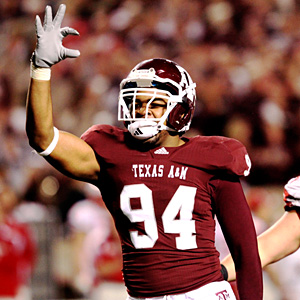
The Aggies return three starters along their 34 front in future NFL draft pick Tony Jerod-Eddie, Jerome Mathis, and Eddie Brown. Jerod-Eddie is the unquestioned star up front along the line and really showed flashes during the spring of becoming a dominant defensive player that will require multiple blockers. That success began to transition into the fall before Jerod-Eddie had a foot injury that required him to wear a walking boot for several days. But Jerod-Eddie was back on the field before fall camp ended and was showing flashes once again that he can lead the Wrecking Crew up front. If you were to make a list of players that will have to improve their overall game and become a leader for Tim DeRutyer's defense in order to replace the #2 overall draft pick in the NFL in Von Miller, Jerod-Eddie might just top the list. He is finally bringing a consistency to his game which he has lacked in the past. The Aggie offense knows just how dominant he can be as he constantly has to be double-teamed if they want to make any headway on the ground. If teams plan to run the ball against the Aggies in 2011, they will have to specifically game plan around the defensive end. As teams concentrate on Jerod-Eddie, it will only leave another future NFL player in Jonathan Mathis with opportunities to make plays on the opposite side of the field. Mathis was moved from nose guard to his more natural defensive end position where he can use his unique speed and quickness to get off blocks and make plays in the backfield. If he is able to be blocked one-on-one, it is going to be a battle he will win at the line of scrimmage almost every time. Mathis made a lot of improvement last year towards the end of the year and continues to feel more comfortable as a natural in coach DeRutyer's defense. The combo of bull-rushing Jerod-Eddie and quick reflexes of Mathis on the other end will leave many offensive coordinators wondering how they will able to get their running back past the line of scrimmage.
At the nose guard position, Eddie Brown returns as the starter and will be backed up by the emerging playmaker in Kirby Ennis. Brown is probably most remembered in 2010 for driving back the Nebraska center who then stepped on Taylor Martinez's foot to take him out of the game. Eddie Brown doesn't have the same amount of talent as a Jerod-Eddie or Jonathan Mathis, but he makes up for it in his drive and work ethic on the field, not stopping until the whistle blows. Just a relentless defensive lineman that no center will want to handle inside. He is very active fighting off blocks and then keeping his position along the line of scrimmage and not rushing up the field to make sure no ball carrier sneaks by him. Kirby Ennis has probably been the most pleasant surprise of both the spring and fall for coach Terrell Williams. With JUCO nose guard LaMarc Strahan unable to make it to campus, someone was going to have to step up at the position behind Brown. That has been the sophomore Kirby Ennis who didn't play last year coming off a knee injury suffered in the 2009 Independence Bowl against Georgia. Ennis has been very dominant at the line during the fall so much so he will likely split snaps evenly with Brown at the position. Having a reliable 4 man rotation for 3 starting spots allows coach Williams to be creative with his substitutions and allowing players like Mathis, Brown, and Ennis to play multiple positions to provide unique looks to the offense and keeping everyone fresh for four quarters.
Other depth along the defensive line will come from players like DE Spencer Nealy, DE Ben Bass, NG Stephan Barrera, and redshirt freshman Ivan Robinson and Galvin Stansbury. Stephan Barrera is an intriguing player to watch this season. After moving to the defensive line from the offensive line, he was pushing for serious playing time last season before suffering a season ending injury. Now moved to the nose guard position, he was again making progress before being sidelined for most of fall camp with another injury. If Barrera can stay healthy, he may be playing his way onto the field and making an impact for coach Williams into October and November. Two other quality rotational players is the energy player Spencer Nealy and the reliable Ben Bass. Nealy brings an energy to the defense and plays 100mph all the time when he is on the field. I expect to see Nealy used mostly in pass rushing situations compared to common run downs. Bass was a quality contributor for the Aggies last season. Almost three seasons ago, Bass was the best defensive lineman the Aggies had on their roster before having to miss the 2009 season due to academic issues. Now this being his second year back with the Aggies, Bass can continue to make progress toward being that dominant lineman many expected him to be. Two other players who might sneak into the rotation are Ivan Robinson and Galvin Stansbury. Both are still freshman but have shown ability in camp. Stansbury seems to play the run better of the two, while Robinson is a brute-force type of guy that needs to continue to round out his game with learning moves and game experience.
The main point to take away is the Aggies have not just depth but quality to keep their defensive line healthy and fresh as the game enters the 4th quarter and the season drags on into November.
Outside Linebackers
This has been one of the most interesting positions to watch develop this fall. The star of the group and the player that is ready to become the leader of this defense is Sean Porter. Playing on the other side of Von Miller, Porter has learned from the best and is now inspired to devout this career to the same motivation and passion that Miller carried with his to take Texas A&M to the next level. Porter is one of the quickest linebackers on the team and a true sideline to sideline player. He is great in intermediary coverage but actually needs to become a better pass rusher and bulk up to take on blocks and then fight them off to become a complete player at the position. He has made those improvements in the offseason, bulking up while maintaining his quickness that makes him an all Big XII player. It will be interesting to watch early on in the fall how he is used in coach DeRutyer's zone blitzing system as either a blitzer, cover LB, or an even split of both. If you are looking for a breakout player in 2011, Sean Porter seems to fit the bill and is ready for the spotlight.
Many people were surprised to see Caleb Russell be the starter on the other side of Porter leaving the spring, taking over Miller's Joker position. But Caleb deserves the spot with his effort. He doesn't bring the same natural skill set as a Damontre Moore, but he is deceivingly explosive and a lot more athletic than you would think. Russell goes all out every play, and just like Porter needs to become a complete player at the position, but its his coverage skills are what need improvement. However, if he brings 110% every play to the defense like he did in the late fall of 2010 and spring, he will hold onto the spot and play well. I expect to see a lot of Caleb on 1st and 2nd downs. Damontre Moore burst onto the scene as a true freshman, and made the most impact in the earlier part of the season as Von Miller battled injury. Moore was expected to fill Von Miller's shoes and become an all-conference player himself. However, off the field trouble in the summer and his inconsistent play in the spring has slid him down the depth chart and in the doghouse of the coaches. Moore has seemed to have gotten the message that is being sent his way as he put together a number of strong performances in the second half of fall camp, becoming a much more consistent player and a guy that gives maximal effort every play. If Moore continues to fight, he will be a dangerous pass rusher for any team to stop. The only question is will his offseason mishaps affect the amount of playing time he sees early on in the season. This Aggie defensive will immediately jump to one of the best if not the best in the Big XII if Moore reverts back to his early 2010 and becomes a dominant pass rusher.
But the development of three true freshman have been the story of the preseason. Brandon Alexander, Shaun Ward and Tyrell Taylor have brought their unique characteristics to fill out some of the depth at the position. Brandon Alexander is a 6-6 240 pound former defensive end who is playing standing up instead of with his hand on the ground for the first time. He has done surprisingly well in not just rushing the passer but also in coverage as his speed and acceleration have chased down ball carriers and his athleticism has allowed him to break up a few passes in zone. He should see time behind Sean Porter. Shaun Ward brings his burst and explosion off the snap that reminds many of Von Miller. Ward needs to lean down a little bit as well as become conditioned to become more effective in coverage and playing the ball when he isn't trying to sack the quarterback. But the surprise has been Tyrell Taylor who has a long frame at 6-4 but is only 200 pounds. That doesn't slow Taylor down as he is probably the most natural pass rusher of the group and fights off blocks to get to the quarterback. Quotes from coach Sherman seem to indicate that Taylor will be one of the freshman to see playing time in the fall. That doesn't mean he will be playing every snap and will be a liability with his size; Taylor will be brought in for unique packages during pass rushing situations and be asked to do what he does best -- get after the quarterback. His specific skills will find its niche in Tim DeRutyer's defense. If we had to pick two of three that will see playing time at Kyle this fall it would be Alexander and Taylor, but Shaun Ward with his talent may avoid the redshirt as well, especially if an injury or two occurs.
Inside Linebackers
Probably the biggest question surrounding the Aggie defense entering into the fall was who was going to man the two inside linebacker spots. To many, it was a surprise to see Jonathan Stewart and true freshman Donnie Baggs getting the nod to run with the first team when the fall opened up. Both Garrick Williams and Kyle Mangan were running with the second team. However, Jonathan Stewart carried a strong finish to his spring into the fall and proved he deserved to be playing the spot left open by senior leader Michael Hodges. Stewart has always had the physical tools to play the position, but at times needed to be quicker off the snap in his first step and be more instinctive. Not only has Stewart finally found himself comfortable in DeRutyer's scheme, but he is also a vocal leader on the field helping others getting lined up and making calls to the rest of the defense. It is that kind of vocal leadership this defense is going to find very valuable after the departure of Michael Hodges. Donnie Baggs had a strong spring as a true freshman and didn't let his inexperience at the position get the best of him. In the fall, he continued to play fast and was most effective in coverage over the middle, something that got the Aggies in trouble at times last year. Baggs most likely won't be a starter on opening night as he has to be better in attacking the line of scrimmage against the run, but that doesn't mean he won't see plenty of action. It was Garrick Williams who started opposite of Jonathan Stewart to close out the fall. Williams was penciled in as a no-brainer starter by many leaving the spring, but he might have been a victim of being too lax with his position and finding himself with the wrong crowd in the offseason. As a senior, Williams should be showing the freshman how to play and conduct themselves, not the other way around. However much like Damontre Moore, Williams seemed to get the message towards the second half of camp and put on a show to regain his starting position. He needs to continue to realize he needs to be a leader on the field not only by his play but also his vocal presence. Williams can cover sideline to sideline and plays a lot more physical at this point than Baggs. Where Williams gets in trouble at times is his awareness of a developing play. If he is able to see the whole field better and anticipate what the offense is thowing at him, he can become one of the best in the Big XII at his position. Kyle Mangan is the 4th linebacker in the group and seems to be healthy after multiple shoulder injuries. His overall athleticism doesn't compare to the other three linebackers. However, he is a player that goes all out and will be a part of the linebacking rotation and a value to special teams. JUCO transfer Steven Jenkins will be a player I will be watching for as the season goes on. Jenkins is the most athletic linebacker on the roster and has incredible range. He also delivers monster hits. The problem with Jenkins is he still has to adjust and learn DeRutyer's defense. Once he gets that down, he will be able to play at full speed and make an impact for this football team. I expect to see a lot more of Steven in October and November in the heart of the conference schedule. The qualities he possess make him a perfect fit in a defense that constantly has to defend the spread offense.
How sound is the group? If Garrick Williams can play as he did in 2010 and Jonathan Stewart really has finally grasped the position, this group can be just as good if not better than last year. The position has become more athletic and should be better in pass coverage over the middle. I think the question will lie in if this group will be able to stop the run as well as they did last season and can they replace the heart and passion of Michael Hodges. That will be hard to do.
Secondary
There may not be a more deep and talented group on the A&M roster. And when you play against a spread, pass happy Big XII, that is a very good thing. If you are going to start talking about secondary, you have to begin with the leader of the defense in Trent Hunter. Trent, along with Ryan Tannehill, was voted a team leader on Wednesday night. He is a 4 year starter at the position and became very comfortable in what Coach DeRutyer asked him to do towards the end of 2010. It also helps when you have a player that is as talented as Steven Campbell beside you. Trent isn't the most athletic guy to play the position, but that doesn't hold him back in always wanting to be near the football. He is very good in coming up in run support, and then playing back in coverage like we saw during the Oklahoma and Nebraska football games has improved. Being the unquestioned leader of the secondary, he barks out signals and making sure his running mates are where they are supposed to be and know what is going on. Beside him is maybe the most electric and game-changing player on the defense in Steven Campbell. When asked about how coach Sherman was going to replace Von Miller, he said you could never replace a Von Miller but it would have to be a combination of players. However, if there was a player on the A&M defense that brings the same playmaking ability that can change a game and dominate an offense, it is Steven Campbell. It is not coincidence that the Wrecking Crew came back to form in the second half of the season when Steven was healthy. He is healthy once again entering into this season; his range and acceleration in the backfield makes him A&M's most dangerous defender and should be a household name to many Big XII fans in October and November.
One name that gets lost in the safety shuffle is Steven Terrell. Terrell entered into last season as a starter in place of the injured Steven Campbell. While Terrell isn't as dynamic as Campbell or bring the intangibles of Hunter, there are many Big XII teams who would love to have Terrell in their secondary. He will be a backup for both positions and will be a great rotational player to give either player a breather on the sideline. Another freshman that is turning heads is Howard Matthews. Matthews is so impressive that he has been working in during nickel and dime packages and running with the 1st team during stretches of camp. He will be a immediate impact player in the secondary and another ball hawk the offense will have to watch. Then there is JUCO transfer Johntel Franklin who will also be brought in at times to help cover against the pass. Johntel is more of a finesse player at this point and still has to learn the defensive playbook; but he should be a very valuable player next season for the Aggies.
The Aggie corners are six deep in talented playmakers. Coryell Judie headlines the group as a future NFL talent. Judie is the lockdown type corner the Aggie defense has missed for sometime. He has also proven to be a dynamic returner. What makes Judie so great is his physical play with the receiver at the line of scrimmage, throwing them off their route and timing with the quarterback. When the ball is in the air, the receiver better be ready for Judie to be all over him. What concerns many Aggies is Judie's shoulder that still appears not to be properly healed. The coaches made Judie wear a black jersey for most of the fall, meaning not to be physical or hit the corner. While he was still participating, it is concerning because Judie thrives on being physical, and with a bum shoulder he might not be able to play his style of defense. The good news is Judie still has a little under a month before he has to match up with a Justin Blackmon or Greg Childs, allowing time for the shoulder to heal.
Three other names are common to many Aggies by now in Terrence Frederick, Dustin Harris, and Lionel Smith. Frederick is like ole reliable at his position. Much like Trent Hunter, the former Katy Tiger has spent four long years at his position, not working with the same skill set that now some of the younger players are bringing in like a Floyd Raven. Still, Frederick uses his no-nonsense approach and technique to become a dependable corner. Frederick has even become a great blitzer off the edge. The weakest part of Frederick's game may be deep passing routes as quicker and more agile receivers are able to create separation. If you are close to the line of scrimmage, you get a corner that isn't afraid to smack you and help in run support. Harris is entering his third year that might be the most productive for him yet. He can run with any receiver and has a knack for finding the ball when it is in the air to make a play on it or even intercept it. He is the kind of player who can come out of no where and steal the ball away from the defender on a moment's notice. Because of these skills, Harris may also find himself as an offensive receiver a time or two, asked to go deep down the field and separate from the coverage for a long touchdown. Lionel Smith is the fourth corner of the group and has finally settled in after moving between the secondary and receivers. Smith is often overlooked by many, but he continues to improve every single year and at times finds himself running with the first team when other players are out due to injury. It's his never give up mentality that makes him so successful and will be ready to play whenever his number is called. If nothing else, he makes a great corner in nickel and dime packages.
Three other future corners round out the group in Toney Hurd Jr., Floyd Raven, and Deshazor Everett. Hurd moves over from playing secondary last year to his more natural position of corner. Much like Terrance Frederick, he is great in playing at the line and attack an underneath route or run play. He also brings the physicality of a Judie when covering a receiver. He left fall camp with some injury issues, specifically his back. All has checked out well, and will be a fantastic special teams player. Floyd Raven hasn't disappointed many as the talented freshman brings natural skills that many haven't seen in the Wrecking Crew backfield in quite some time. He is just a natural cover corner that can play a receiver at any position on the field. You won't be beating this young man deep either. He is though still very raw and will get some great tutor-age from older players like Coyrell Judie and Terrance Frederick on how to be a technician at the position. It will be interesting to see if he redshirts or finds his way onto the field. If this position wasn't so deep, there wouldn't be any question he deserves playing time. Another freshman that has impressed buy most likely will be redshirted is Deshazor Everett. Everett has made some great hits at practice and isn't afraid to pop anybody. But he needs to work in his cover skills before seeing time at Kyle. His future along with Raven's is very bright however.
Kick Coverage and Punting
The Aggies are finally entering into a situation where they have plenty of young talented bodies who can cover kicks effectively. Such players included previously mentioned players like Tony Hurd Jr., Steven Jenkins, Kyle Mangan, and Malcolm Kennedy. You couldn't find this quality of players on special teams two seasons ago. But that is what happens when you build up a program is that you have young future starters contributing to the teams and being effective. I don't think the Aggies have to worry to much anymore about someone breaking one long or the teams not covering properly.
Punting, like almost every season before, is once again a problem and concern. The Aggies have brought in numerous players, this year scholarship punter Drew Kaser, to relieve the worries. To Kaser's credit, he has been injured from the very beginning of camp and is only now becoming healthy enough to take on the kicking duties. However, just like the field goal unit, it may be the snap which is the most questionable problem. Some snaps have been reportedly so bad that Kaser and others have had to rush kicks leading to very poor punts. For a team that is ready to make a move into a championship contender, these kind of special teams problems could be the difference between a close win or loss. Just ask the San Diego Chargers how much special teams can cost your season, no matter how good your offense or defense is statistically. The Aggies must use field position to their advantage this year in contests like Oklahoma State, Arkansas, and Oklahoma or they might end up on the wrong end.
Overall Outlook
After a 9-4 season and 18 starters returning, the Aggies are ready to make a serious push for a Big XII championship and BCS bowl game berth. The Aggies will have to do several things if they expect to get there. On offense, the Aggies must simply decrease the number of turnovers they had a year ago. They can't continue to let the other team put easy points on the board. They also don't have to put up 35-40 points up every contest if they expect to win anymore; the defense has improved to where if they can score in the mid to high 20's they are in a position to win. But the offense must be efficient, and by that I mean they have to at least get one or two first downs every drive to flip the field position if they have to punt and put themselves in 3rd and 5 or shorter situations to at least give them a chance to convert. With the power running game and experience on the offensive line now, that should be a problem. But the key area is redzone. When the Aggies get past the 20 yard line, they must put the ball in the endzone. This has been a problem before with the more spread offense the Aggies running. Now with a more talented offensive line and running backs like Cyrus Gray and Christine Michael, they have the ability to push the ball into the endzone. What they can't do is constantly settle for field goal opportunities.
On defense, the Aggies must continue to find ways to constantly pressure the quarterback. With Von Miller's departure, young players like Damontre Moore, Sean Porter, and Tyrell Taylor will have to take his place collectively. Also, the Aggies should see more dominance up front with Jerod-Eddie and Jerome Mathis. If the Aggies continue to stop the run like they did last year and make offenses one dimensional, it will play right into Tim DeRutyer's hands with his exotic blitz packages and one of the strongest secondary units in the country behind them. What the Aggies can't afford is long touchdowns. If they are able to keep big plays from happening either with the long pass or break-out run, I don't think many offenses will have the ability to drive down the field and put seven on the board. Something bad -- either a sack, interception, or fumble -- will happen against this attacking defense in the span of 8-12 plays, getting them off the field.
If those things hold true and we are able to see reliable special teams in the place kicking and punting department, I really believe the Aggies are as good as their #9 ranking in the coaches poll and could find themselves in a BCS bowl game at the end of the year. But they have to remain humble and realize they are the new kids on the block in this department and have to continue to fight and get better every single day. There is not a single team the Aggies cannot defeat on their schedule. Two stretches of games make me take pause in Oklahoma State, Arkansas, and then at Texas Tech, followed by Missouri, at Oklahoma and at Kansas State. If the Aggies can go 2-1 in each of those stretches, they will put themselves in position for a Big XII championship and a very nice bowl game at the end of the year. I personally see the Aggies finishing up 11-1 and playing in a BCS bowl game to close the year, but not winning the Big XII title as they lose to a 10-2 Oklahoma squad in Norman.
It is easy to see this year is shaping up to be the best in Aggieland in quite some time. However, the Aggies have to take each step one at the time in order to climb to the top of the college football world, where they belong.
 There are two strong trends in the industry right now. One is cloud based hosted PBX telephone and the other is SIP trunking. They work perfectly together, but you can also have SIP trunking without cloud services.