Showing posts with label jitter. Show all posts

Sunday, October 23, 2011

IP WAN over MPLS Advantages

When we think of IP wide area networks, the first thing that comes to mind is the Internet. While the Internet does have almost universal connectivity and modest cost to access, there are some serious issues when it comes to business applications. Bandwidth, latency, jitter and packet loss have no guarantees and few expectations. Security is a joke. But aren’t other methods to interconnect business locations costly and hard to manage?

It is possible to set up a private IP network that lets you use your familiar IP addressing schemes and avoid encryption, firewalls, tunnels, and additional hardware. You’ll gain a performance advantage compared to using VPN techniques over the Internet and save yourself the administrative headaches of trying to manage a WAN with inherently indeterminate characteristics. Who offers something like this? It’s TelePacific, one of the nation’s largest competitive carriers.

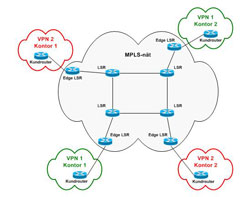
TelePacific’s 1Net is an IP VPN running on a private MPLS network, not the Internet. Since MPLS or Multi-Protocol Label Switching can transport almost any protocol, it can be set up to mimic the Internet while keeping your data private. Only the locations that you set up can exchange traffic. No one outside of your user group can capture or view your data. You’ll have any to any connectivity within the group with security sufficient to address HIPPA or similar government regulations.

In fact, TelePacific set up just such a private IP Network for a medical imaging organization with 6 locations. They use it to transport patients’ private medical records among their location. Referring physicians can access patient imaging results within hours at their own computers. The system is also used for claims processing, patient scheduling and registration. Interestingly, this system also allows dedicated Internet access through a single firewall at corporate headquarters.

The TelePacific 1Net IP VPN has both cost and performance advantages over other secure networking solutions, including private line, ATM and Frame Relay. You can specify up to six different Classes of Service (CoS) to support sensitive real-time services such as VoIP telephone and teleconferencing. On Net, latency for all CoS is specified at 50 msec. That rises to just 100 msec for extended reach locations off the TelePacific network but still within the US. Network availability is 99.999% (5 nines) both on and off network locations.

The Classes of Service are CoS 1 for VoIP real time traffic, CoS2 for video conferencing and real time data traffic, CoS3 for high priority, delay sensitive business data like Ecommerce and Citrix, CoS4 for medium priority delay-sensisitive business data such as CRM and WebEx, CoS5 for general less delay sensitive business data like ERP, and CoS6 for best effort traffic with no prioritization. That’s typically Email and FTP.

Are you cringing at the cost and effort involved in linking your business locations by private lines or frustrated by the highly variable performance and difficulty in securing the Internet? Perhaps the best solution for your business needs is a private IP VPN based on MPLS networking. Check prices and features to compare with your other choices.

Click to check pricing and features or get support from a Telarus product specialist.


Note: MPLS network diagram courtesy of Wikimedia Commons.



Follow Telexplainer on Twitter

Tuesday, August 16, 2011

Advantage of Dedicated Cloud Connections

The capital investment and staff cost savings offered by cloud services are encouraging small, medium and large companies alike to move their telephone and IT resources to the cloud. It’s been assumed that a simple broadband Internet connection will suffice for access. That’s turning out to be a disappointment in some cases.

Improve cloud performance with a dedicated connection...The notion that bandwidth is bandwidth is how we get in trouble specifying metro and wide area network connections. What makes the Internet attractive as a WAN service is that it is almost universally available and the cost is spread over millions, even billions of users. Savvy companies discovered long ago that you could get around the security issues by encrypting your data to create a VPN or Virtual Private Network. The VPN gives you a private tunnel through a public network.

VPNs work great to support remote workers and traveling employees who’s only way to connect with corporate headquarters is through a wired or wireless Internet service. They’re also good for linking multiple business locations, such as branch offices or franchises. With a VPN you can transfer sensitive financial and inventory files among dozens, hundreds or thousands of locations.

Note that we are talking about file transfers. The TCP/IP network protocol was made for this application. All you do is launch the transfer and TCP will ensure that all the packets that make up the file will get from point A to point B intact. If something goes awry and a packet is corrupted, it is automatically resent.

Remember that the Internet was designed for universal access and to be self-healing in the face of equipment failure or line breaks. While TCP/IP is making sure that files are being accurately transfered, the Internet itself is making sure that there is a path available from point A to point B no matter what. While you can expect to transfer data, voice or video files over the Internet, you can’t really expect that this is going to happen without hiccups or in any minimal amount of time. Packets may or may not be lost and require a resend. The path may change from packet to packet. The latency or time delay from source to destination can vary all over the place, or jitter.

The result of this is that real time performance of Internet connections is highly variable. This is no big deal for data file transfers. The time to transfer may vary by milliseconds or seconds for each file. Time sensitive data streams like audio and video need some extra help in the form of buffering. You compensate for unknowable transmission rate variations by filling up a buffer with packets and then clocking them out at a constant rate.

Buffering works great for one-way downloads, but creates havoc for real-time video or audio streams. That includes telephone calls and video conferencing. You can’t have much of a buffer or the latency increases to the point where you can’t talk and listen at the same time. There is a noticeable delay, fractions of a second or longer, that make two-way communication painful at best. Lost packets from iffy Internet connections add distortion that blurs your video and garbles your audio.

The same Internet that seems fast and responsive when searching for information on Google can be maddening when trying to calm down an angry customer on a VoIP phone call that is breaking up. Automated business processes that worked fine over the LAN when the data center was in-house all of a sudden become sluggish in the cloud. It’s not that the cloud isn’t just as good or better than local resources, it’s that you need a better connection.

What you want is a dedicated connection between you and your cloud provider. Level 3 Communications is now offering dedicated connections to Amazon Web Services (AWS) running in Equinix data centers to meet the demand from larger corporations. Dedicated connections include Ethernet Private Line, Ethernet MPLS and Wavelength services. T1 lines are also suitable for smaller companies, although Ethernet over Copper may be a lower cost option and offer more bandwidth for the money.

A dedicated connection ensures that you have steady guaranteed bandwidth plus low latency, jitter and packet loss. Security is also improved because access is limited, not publicly available. A well engineered dedicated connection is just like a very long LAN that includes your locations and your service provider.

Are you disappointed with the performance of your cloud services or concerned that quality will suffer if you move from a local data center to the cloud? All you may need to get things working to your satisfaction is a high quality dedicated cloud connection. Why put up with all that aggravation when dedicated connection prices are lower than they’ve ever been? Check prices and availability of dedicated cloud connection bandwidth you need to support your critical applications.

Click to check pricing and features or get support from a Telarus product specialist.


Follow Telexplainer on Twitter

Wednesday, October 27, 2010

MPLS Service Providers Link Your Business Locations

It’s common for businesses to have multiple locations that need to be tied together with voice, data and sometimes video services. These can be branch offices, remote data centers, warehouses, franchises, factories and other business locations. What’s needed is a simple, cost effective way to link geographically diverse locations. MPLS service providers are ready to do just that.

Why MPLS? After all, there have been telecommunications services available for decades that can link one site to another. T1 point to point lines are readily available just about anywhere you need service. The public telephone network connects any phone to any other phone in the world. So what is it that MPLS networks have to offer that is new and different?

What MPLS is all about is privately owned and operated networks that serve large regions of the United States, some with national and even international footprints. These are what are also called “cloud networks.” The beauty of the cloud is that you don’t personally have to worry about the intricacies of wiring up and operating the many, many connections linking sites within the cloud. That’s all taken care of by the MPLS service providers. All you need is a link to the MPLS network from each of your locations. The network operator takes care of setting up the connections among your sites per your specification.

You might think that MPLS networks sound a bit like the Internet, and you’d be right. The similarity is in the way they make connections from anywhere to anywhere else. But that’s where the similarity ends. The Internet is a public resource with no quality of service mechanisms. If particular nodes get congested, packets wait or get lost. The Internet automatically sets up routing on the fly, so you never really know how your packets are getting from point A to point B. They just do somehow.

MPLS networks are engineered around predictable and dependable performance. Routing is done by a proprietary tagging protocol unique to MPLS networks. That makes them far more secure to outside intruders than the Internet. The tag switches have determinate paths that don’t change unless there is an equipment failure that needs to be worked around. Bandwidth, jitter, latency and packet loss are carefully controlled for each customer of the network.

What this all means is that MPLS networks work well for business users that set high standards for the quality, reliability and security of their telephone conversations and data transfers between locations. What MPLS providers can do is offer you a substantial cost savings over building your own private network to link multiple business locations. This is especially true if you have many locations scattered across a wide geographical area, including international offices.

How much of a cost difference is there between an MPLS network solution and what you are doing now for connectivity or have under consideration? Find out quickly and easily with a short inquiry to our knowledgeable Telarus consultants. They’ll get you competitive quotes from MPLS service providers that will clearly show how much you can save.

Click to check pricing and features or get support from a Telarus product specialist.


Follow Telexplainer on Twitter

Tuesday, September 14, 2010

Wireless SIP Trunking

One thing we know about business telephone and dedicated broadband access is that they are wireline services. Well, that’s what we used to know. There’s a new player in the marketplace and it is wireless SIP trunking.

Get service availabilty and pricing on fixed wireless for voice and data.A pioneer in this field is Airband Communications. They offer enterprise-class IP-based voice services bundled with wireless Internet access. In wireline parlance, this could be called a SIP trunk or Integrated voice and data service. But Airband VoIP trunking service has some unique advantages.

Like other integrated services, there is only one WAN connection providing both telephone and broadband Internet access. This one just happens to be wireless. Also like the better integrated services, bandwidth is dynamically allocated between voice and data to make efficient use of the connection. Voice packets get priority to maintain quality of service. The bandwidth sharing of voice and data also only exists between your facility and Airband. Your telephone calls never travel on the Internet and aren’t subject to the disruptive effects of congestion, jitter and latency on the public network. In fact, you get a unified service level agreement from Airband that covers availability, packet loss, latency and jitter for your peace of mind.

Standard telephone trunking using ISDN PRI generally comes in blocks of 23 channel with a maximum carrying capacity of 23 separate phone lines. Airband’s VoIP trunks can be added in single increments. Buy these outside phone line connections as business picks up and you need them rather than paying for excess resources up front.

A standard package starts at 5 VoIP trunks minimum bundled with 2 Mbps of Internet access. This is perfect for smaller businesses, with unlimited local calling and 200 minutes of domestic long distance per trunk. 911 support is included. So is local number portability so you can keep the phone numbers you have now. You’ll also get both inbound and outbound caller name and ID. If you want, you can add-on DIDs (Direct Inward Dialing), toll free numbers and directory listing, and analog/Fax/security lines. The interface of this system will support either PRI or SIP to your in-house telephone system.

Don’t confuse this fixed wireless service with either cellular or WiFi services. This is professional grade private fixed wireless network with 128 bit data encryption and quality of service (QoS) controls. The radios at each end automatically adjust 8 levels of signal modulation to ensure reliable transmission in all types of weather. In fact Airband offers Dual Path Service Delivery (DPSD) that automatically fails over to the backup service should the main path ever fail. With wireline services, you have to do this yourself by ordering separate diverse line services from different carriers or take your chances on line breaks.

Could your business or organization benefit from a high quality fixed wireless solution with bandwidth up to Gigabit Ethernet? If so, get service availability and pricing on fixed wireless for voice and data now.

Click to check pricing and features or get support from a Telarus product specialist.


Follow Telexplainer on Twitter