Showing posts with label HIPPA. Show all posts

Thursday, January 5, 2012

EarthLink Offers Healthcare IT Resources

Healthcare automation is seen as a major cost reduction opportunity for doctor’s offices, clinics, hospitals and other healthcare facilities. Not all healthcare providers have the IT resources to modernize their operations to take advantage of new technology. They may even find it difficult to meet privacy regulations, such as the Health Insurance Portability and Accountability Act (HIPPA). This is where a major network services provider like EarthLink Business can fill the void. As an example, check out this video on how EarthLink meets the needs of Monadnock Community Hospital in Peterborough, New Hampshire.


Like many healthcare facilities and other businesses, Monadnock has multiple connectivity requirements. In addition to the primary location with over 700 employees, there are four other satellite locations. They need both voice and data solutions.

In this case, the telephone system is powered by multiple PRI trunk lines, the satellite facilities are linked through an MPLS network and broadband Internet access is provided by a partial DS3 line.

EarthLink has a comprehensive portfolio of services that include basics, such as ISDN PRI telephone trunk lines and Internet access with speeds that range from 1.5 Mbps (T1 line) on up to 100 Mbps. Bonded T1 lines will take you from 1.5 to 12 Mbps. T3/DS3 covers the range of 15 to 45 Mbps and Ethernet offers speeds that range from 3 Mbps on up to 100 Mbps.

MPLS networks are proving ideal for linking multiple business locations. The Multi-Protocol Label Switching (MPLS) technology is designed to transport whatever protocol you are using from point to point or in a meshed multipoint arrangement. MPLS networks offer high bandwidth, low latency, and low jitter & packet loss characteristics. Unlike proprietary networks that you construct yourself using dedicated point to point lines, MPLS lets you quickly and easily add locations to your network. Best of all, the cost is considerably more attractive than alternative solutions.

Locations with their own in-house PBX phone systems have traditionally used analog business lines when only a few are needed and ISDN PRI digital trunks for a dozen or more outside lines. ISDN PRI is a cost saver for multiple line phone services and still the mainstay of business telephone systems. A newer technology that is providing a competitive solution is SIP Trunking. This is an IP transport technology that is most often associated with enterprise VoIP telephony. SIP trunks can be used with PBX, IP PBX and hosted PBX. Hosted solutions are becoming more popular because the burden of maintaining the switching hardware is handled by the service provider. As a user, you pay the by seat per month for your usage. You can also quickly and easily add phones to your system. Some providers even include new phones with their service plans.

Does your hospital, medical center, doctor’s office or other business have a need for IT services? Would you be interested in looking at competitive quotes or alternative solutions, included cloud hosted solutions? Get network service options and pricing now, for large, medium and small operations.


Click to check pricing and features or get support from a Telarus product specialist.


Follow Telexplainer on Twitter

Sunday, October 23, 2011

IP WAN over MPLS Advantages

When we think of IP wide area networks, the first thing that comes to mind is the Internet. While the Internet does have almost universal connectivity and modest cost to access, there are some serious issues when it comes to business applications. Bandwidth, latency, jitter and packet loss have no guarantees and few expectations. Security is a joke. But aren’t other methods to interconnect business locations costly and hard to manage?

It is possible to set up a private IP network that lets you use your familiar IP addressing schemes and avoid encryption, firewalls, tunnels, and additional hardware. You’ll gain a performance advantage compared to using VPN techniques over the Internet and save yourself the administrative headaches of trying to manage a WAN with inherently indeterminate characteristics. Who offers something like this? It’s TelePacific, one of the nation’s largest competitive carriers.

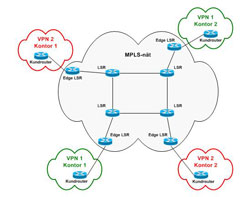
TelePacific’s 1Net is an IP VPN running on a private MPLS network, not the Internet. Since MPLS or Multi-Protocol Label Switching can transport almost any protocol, it can be set up to mimic the Internet while keeping your data private. Only the locations that you set up can exchange traffic. No one outside of your user group can capture or view your data. You’ll have any to any connectivity within the group with security sufficient to address HIPPA or similar government regulations.

In fact, TelePacific set up just such a private IP Network for a medical imaging organization with 6 locations. They use it to transport patients’ private medical records among their location. Referring physicians can access patient imaging results within hours at their own computers. The system is also used for claims processing, patient scheduling and registration. Interestingly, this system also allows dedicated Internet access through a single firewall at corporate headquarters.

The TelePacific 1Net IP VPN has both cost and performance advantages over other secure networking solutions, including private line, ATM and Frame Relay. You can specify up to six different Classes of Service (CoS) to support sensitive real-time services such as VoIP telephone and teleconferencing. On Net, latency for all CoS is specified at 50 msec. That rises to just 100 msec for extended reach locations off the TelePacific network but still within the US. Network availability is 99.999% (5 nines) both on and off network locations.

The Classes of Service are CoS 1 for VoIP real time traffic, CoS2 for video conferencing and real time data traffic, CoS3 for high priority, delay sensitive business data like Ecommerce and Citrix, CoS4 for medium priority delay-sensisitive business data such as CRM and WebEx, CoS5 for general less delay sensitive business data like ERP, and CoS6 for best effort traffic with no prioritization. That’s typically Email and FTP.

Are you cringing at the cost and effort involved in linking your business locations by private lines or frustrated by the highly variable performance and difficulty in securing the Internet? Perhaps the best solution for your business needs is a private IP VPN based on MPLS networking. Check prices and features to compare with your other choices.

Click to check pricing and features or get support from a Telarus product specialist.


Note: MPLS network diagram courtesy of Wikimedia Commons.


Follow Telexplainer on Twitter

Monday, March 22, 2010

PAETEC Adds Intrusion Detection For MPLS Networking

MPLS networks are on the ascendant as the preferred solution for linking multiple business locations. Now PAETEC is offering a new service to further enhance the security of its already secure MPLS network solutions by monitoring for network intrusions. What distinguishes this service is that operation and management is largely transparent to users.

Network intrusion detection and prevention keep your MPLS network secure.Network security has become a hot topic in recent years. We’re all familiar with the constant barrage of viruses, phishing schemes, hacking and other criminal activities on the Internet. You don’t need a connection to the Internet to worry about electronic security. Any company or organization with a computer network is a target for those who think they can benefit from compromising it. No amount of physical security protects your network once it leaves your premises. But to do business today, you need connections to multiple office locations, factories, warehouses, customers and suppliers.

This is where PAETEC, a telecommunications company with a nationwide fiber optic footprint, steps in. Rather than trying to build a meshed network from dedicated point to point lines and then having to install and manage network security appliances and software, you can simply turn the job over to PAETEC. They provide each of your locations with access to their privately-run network cloud. You define how you want each location to communicate. Built-into the network is the new managed Network Intrusion Detection and Prevention System known as IDPS. You don’t need to buy any special on-site equipment or install and maintain any network security software. It’s all built into the PAETEC MPLS network.

How does this system work? It’s a network based firewall with two components. The intrusion detection part inspects all traffic entering and leaving the network to identify suspicious patterns. It notifies the enterprise system administrator with recommendations on how to respond to any threat it finds. The second part is an intrusion prevention system that looks for potential threats and makes recommendations on how to respond before an actual break-in occurs. PAETEC operates a 24/7 Security Operations Center that can handle alarm responses for customers who don’t have their own full time system administrators.

The addition of an IDPS to your WAN network is more than just a good idea. It’s a requirement for sensitive applications such as PCI for credit card transactions and HIPPA for medical records. Health care modernization initiatives are certain to increase the number of locations connected by high speed MPLS networks and in need of industry mandated security.

Are you interested in starting a secure multi-location WAN network or improving the security of the one you have now? Would you like to do that in a cost effective way? If so, you should take a look at the secure MPLS network options from PAETEC and other competitive network service providers.

Click to check pricing and features or get support from a Telarus product specialist.


Follow Telexplainer on Twitter