Showing posts with label WAN connection. Show all posts

Tuesday, February 15, 2011

Metropolitan Area Networks

We’re all familiar with LANs. Those are the local area networks used in nearly every business to interconnect computers, centralized storage, printers, wireless access points, WiFi hotspots, scanners and, increasingly, telephones and video equipment. When we want to connect to the outside world, we might think of a long haul or WAN connection to the Internet or distant business location. But there is another important type of network in-between the LAN and the WAN. That’s the MAN or Metropolitan Area Network.

Find Metropolitan Area Network pricing and availability for your business locations.The Metropolitan Area Network is an important service in its own right. For many companies, the only long-haul connections they may need are a dedicated broadband Internet and long distance telephone services. Most all of their traffic stays local. Not local as on the LAN, but geographically local. That means within the bounds of a city, suburbs and nearby locations.

This is where the term Metropolitan Area Network got its name. It’s a network that spans a given metropolitan area and not much further. You don’t find MAN services out in the countryside. Not that there aren’t important customers beyond the city limits, mind you. It’s just that MAN networks tend to be build upon fiber optic networks and very little fiber exits out in the boonies right now.

As you might suspect, the greatest concentration of MAN services will be found in business districts of major cities. That’s simply because the greatest population density and number of businesses are also found downtown and in the business districts of adjoining suburbs. Fiber optic cable construction and equipment are expensive. Service providers need lots of traffic from lots of customers to justify the expense of building out a MAN.

It’s possible to construct your own private MAN by ordering point to point lines between each of the locations you want to connect, or by establishing a star network with corporate headquarters at the center. Many companies buy MAN services instead because the costs are lower for a given bandwidth level. That makes sense, since the network infrastructure cost can be amortized over a large user base. A properly run MAN will give you the performance and security you require at a savings over creating your own private network.

How do service providers build a MAN? A classic approach is to construct a fiber optic SONET ring around the city, linking all the important office buildings, industrial parks, data centers and carrier hotels. SONET is the Synchronous Optical NETwork standard for legacy switched circuit telecom services. It features two lit fiber strands sending traffic in opposite directions for redundancy. If one fiber fails, the other picks up the load within 50 mSec.

Newer MAN services are build upon Carrier Ethernet or Metro Ethernet. The core network may still be running SONET or it may be an IP core network. Either way, the customer only sees an Ethernet interface. It may be an E-Line point to point connection or an E-LAN multipoint to multipoint connection. MPLS networks implemented as a MAN have the advantage of being able to handle nearly any type of traffic.

Downtown, you may also have the option of using a wireless MAN. These are based on fixed wireless transmissions between a carrier’s tower and radio equipment at each location served. These are short range services and require line of sight between buildings. If it happens to work out for you, wireless has the advantage of fast installation and low construction cost compared to bringing in fiber to locations not already lit.

Does your business need to communicate between two or more locations in town? If so, Metropolitan Area Networks are what you are looking for. Get prices and availability for now.

Click to check pricing and features or get support from a Telarus product specialist.


Note: Photo of New York City courtesy of I, Laslovarga on Wikimedia Commons.



Follow Telexplainer on Twitter

Tuesday, September 14, 2010

Wireless SIP Trunking

One thing we know about business telephone and dedicated broadband access is that they are wireline services. Well, that’s what we used to know. There’s a new player in the marketplace and it is wireless SIP trunking.

Get service availabilty and pricing on fixed wireless for voice and data.A pioneer in this field is Airband Communications. They offer enterprise-class IP-based voice services bundled with wireless Internet access. In wireline parlance, this could be called a SIP trunk or Integrated voice and data service. But Airband VoIP trunking service has some unique advantages.

Like other integrated services, there is only one WAN connection providing both telephone and broadband Internet access. This one just happens to be wireless. Also like the better integrated services, bandwidth is dynamically allocated between voice and data to make efficient use of the connection. Voice packets get priority to maintain quality of service. The bandwidth sharing of voice and data also only exists between your facility and Airband. Your telephone calls never travel on the Internet and aren’t subject to the disruptive effects of congestion, jitter and latency on the public network. In fact, you get a unified service level agreement from Airband that covers availability, packet loss, latency and jitter for your peace of mind.

Standard telephone trunking using ISDN PRI generally comes in blocks of 23 channel with a maximum carrying capacity of 23 separate phone lines. Airband’s VoIP trunks can be added in single increments. Buy these outside phone line connections as business picks up and you need them rather than paying for excess resources up front.

A standard package starts at 5 VoIP trunks minimum bundled with 2 Mbps of Internet access. This is perfect for smaller businesses, with unlimited local calling and 200 minutes of domestic long distance per trunk. 911 support is included. So is local number portability so you can keep the phone numbers you have now. You’ll also get both inbound and outbound caller name and ID. If you want, you can add-on DIDs (Direct Inward Dialing), toll free numbers and directory listing, and analog/Fax/security lines. The interface of this system will support either PRI or SIP to your in-house telephone system.

Don’t confuse this fixed wireless service with either cellular or WiFi services. This is professional grade private fixed wireless network with 128 bit data encryption and quality of service (QoS) controls. The radios at each end automatically adjust 8 levels of signal modulation to ensure reliable transmission in all types of weather. In fact Airband offers Dual Path Service Delivery (DPSD) that automatically fails over to the backup service should the main path ever fail. With wireline services, you have to do this yourself by ordering separate diverse line services from different carriers or take your chances on line breaks.

Could your business or organization benefit from a high quality fixed wireless solution with bandwidth up to Gigabit Ethernet? If so, get service availability and pricing on fixed wireless for voice and data now.

Click to check pricing and features or get support from a Telarus product specialist.


Follow Telexplainer on Twitter

Tuesday, February 9, 2010

Ethernet Over Copper Vs T1

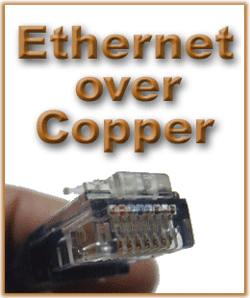
The standard business bandwidth connection is the versatile T1 line. These connections are available just about everywhere, they offer a dedicated and reliable bandwidth and prices have been getting lower over the years. It’s hard to go wrong with a T1 line, but there’s another service that is gaining popularity that you should also consider. That’s EoC or Ethernet over Copper.

Check Ethernet over Copper pricing vs T1 line pricing now.EoC is an Ethernet WAN connection that can link multiple business locations or give you a high speed dedicated Ethernet connection. It also makes a good on-ramp to private cloud networks such as nationwide or international MPLS networks.

What Ethernet over Copper and T1 lines have in common is that they are both provisioned over multiple twisted pair telco wiring. That’s what’s in the bundle of telephone wiring that’s connected to your business now. Both T1 and EoC can use multiple wire pairs to increase bandwidth in a process known as bonding.

There are technology differences in the protocols and modulation schemes that are used to transport the signal between your business location and the closest carrier office, but you generally don't need to be concerned about that level of detail. Both technologies can transport your packets quickly and reliably. What you need to really compare is how much bandwidth you can get for a particular price level.

Where available, EoC often offers both higher bandwidths and lower prices. Part of that is due to the efficiency of the technology involved in transmitting higher bandwidths over common copper wiring. The other factor reducing prices is that EoC is often promoted by competitive carriers looking to establish a foothold or even dominance in a particular market.

What sort of bandwidths are available? T1 lines offer a rock solid 1.5 Mbps per line. Each additional line bonded-in increases that by 1.5 Mbps, so a double bonded solution is 3 Mbps. Bonding is practical up to about 10 or 12 Mbps. Above that, other solutions such as DS3 are often more cost effective.

Ethernet offers a wide variety of bandwidth options, including low speeds of around 1 Mbps, the standard 10 Mbps Ethernet that is also the basic Ethernet LAN speed, and other steps up to around 45 Mbps. That seems to give EoC a bandwidth advantage, but there’s a rub. Ethernet over Copper has distance limitations. You need to be within a few miles of a carrier point of presence to get this service. T1 and bonded T1 does not have these limitations.

If you are located in a small town, rural area or are otherwise not eligible for EoC service, there is another option rapidly becoming available called EoDS1 or Ethernet over DS1. This uses the data specification for T1 lines, called DS1, to transport Ethernet. In effect, this is Ethernet delivered over a T1 line using special interface equipment at both ends.

So what’s best service to order? The answer depends a lot on where you are located. Why not get a set of competitive quotes for your business location so you can make an informed decision? Take just a second to put in a request for Ethernet over Copper vs T1 Pricing and Availability. A friendly Telarus consultant will be happy to review the options with you and make recommendations for your particular situation. Sorry, no residential service available.

Click to check pricing and features or get support from a Telarus product specialist.


Follow Telexplainer on Twitter