Showing posts with label Fiber optic transmission. Show all posts

Monday, June 13, 2011

Choosing Dark Fiber vs Lit Fiber Service

When your applications are demanding enough to require fiber optic transmission, you’re faced with a choice. Do you order one of the lit fiber services available for your business location or do you buy or rent dark fiber and create your own transport services?

Choosing between dark and lit fiber optic options. Click for pricing and availability.The tradeoffs can be tricky, so you’ll probably want to set up a spreadsheet to compare the performance, cost and installation time for all the services you are interested in.

Installation time? By focusing strictly on cost, you can get caught in a situation where you’ll have the best deal possible... whenever they can get it installed. That can be weeks or even months if you have a particularly difficult situation. Will that meet your needs? If you do your planning well in advance, it just might. If circumstances conspire to demand an order of magnitude bandwidth increase immediately, availability may trump lease cost.

The dark vs lit fiber tradeoff is the classic own vs rent situation. Most companies choose to survey the marketplace for bandwidth services and pick the least cost solution that meets their needs. That process is made easy by using a telecom broker, like Telarus, Inc., that represents dozens of service providers. If you have enough competition for your business, you can get much better pricing than if you are eye to eye with the only telecom sales person for a hundred miles.

One characteristic of both dark and lit fiber services is that they are extremely location sensitive. There may well be accessible fiber running on your side of the turnpike and nothing on the other side, or vice versa. Some buildings have already been “lit” by a particular carrier while others remain dark. Those dark buildings may or may not justify the construction costs of bringing in new fiber connections depending on location and how much service is needed by the tenants.

Lit fiber falls into several major categories. The traditional telecom service is SONET/SDH with OC-3 as the lowest bandwidth of 156 Mbps. An OC-3 can also carry 3 multiplexed DS3 circuits at 45 Mbps each. It’s common for companies to order DS3 and have it delivered by fiber optic cables of much higher capacity. Other SONET levels are OC-12 at 622 Mbps, OC-24 at 1.2 Gbps, OC-48 at 2.5 Gbps and OC-192 at 10 Gbps.

The hot competition for fiber optic bandwidth is Carrier Ethernet. Ethernet tends to be both more scalable and lower cost than SONET where it is available. That availability is becoming more and more common, thanks to aggressive build-outs by competitive carriers and business demand for higher bandwidths at lower costs.

Typical fiber optic Ethernet service levels are 100 Mbps Fast Ethernet, 250 Mbps, 500 Mbps, 1 Gbps Gigabit Ethernet and 10 Gbps 10GigE. Lower bandwidth such as 50 Mbps Ethernet that competes directly with DS3 may be provisioned on either copper or fiber, depending on the carrier’s available equipment.

Coming on strong for higher bandwidth fiber optic connections is wavelength services. When you order a wavelength, you are getting a virtual fiber all to yourself. Of course, there are many wavelengths on the same physical glass fiber strand, but they differ in color and do not interact. Wavelength services may sense for 10 Gbps requirements, with the added advantages of low latency and high security. With an entire wavelength dedicated to your use, you can use a different protocol than other customers on the fiber. You may be running Ethernet while others are running SONET.

The ultimate in flexibility is dark fiber. By leasing a dark fiber run, you have all the wavelengths at your disposal. You’ll have to buy the termination equipment for each end, but then you’ll have the option to light up as few or many wavelengths as you want. You can run a different protocol on each wavelength and even operate with something non-standard or experimental. Usually it is the largest companies with the most complex IT requirements that go the dark fiber route.

What type of fiber optic service makes the most sense for your operation? Don’t jump to any conclusions until you get a complete set of prices and install times for fiber optic options available for your business location or locations.

Click to check pricing and features or get support from a Telarus product specialist.


Note: Light bulb photo courtesy of Ulfbastel on Wikimedia Commons.



Follow Telexplainer on Twitter

Thursday, February 3, 2011

WDM Wavelength Services Offer Expandability

If your need is for high bandwidth, security and flexibility, you should take a look at wavelength services. This is more than the typical fiber optic bandwidth service. It’s almost like owning the network facilities yourself.

Wavelength division multiplexing gives you multiple color beams on a single fiber optic strand. Click for pricing and availability.The thing about fiber optic transmission is that it offers almost limitless bandwidth. That’s a foreign concept to anyone who’s been tied to copper wireline services. It’s also an odd notion for those who pick a fiber optic service level and sign a contract for it. If you order OC3 SONET service, what you get is a line that runs at 155.52 Mbps with a payload of 148.608 Mbps. You don’t have to fill the pipe continuously, but the capacity is there all the time. If you need more bandwidth, you only recourse is to add an additional service or upgrade to something like OC12 or Gigabit Ethernet.

What you are using with fiber optic services is not the entire bandwidth of the fiber. In fact, you may be totally unaware that your signals are multiplexed with lots of others all traveling on the same fiber strand. If there is only one laser beam with a single color or wavelength shining through that fiber, it likely has a capacity of at least 10 Gbps. Chances are, though, that there are many different color beams all riding simultaneously down the fiber. They don’t interfere because they are different colors of light, called Lambdas, all in the infrared region of the spectrum. Each Lambda or wavelength has a carrying capacity as high as 10 Gbps. You can think of these as equivalent to individual high capacity lines. If the fiber optic strand were made of copper, each wavelength would be a separate pair of wires.

What if you could lease a wavelength instead of a copper wireline or a fixed bandwidth service on a fiber optic cable? The wavelength doesn’t care what modulation or data pattern you use. It’s just a pure light beam of one wavelength. There’s no fancy footwork required to convert between one protocol and another just to be compatible with what’s running on the line. That opens some interesting possibilities. You could use your leased wavelength to carry Gigabit Ethernet or Fast Ethernet, SONET OC3, OC12 or OC48, Fibre Channel, or ESCON.

Need to transport a variety of high bandwidth protocols? OK. Just lease multiple wavelengths and give each protocol its own Lambda. The won’t interfere. In fact, they won’t even known the other wavelengths exist.

This type of network transport is no longer a pipe dream. All you need to do is lease WDM Wavelength Services from a fiber optic network carrier such as AboveNet. What AboveNet has done is install a base of dark fiber in many metropolitan areas. It’s called dark because it hasn’t already be put into service with a particular fiber optic service in mind. It’s like a blank canvas ready to become any work of art. AboveNet “lights” the fiber as needed using WDM equipment to create their wavelength services.

WDM stands for Wavelength Division Multiplexing. It’s the technology that creates multiple wavelengths on a single fiber strand. This is a standardized process that ensures there is enough separation between the wavelengths that they won’t interfere and that different brands of networking equipment will work together. There are two flavors of WDM: CWDM or Coarse Wavelength Division Multiplexing and DWDM or Dense Wavelength Division Multiplexing. The difference is that DWDM squeezes more wavelengths, up to 160, onto a given fiber but at a higher cost than CWDM.

Is this affordable? AboveNet says that their CWDM service becomes competitive at the OC-3 service bit-rate. If you can use more bandwidth than that, you’ll save money with CWDM. Typical applications include connecting corporate headquarters with branch offices and data centers, or connecting multiple hospitals and medical centers for exchange of medical images and other health service records.

Has your business or organization become limited by the network services available? Perhaps it’s time to move up to wavelength services. Find out by getting prices and availability of fiber optic wavelength services for your locations. Complementary consulting by bandwidth experts is also available for serious applications.

Click to check pricing and features or get support from a Telarus product specialist.


Note: Image of light spectrum from prisms courtesy of Marcellus Wallace on Wikimedia Commons.


Follow Telexplainer on Twitter

Sunday, June 13, 2010

Fiber Optic DWDM Up to 100 Gbps Per Wavelength

The incredible growth of bandwidth demand continues unabated. Odd, perhaps, in these soft economic times. It’s the proliferation of video and especially high definition video that has dramatically increased network bandwidth requirements, including metro and long haul WAN networks. Now a new benchmark has been achieved at 100 Gbps per wavelength in DWDM or Dense Wavelength Division Multiplexing fiber optic systems.

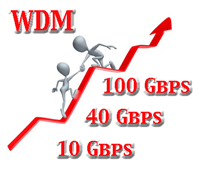
Growth in fiber wavelength bandwidth. Get price quotes now for your bandwidth needs.It wasn’t all that long ago that we were hearing of the move from 10 Gbps to 40 Gbps channels. Alcatel-Lucent is offering a new upgrade module that operates at both 40 Gbps and 100 Gbps using a single optical carrier. It’s available in their 1830 Photonic Service Switch (PSS).

What does it take to achieve such speeds on existing fiber that was intended for 10 Gbps transmissions? After all, you can’t exactly rip up all that installed fiber and lay new cables just to up the bandwidth. Also complicating the design is that in wavelength division multiplexing not all wavelengths will be scheduled for simultaneous upgrade. What’s needed in an upgrade that won’t interfere with existing 10 Gbps and 40 Gbps signals nor demand larger amounts of rack space and power.

Alcatel-Lucent has met these design goals with a new electro-optics engine that depends heavily on digital signal processing and better modulation and detection techniques for the optical signal. It starts with a change from amplitude shift keying (ASK) to phase shift keying (PSK). With a constant amplitude, the signal has better resilience against non-linear effects in the fiber. Both two-phase-state and four-phase-state coding schemes can be used to load more information on the signal. They then double the bit rate again without increasing the symbol rate by adding PDM or polarization division multiplexing on the same signal.

As you probably guessed, transmitting more information on the same wavelength has a price. That price is sophistication of the electronics. Coherent detection uses a local oscillator mixed with the optical signal to produce interferences that give an output of phase, amplitude and polarization to the digital signal processor. Some heavy duty number crunching allows the DSP to compensate for linear distortions in the fiber while it recovers the bit information.

Alcatel-Lucent proved all this out last fall during a field trial in Spain, by transmitting 112 Gbps per channel along with 40 Gbps and 10 Gbps channels on a 1088 km link between Madrid and Merida via Seville, as described in their technology white paper, “Next-generation Electro-Optics Technology with Coherent Detection”.

Ciena has a competing system, the OME or Optical Multiservice Edge 6500 that also runs at 100 Gbps. These two companies should set the standard at 100 Gbps... at least for awhile. You know that whenever there is competition, there will be the competitive spirit to take things to the next level. What is that? 200 Gbps? 500 Gbps? 1 Tbps?

Service providers worldwide are in a scramble to provide higher speed services at lower costs. Prices have dropped so much in the last few years that you can probably afford more bandwidth than you think. Why wonder when you can get high bandwidth fiber optic service quotes quickly and easily. It only takes a minute to inquire, so why not take that minute right now?

Click to check pricing and features or get support from a Telarus product specialist.


Follow Telexplainer on Twitter