Showing posts with label dark fiber. Show all posts

Monday, June 13, 2011

Choosing Dark Fiber vs Lit Fiber Service

When your applications are demanding enough to require fiber optic transmission, you’re faced with a choice. Do you order one of the lit fiber services available for your business location or do you buy or rent dark fiber and create your own transport services?

Choosing between dark and lit fiber optic options. Click for pricing and availability.The tradeoffs can be tricky, so you’ll probably want to set up a spreadsheet to compare the performance, cost and installation time for all the services you are interested in.

Installation time? By focusing strictly on cost, you can get caught in a situation where you’ll have the best deal possible... whenever they can get it installed. That can be weeks or even months if you have a particularly difficult situation. Will that meet your needs? If you do your planning well in advance, it just might. If circumstances conspire to demand an order of magnitude bandwidth increase immediately, availability may trump lease cost.

The dark vs lit fiber tradeoff is the classic own vs rent situation. Most companies choose to survey the marketplace for bandwidth services and pick the least cost solution that meets their needs. That process is made easy by using a telecom broker, like Telarus, Inc., that represents dozens of service providers. If you have enough competition for your business, you can get much better pricing than if you are eye to eye with the only telecom sales person for a hundred miles.

One characteristic of both dark and lit fiber services is that they are extremely location sensitive. There may well be accessible fiber running on your side of the turnpike and nothing on the other side, or vice versa. Some buildings have already been “lit” by a particular carrier while others remain dark. Those dark buildings may or may not justify the construction costs of bringing in new fiber connections depending on location and how much service is needed by the tenants.

Lit fiber falls into several major categories. The traditional telecom service is SONET/SDH with OC-3 as the lowest bandwidth of 156 Mbps. An OC-3 can also carry 3 multiplexed DS3 circuits at 45 Mbps each. It’s common for companies to order DS3 and have it delivered by fiber optic cables of much higher capacity. Other SONET levels are OC-12 at 622 Mbps, OC-24 at 1.2 Gbps, OC-48 at 2.5 Gbps and OC-192 at 10 Gbps.

The hot competition for fiber optic bandwidth is Carrier Ethernet. Ethernet tends to be both more scalable and lower cost than SONET where it is available. That availability is becoming more and more common, thanks to aggressive build-outs by competitive carriers and business demand for higher bandwidths at lower costs.

Typical fiber optic Ethernet service levels are 100 Mbps Fast Ethernet, 250 Mbps, 500 Mbps, 1 Gbps Gigabit Ethernet and 10 Gbps 10GigE. Lower bandwidth such as 50 Mbps Ethernet that competes directly with DS3 may be provisioned on either copper or fiber, depending on the carrier’s available equipment.

Coming on strong for higher bandwidth fiber optic connections is wavelength services. When you order a wavelength, you are getting a virtual fiber all to yourself. Of course, there are many wavelengths on the same physical glass fiber strand, but they differ in color and do not interact. Wavelength services may sense for 10 Gbps requirements, with the added advantages of low latency and high security. With an entire wavelength dedicated to your use, you can use a different protocol than other customers on the fiber. You may be running Ethernet while others are running SONET.

The ultimate in flexibility is dark fiber. By leasing a dark fiber run, you have all the wavelengths at your disposal. You’ll have to buy the termination equipment for each end, but then you’ll have the option to light up as few or many wavelengths as you want. You can run a different protocol on each wavelength and even operate with something non-standard or experimental. Usually it is the largest companies with the most complex IT requirements that go the dark fiber route.

What type of fiber optic service makes the most sense for your operation? Don’t jump to any conclusions until you get a complete set of prices and install times for fiber optic options available for your business location or locations.

Click to check pricing and features or get support from a Telarus product specialist.


Note: Light bulb photo courtesy of Ulfbastel on Wikimedia Commons.



Follow Telexplainer on Twitter

Sunday, May 15, 2011

Wavelength Services vs Dark Fiber

Fiber optic services are popular for high bandwidth metro and long haul connections. They typically start about 100 Mbps and go on up to 10 Gbps, 40 Gbps and occasionally 100 Gbps bandwidths. But what if you find that fiber optic bandwidth services are too restrictive for your needs? There are a couple of alternatives. One is leasing dark fiber routes and the other is wavelength services. Let’s see how they compare and why you might find one more attractive than the other.

Fiber optic services from dark fibers to wavelength services, to traditional bandwidth services. Click for pricing.Fiber optic bandwidth services are standardized, packaged services that offer either SONET or Ethernet connectivity from point to point. You may think of them as private line services, but chances are that you are not the only customer riding on the fiber strand. At lower bandwidths, such as OC3, you are probably being electrically multiplexed with other users to create a much larger bandwidth signal that is more cost effective to transport. If you are using a 10 Gbps or 40 Gbps service, you are still sharing the strand with other users but optically multiplexed using wavelengths.

One problem with these pre-packaged fiber optic services is that they generally limit you to a particular protocol and speed. If you change your mind, it can be time consuming and costly to change or upgrade your service. For this reason, some companies have decided to become their own bandwidth providers by leasing dark fiber and lighting it up with equipment they own. This gives you the ability to have multiple protocols running on the same fiber at whatever bandwidth makes sense. When you want something different, your own engineering staff reconfigures or changes out the equipment one each end. There’s no waiting around for carrier personnel because you are the carrier. The dark fiber is just an empty pipe, as the name implies.

The trick to having multiple protocols on one fiber is called WDM or Wavelength Division Multiplexing. It’s somewhat akin to the idea of electrical multiplexing in that many different signals can share the same transport mechanism. However, technically it is quite different. WDM uses multiple wavelengths or colors of laser light that are separate enough in frequency to be distinct. All of these colors, also called lambdas, exist in the infrared portion of the light spectrum that is seen as nearly transparent through glass fiber.

Think of WDM as shining a whole rainbow of laser beams down a fiber optic cable where they are detected separately at the other end. Each beam is independent of the others. One color doesn’t care that it is running Ethernet and the next color up is carrying SONET or ESCON. They don’t see each other and don’t interfere.

Since WDM is an established technology running on just about all carrier fiber optic networks, there is no reason why you can’t just lease an entire wavelength instead of a service running on that wavelength. That’s fairly easy to do these days because many networks have excess wavelength capacity available. You can have your own wavelength running a high bandwidth Ethernet service (10 GigE) or 10 Gbps or 40 Gbps SONET.

Why lease a wavelength instead of dark fiber? For one thing, you may not need the entire capacity of the fiber or all those wavelengths you can create yourself. There’s considerable capital cost in purchasing the WDM systems for each end of the fiber that you can avoid by just leasing the wavelengths you need by the month. Capital expense and network management then become the service provider’s problem.

Dark fiber may not be available for the entire route you have in mind or you may be planning to install your own fiber in a particular area. Until it is ready, you can make good use of existing capability by leasing wavelength services as long as needed.

Dark fiber, wavelength services, Gigabit Ethernet or OCx SONET. Which is right for your needs? Get comparative pricing and availability of fiber optic services now to do a good trade off analysis.

Click to check pricing and features or get support from a Telarus product specialist.


Note: Photo courtesy of Sandia National Labratories.


Follow Telexplainer on Twitter

Tuesday, March 1, 2011

Dark Fiber Community Builds Infrastructure

You hear the stories that our infrastructure is crumbling. Not all infrastructure. There’s a big construction project underway now to ring the country with a thousand fiber strands, a high bandwidth nervous system for information technology. Lighting up this dark fiber promises almost unlimited low latency bandwidth for the foreseeable future.

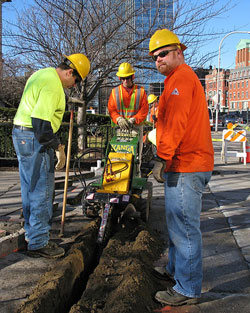
Typical fiber optic cable installation underway.Why the need for this dark fiber infrastructure? It’s not so much that the old infrastructure is crumbling as it is chock full. You remember the great fiber buildout late last century? It seemed to be way overdone when the tech crash came. Indeed, it’s taken over a decade to light up all that excess fiber. There may still be some underutilized fiber rings looking to see the light, the laser light that is. But there is also an enormous additional need coming from business process automation, high frequency financial services, electronic medical records, and 4G wireless, to name a few demanding applications.

Rising to the challenge is Allied Fiber and its Dark Fiber Community. Allied fiber isn’t a carrier. They are an infrastructure builder. They are where the carriers go to get new unlit fiber routes. One of the most prestigious fiber optic carriers, AboveNet, has just joined the Dark Fiber Community to provide expertise in high performance fiber optic networking and be part of this enormous resource.

The Dark Fiber Community is an association of over 60 members that include equipment vendors, carriers, industry technical associations, financing companies and other interested parties. It’s hosted by TMCnet.com as an online resource and educational platform to support Allied Fiber.

Allied Fiber, itself, is the company that is building out and leasing this enormous national dark fiber optic backbone. It will eventually be in the form of a ring linking New York City, Chicago, Seattle, Los Angeles, Phoenix, Dallas, Houston, Jacksonville, Miami, Ashburn, VA and back to NYC. Draw a circle around the lower 48 states and you’ll have the general route for Allied Fiber.

But what if you don’t happen to be located in one of those major cities on the fiber route? Here’s the cleverness of the design. It’s not just a few long haul fiber routes. It’s two parallel routes. One is long haul between the major cities mentioned. The other, running side by side, is broken up into 60 mile segments. These short haul routes terminate in colocation huts where the laser signals are regenerated to boost them for the next segment. Inside the same hut are racks for multiplexing equipment to add and drop network services on the route. This long-haul/short haul arrangement allows Allied to provide low latency fiber between major city pairs while having the flexibility to also serve many other locations along the way and connect to other short haul routes off the major route.

One series of connections will be Fiber to the Tower or FTTT. You may not have heard of FTTT before, but you will hear plenty about it in the near future. The wireless industry is moving into 4G as fast as they can. Unfortunately, their old T1 based copper backhaul infrastructure is maxed out for bandwidth. That means new fiber connections to those cellular base stations in many cases. Allied’s FTTT plan is to provide access to the duct fiber every 1 to 2 miles in order to create lateral extensions from the main fiber route to where the towers are located.

Are you in need of higher bandwidth fiber optic services at highly competitive prices? If so, you may have more options than you think. Find out by getting prices and availability for dark and lit fiber optic bandwidth services now.

Click to check pricing and features or get support from a Telarus product specialist.


Note: Photo of workmen installing fiber optic cable courtesy of Paul Keleher on Wikimedia Commons.


Follow Telexplainer on Twitter

Monday, June 28, 2010

Ciena Takes New Bandwidth Technologies On The Road

If you happen to be near Waltham, MA today, June 29, you have an opportunity to see the latest in carrier bandwidth technology right at your doorstep. Simply step into the Ciena Innovation Lab and check out the demos of their optical, Ethernet and software solutions. Next stop is White Marsh, MD on July 15.

What’s the Ciena Innovation Lab? It’s a semi trailer chock full of the newest telecom and networking developments. Here, take a look:


If you are involved with Gigabit and Terabit bandwidth applications, you are familiar with Ciena... or should be. Certainly, fiber optic service providers keep a keen eye on developments from the Ciena labs. But now major corporations, content providers and large medical organizations need to familiarize themselves with packet-optical transport and switching systems. Today, you may be just broaching the idea of installing Gigabit Ethernet service. Tomorrow, you may well be ordering dark fiber for your own private point to point networks.

Ciena now has platforms that make deploying 40G and 100G fiber optic connections as easy as 10G. They are ready to support carrier Ethernet services, including high speed access, backhaul and aggregation. Their software suites make it easier for you to manage optical networks, Ethernet services and other high bandwidth networks services.

Is your company ready to move up to gigabit and higher levels of service? If so, you’ll benefit from a discussion with our Telarus bandwidth brokerage consultants. No charge for this service, of course. Take just a minute or so and describe your bandwidth needs in an easy online inquiry.

Click to check pricing and features or get support from a Telarus product specialist.


Follow Telexplainer on Twitter