Showing posts with label ESCON. Show all posts

Monday, February 14, 2011

New Data Center Networking Solutions

Data management and storage requirements for enterprise level organizations continue to increase. In addition, a majority of enterprise IT departments now replicate data between data centers. This has created a need for new and more cost effective bandwidth services, especially at 10 Gbps and above. Level 3 is addressing these needs with an enhancement of its existing data center networking solutions.

Data center networking solutions are needed by enterprise IT managers.What’s different about data center connectivity compared to other business requirements? Data centers are far more concentrated than other computing resources. This is especially true for storage, a prime driver for offsite data centers in the first place. What this does is increase the need for high bandwidth connections between the concentration of storage and the concentration of users. It also influences the connectivity required.

What you need for last mile connections to an MPLS network or private lines to link business locations can usually be handled by T-Carrier, SONET/SDH or Carrier Ethernet line services. Data centers need higher bandwidth connections, but may also need special SAN protocols including Fibre Channel, Infiniband, ESCON and FICON.

SAN stands for Storage Area Networks. These are large collections of disk drives that connect directly to the application servers. SAN networks have traditionally been very localized, with the disk arrays physically near the servers. But what do you do when you need to duplicate data between data centers?

Many companies operate two or more data centers, sometimes a half-dozen or more. Some of this is due to mergers and acquisitions of formerly independent organizations with their own IT infrastructures. Much is driven by a need for disaster protection and recovery. When your business is critically dependent on its electronic data, normal backup processes aren’t adequate. You can have multiple copies of your files locked up locally and still be put out of business by a fire, tornado, flood, earthquake, hurricane or other disaster that destroys whole buildings and everything in them.

This means that you want to have copies of your critical data dispersed geographically. Establishing independent data centers in two or more cities far apart means than a disaster that takes out one center probably won’t knock out everything. There’s also an advantage to content providers in having the servers and data content located close to the customers. Latency is reduced and performance is increased due to less network congestion. A challenge is how to make sure the data is replicated exactly at all locations.

This is where long distance SAN networking comes into play. You need high levels of bandwidth but also support for SAN protocols to keep everything synchronized. FCoE or Fiber Channel over Ethernet is a popular protocol for transmitting Fibre Channel frames over 10 Gbps Ethernet connections. WDM or Wavelength Division Multiplexing avoids having to layer protocols to connect facilities. Each wavelength in a fiber optic link can be assigned its own protocol, regardless of what is running on other wavelengths in the same beam.

Level 3 Communications has expanded its data center networking portfolio to include SAN fiber channel protocol, dark fiber and managed fiber solutions. This is in addition to dedicated bandwidth services from 1 Gbps to more than 40 Gbps, including 10 Gbps EVPL or Ethernet Virtual Private Line service. They offer low latency route guarantees and an international service footprint, including a presence at key public exchange facilities.

Are you concerned with managing multiple high performance data centers? Would you like to have more options and/or better pricing for all your telecom connectivity needs? If so, get complementary consulting help and pricing and availability for high bandwidth networking services.

Click to check pricing and features or get support from a Telarus product specialist.


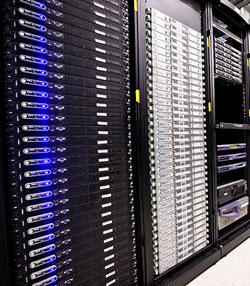
Note: Photo of data center servers courtesy of WikimediaCommons



Follow Telexplainer on Twitter

Thursday, February 3, 2011

WDM Wavelength Services Offer Expandability

If your need is for high bandwidth, security and flexibility, you should take a look at wavelength services. This is more than the typical fiber optic bandwidth service. It’s almost like owning the network facilities yourself.

Wavelength division multiplexing gives you multiple color beams on a single fiber optic strand. Click for pricing and availability.The thing about fiber optic transmission is that it offers almost limitless bandwidth. That’s a foreign concept to anyone who’s been tied to copper wireline services. It’s also an odd notion for those who pick a fiber optic service level and sign a contract for it. If you order OC3 SONET service, what you get is a line that runs at 155.52 Mbps with a payload of 148.608 Mbps. You don’t have to fill the pipe continuously, but the capacity is there all the time. If you need more bandwidth, you only recourse is to add an additional service or upgrade to something like OC12 or Gigabit Ethernet.

What you are using with fiber optic services is not the entire bandwidth of the fiber. In fact, you may be totally unaware that your signals are multiplexed with lots of others all traveling on the same fiber strand. If there is only one laser beam with a single color or wavelength shining through that fiber, it likely has a capacity of at least 10 Gbps. Chances are, though, that there are many different color beams all riding simultaneously down the fiber. They don’t interfere because they are different colors of light, called Lambdas, all in the infrared region of the spectrum. Each Lambda or wavelength has a carrying capacity as high as 10 Gbps. You can think of these as equivalent to individual high capacity lines. If the fiber optic strand were made of copper, each wavelength would be a separate pair of wires.

What if you could lease a wavelength instead of a copper wireline or a fixed bandwidth service on a fiber optic cable? The wavelength doesn’t care what modulation or data pattern you use. It’s just a pure light beam of one wavelength. There’s no fancy footwork required to convert between one protocol and another just to be compatible with what’s running on the line. That opens some interesting possibilities. You could use your leased wavelength to carry Gigabit Ethernet or Fast Ethernet, SONET OC3, OC12 or OC48, Fibre Channel, or ESCON.

Need to transport a variety of high bandwidth protocols? OK. Just lease multiple wavelengths and give each protocol its own Lambda. The won’t interfere. In fact, they won’t even known the other wavelengths exist.

This type of network transport is no longer a pipe dream. All you need to do is lease WDM Wavelength Services from a fiber optic network carrier such as AboveNet. What AboveNet has done is install a base of dark fiber in many metropolitan areas. It’s called dark because it hasn’t already be put into service with a particular fiber optic service in mind. It’s like a blank canvas ready to become any work of art. AboveNet “lights” the fiber as needed using WDM equipment to create their wavelength services.

WDM stands for Wavelength Division Multiplexing. It’s the technology that creates multiple wavelengths on a single fiber strand. This is a standardized process that ensures there is enough separation between the wavelengths that they won’t interfere and that different brands of networking equipment will work together. There are two flavors of WDM: CWDM or Coarse Wavelength Division Multiplexing and DWDM or Dense Wavelength Division Multiplexing. The difference is that DWDM squeezes more wavelengths, up to 160, onto a given fiber but at a higher cost than CWDM.

Is this affordable? AboveNet says that their CWDM service becomes competitive at the OC-3 service bit-rate. If you can use more bandwidth than that, you’ll save money with CWDM. Typical applications include connecting corporate headquarters with branch offices and data centers, or connecting multiple hospitals and medical centers for exchange of medical images and other health service records.

Has your business or organization become limited by the network services available? Perhaps it’s time to move up to wavelength services. Find out by getting prices and availability of fiber optic wavelength services for your locations. Complementary consulting by bandwidth experts is also available for serious applications.

Click to check pricing and features or get support from a Telarus product specialist.


Note: Image of light spectrum from prisms courtesy of Marcellus Wallace on Wikimedia Commons.


Follow Telexplainer on Twitter