Showing posts with label network traffic. Show all posts

Tuesday, January 18, 2011

IP Transit vs Peering vs DIA

We live in a world of networks and networks of networks. The Internet is the ultimate example of networks upon networks upon networks. All of these networks need some way to communicate. For that, you have the choice of IP transit or peering.

Check pricing options for IP Transit, Peering, and Dedicated Internet Access. Network to network communication would be unnecessary if the Internet was constructed the way most people envision it. When we think of the Internet, we think of one giant network that links everyone to everyone. It generally works that way for the end user, but the notion of a monolithic universal network is an illusion. Look inside the Internet and you’ll find it to be a collection of large, medium and small networks that all work together to get packets from one point to another. Let’s see what that takes.

At the top of the heap are Tier 1 networks. These are huge international IP networks that have points of presence in key locations around the world. Tier 1 networks are indeed the superhighways of the Internet. But like all highway systems, they don’t go everywhere. In order to create an Internet, you need to connect these superhighways together.

The connection process is called peering. The name suggests that this is a connection between equals or peers. That’s exactly right. Huge networks have huge amounts of traffic. If two of these networks peer to exchange traffic on an equal basis, then each network effectively doubles its reach. Network A has access to all the customers on Network B and vice versa.

Tier 1 networks peer on a settlement free basis. In other words, the networks are interconnected via high capacity routers and the traffic flows back and forth at will. Settlement free means that there are no toll booths at the border. Neither network pays the other because they are getting equal value through peering.

Not all networks are the same size. Smaller networks, called Tier 2, have less capacity and less reach than Tier 1 networks. Tier 1 networks aren’t about to peer with Tier 2 networks at no charge because the smaller network would be getting a lot more value from the arrangement than the larger one. What Tier 2 networks can do is ban together and peer among themselves to create a much larger entity that can compete with those Tier 1 networks. If they want access to the Tier 1 networks, they can pay a settlement charge based on the traffic imbalance. That charge is called IP transit.

Internet Service Providers have a choice when it comes to accessing the Internet. They can spend the capital and maintenance cost to build out their networks to the point where they can peer with other large networks, or they can just purchase IP transit services from a large network and avoid the investment in equipment and personnel.

Very small networks or medium size companies with their own internal networks will choose to buy Dedicated Internet Access rather than IP transit. You need to be a network operator with an assigned AS or Autonomous System number (ASN) that identifies each network on the Internet in order to qualify for IP Transit services. Some large organizations with connections to multiple networks may fit this definition, as well as large scale ISPs.

Everyone else, from local WISPs (Wireless Internet Service Providers) to SMBs (Small to Medium Size Businesses) simply purchases Dedicated Internet Access by the Mbps or Gbps of bandwidth. Operation of the Internet is left to those networks who specialize in that service.

What type of Internet connectivity makes the most sense for your business? It depends on whether you are a large ISP, a content delivery network, a large corporation with international locations, or a network of retail stores. Why not compare pricing options for IP Transit, Peering, or Dedicated Internet Access, as appropriate? Complementary consulting services are available to help you sort through the possibilities.


Click to check pricing and features or get support from a Telarus product specialist.


Follow Telexplainer on Twitter

Sunday, January 9, 2011

The Multiple Data Center Dilemma

With mergers and acquisitions on the rise, companies are finding themselves with a multitude of data centers. So, do you leave things the way they are or try to capture some cost savings thorough data center consolidation?

Consider bandwith pricing as part of any data center moves and colsolidations. Click for pricing.The solution may not be as simple as picking one data center to expand and moving everything there. For one thing, each of those data centers is likely somewhat unique. They have different equipment, applications and expert personnel. Even if you take half a dozen small server rooms and move them intact to one big data center, you still have the matter of connectivity.

Most companies have networking set up to support much higher levels of traffic within the facility than to the outside world. That’s changing, as cloud services become more accepted. But even users of cloud computing and storage have to face the fact that they need much higher WAN (Wide Area Network) bandwidth than they used to. That drives two things: cost and availability.

Yes, availability can be a show stopper. If all your facilities are located downtown in major metropolitan areas, you have suite of services and providers to choose from. Telecom service competition in densely populated areas will work to ensure that you get excellent pricing on your service contracts. But what if your facilities are now scattered among small, medium and large cities with some locations out in the boonies?

This is why you start with a paper study before you do anything. Figure out what the new traffic levels will be to and from your main center or centers and then price out bandwidth that supports those levels with some margin for growth. Also make sure that you aren’t at the high end of available service levels or you’ll find future growth completely stifled. Do you really want to make a major move now and then make another one in a few years?

Calculate new bandwidth levels to serve the rest of your business locations. Note that while their data centers may now be downsized or empty, WAN traffic levels will almost certainly be higher. After all, all that data that was stored and processed locally will now have to come from somewhere else.

While virtualization and equipment consolidation may eliminate a lot of hardware and its associated power and cooling costs, you need to make sure that you aren’t just adding that cost back in network service expense. Perhaps you’ll find that modestly priced T1 lines or Ethernet connections are all you need to provide connectivity for those remote facilities.

By the way, if you are going to be ripping out facilities and re-installing equipment, this could be the perfect opportunity to take a look at cost savings you might not otherwise think were worth the effort. One approach is to move everything to a colocation center rather than try to operate your own. The advantage is that you’ll get a better deal on shared resources like HVAC and backup power. Also, bandwidth prices are often best within a colo. There are no availability issues and little or no provisioning costs because multiple carriers are right there in the same building.

Another option is to take a look at cloud services rather than providing your own. Once again, access bandwidth becomes critical with appropriate backup circuits to ensure that you’ll always be able to connect with the cloud. You’ll be trading off the capital expense and ongoing maintenance and operations costs of running your own data center for monthly fees to the cloud service provider. It is a better deal? Do the paper study and see what makes sense for your particular situation.

Would you like some help with this? Our Telarus bandwidth consultants are happy to get your requirements and work out pricing and availability for a variety of options. This consulting service is provided gratis to IT managers with serious requirements. Why not get started now? Put in a quick inquiry for enterprise voice and data services now.

Click to check pricing and features or get support from a Telarus product specialist.


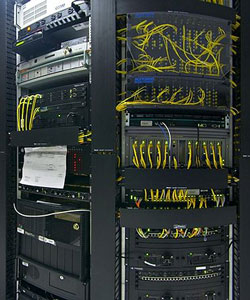
Note: Photo of data center equipment courtesy of Wikimedia Commons.


Follow Telexplainer on Twitter