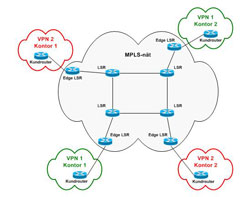
 MPLS stands for Multi-Protocol Label Switching. It’s a completely different technology from what you may be familiar with in the way of either circuit switched or packet switched networks. You can transport IP traffic on an MPLS network but it does not use IP routing.
The beauty of MPLS networks is that they can transport nearly any protocol without having to do any protocol conversions to fit into the structure of the network. MPLS networks also offer a high degree of security because of their unique technology and because they are privately run networks available only to their customers. Quality of service is designed-in, which makes MPLS a good fit with enterprise VoIP and other latency sensitive applications.
Here’s a brief description of how MPLS works. You connect to the network “cloud” through a special device called a label edge router or LER. Since you are entering, this LER is an ingress router. At ingress, your packets are each encapsulated by adding a MPLS label to them. That label defines a FEC or forwarding equivalence class that determines where the packet is to be sent. As packets traverse the network, Label switching routers (LSR) look only at the label and not the internals of the packet to determine how to route them. At the destination, the labels are removed by a LER that functions as an egress router. The packet now exits the network looking exactly as it did upon entering.
It’s the use of the labels that makes MPLS unique and inherently more secure than, say, the Internet. Someone who found a way to snoop on the data traversing the MPLS network would be completely flummoxed since they would not have knowledge of labels used on that particular network. It’s far fetched that you’d have access to MPLS network data at all, since it does not traverse public networks. For this reason, MPLS networks are also called MPLS VPN. If you want even more security than this, you can encrypt your packets as well as transport them on an MPLS VPN.
MPLS networks support quality of service through the label technology and careful network engineering. The labels have a 3 bit traffic class field that designates quality of service, priority and explicit congestion notification. The network operator has the responsibility of ensuring there is adequate bandwidth to accommodate all customers. MPLS networks are designed for mesh networking, although they can also be set up as point to point connections to link two locations only.
With the move to Carrier Ethernet, MPLS networks are a natural for interconnecting large numbers of sites on a national or even international basis. Each site needs an access connection, which can be Ethernet over Copper or Ethernet over Fiber, depending on bandwidth requirements. The MPLS network will transport the Ethernet packets without changing them. This way you have an end to end Ethernet network without having to maintain a long haul network yourself. The transparency of MPLS lets you establish layer 2 switched connections if you desire them.
Economy of scale makes MPLS networks very cost effective for inter-state or international connections. You’ll have the quality of service you expect with dedicated line services along with the flexibility of a “cloud” that can accommodate additional site connections or increased bandwidth requirements easily.
Is a MPLS solution right for your organization? If you have multiple locations that need to be connected regardless of the protocol or application, you’ll want to get MPLS network services pricing for your particular needs.

Note: MPLS network diagram courtesy of Wikimedia Commons.


