Showing posts with label business bandwidth. Show all posts

Wednesday, December 21, 2011

DS1 Bandwidth vs Ethernet

DS1 is a popular WAN bandwidth service for business, although you may know it by it’s more popular name, T1. Let’s have a look at what you get with DS1 and what you can do with it. We’ll also compare DS1 with another popular bandwidth service, Ethernet over Copper.

DS1 bandwidth is available for your location...Actually, DS1 and T1 aren’t exactly the same thing, although most of the time the terms are used interchangeably. They are defined in the same family of technical specifications developed by Bell Labs. This is the T-carrier digital line service introduced as a replacement for analog carrier telephony. While designed for the telephone industry, DS1 and T1 have since greatly expanded their application into data connections for point to point private lines and dedicated Internet access.

Just what does DS1 mean? The term DS1 or DS-1 stands for Digital Signal 1. It is a time division multiplexed set of channels that are also referred to as timeslots. Each channel is 8 contiguous bits. The collection of 24 channels lined up end to end amounts to 192 bits. These are send out as a serial bitstream from transmitter to receiver. How do you tell the channels apart? One additional bit is added to the front of the pack to act as a synchronizing or framing bit. The sync bit says “start a new frame here.” The first 8 bits are channel 1, the second 8 are channel 2, and so on.

The DS1 frames repeat 8,000 times per second. This frequency isn’t arbitrary. It was selected to be just fast enough to adequately sample an audio signal that ranges from 300 to 3,300 Hz. You’ll recognize that as the voice range allocated to telephone calls. To avoid distortion, you need to sample at least twice the highest frequency with a little extra margin for filtering. The combination of 8 bits or 256 different levels times an 8 KHz sampling rate gives each channel a bandwidth of 64 Kbps. The string of 24 channels equals 1.536 Mbps. Add the framing bit (1 bit times 8 KHz) for another 8 Kbps and the grand total is 1.544 Mbps. There is where the T1 bandwidth of 1.5 Mbps (rounded) comes from.

This is what is going on inside a DS1. Each of those 24 channels is called a DS0. You can use them separately to carry 24 separate telephone conversations or combine their capacity to carry 1.536 Mbps of data payload. There is a special service called Integrated T1 that uses some of the channels for voice and some for data. This gives you both telephone and broadband Internet service on the same T1 line.

DS1 is the digital signal that rides on a T1 line. The line is a physical transmission system. It was originally specified as two twisted pair copper phone lines, one for transmit and one for receive. The signal on the line consists of alternating positive and negative pulses that represent the logical “1” level and zero voltage representing a logical “0. Nowadays, other modulation schemes like HDSL and HDSL2 may be used to increase transmission distance and reduce the number of pairs needed from two to one. Regardless, these are all called T1 lines.

There is now a competing line service called Ethernet over Copper (EoC). It uses the same twisted pair copper wiring as T1 lines, although the termination equipment on each end is different. Both T1 and EoC can combine multiple copper pairs to increase bandwidth. Ethernet, itself, is not a channelized protocol. Instead, it uses packets to transmit voice, data or video.

T1 is highly reliable, reasonably priced and almost universally available due to its deployment on the telephone infrastructure over half a century. Ethernet over Copper is also highly reliable and less expensive than T1, where available. You can typically get 2 to 3 Mbps EoC for the same price as 1.5 Mbps T1. Ethernet bandwidths can easily go up to 20 or 30 Mbps, while bonded T1 lines are limited to around 12 Mbps. The limitation of Ethernet is that the signal fades rapidly with distance. You need to be fairly close to the telco central office that terminates your copper pair to get the higher bandwidths. In some areas, Ethernet services are still not readily available.

Would you like the best deals on voice and data service to support your business? If so, get instant online prices and availability on DS1 and Ethernet bandwidth services for your particular location. Higher bandwidth services are also available with excellent pricing.


Click to check pricing and features or get support from a Telarus product specialist.


Follow Telexplainer on Twitter

Thursday, October 13, 2011

Ethernet Gigabit Prices On Demand

Business automation, extensive use of video and a migration to the cloud are straining corporate WAN connections. The logical thing to do is assess your bandwidth needs and then go shopping for the best deals. How easy is that? Really easy! Go ahead and check real time fiber optic bandwidth prices now...


Get real time online quotes for wireline and fiber Ethernet services from 10 Mbps to 1 Gbps now. Just click and use the handy form...


If you’ve been involved in pricing telecommunication circuits over the years, you may cringe at the thought of going out and getting a new set of competitive quotes. You have to locate carriers that service your area, make calls that often go to voice mail and then degenerate into phone tag, get written quotes and sort through all the fine print to make sure you are comparing apples to apples. Even after all this time, effort and eye strain, how can you be sure you didn’t miss the really good deals?

Using legacy methods, your results really are likely to be hit and miss. That’s why Telarus, Inc. invested years and millions of dollars refining a modern automated process that locates providers that service your location, interacts with their pricing systems, and generates online quotes displayed as a table of options priced from least to most expensive. It’s almost like having a dedicated staff member to do the research and compile a report, only a lot faster.

Fiber Network Quotes uses the Telarus GeoQuote real time pricing service to generate both copper and fiber line service prices from 10 Mbps up to 1 Gbps any time you care to use it. Too harried during the work day? No problem. You can run these quotes on a laptop from your favorite coffee shop after five. The system is even available nights and weekends if that’s when you have a few quiet moments to spare. Generate a single T1 line or Gigabit Ethernet quote or investigate a few other possibilities. It tells you which quotes can be provided immediately and which require some manual processing and will be emailed in a few hours or a few days. The tricky ones are multi-location MPLS networks and the like.

You’re not left to the machines completely. An expert Telarus bandwidth consultant is available at no cost to help you assess your needs and compare offers from competing carriers. Just indicate that you’d like a phone call and you’ll get a response promptly.

Are you in the market for additional telephone trunk line capacity, higher WAN bandwidth, networks to transparently link your many business locations? Perhaps you just have an unsettled feeling that you are paying more than you’d have to, considering the rapid increase in competition among telecom service providers. For any of these reasons, just find a few minutes in your busy schedule and get real time telecom line and network prices now.

Click to check pricing and features or get support from a Telarus product specialist.


Follow Telexplainer on Twitter

Wednesday, September 28, 2011

Copper Ethernet Line Prices Instantly!

You’re no doubt aware that Ethernet over Copper is making a strong challenge to be the bandwidth service of choice for businesses. How much of a challenge? The bandwidth increases and cost reductions are making it hard to choose anything else if EoC is available. Just how much can you get and for what price reduction? Why not check Ethernet over Copper prices instantly!

Check Ethernet over Copper line prices instantly. Just click and use the handy form...


Through the magic of the Telarus GeoQuote automated pricing system, it’s now possible to get Ethernet quotes immediately any time you want. Simply use the handy input form you’ll find at CopperEthernet.com and you’ll be automatically set up to get Ethernet over Copper pricing.

How accurate are these prices? They could be considered budgetary pricing, although they are quite accurate. GeoQuote mimics the same procedures that carriers use to make service price quotes. If you go directly to a carrier, however, you’ll probably have to wait a few days or more to get the results back. You’ll also be limited to one provider's offers. Why settle for one quote when you can get several or more to compare?

Telarus is an award winning telecom and network services broker that has agreements with dozens of service providers. You get the same or better pricing through the GeoQuote system as you could by spending hours on the phone calling around for competitive quotes.

It is well worth your while to talk to a Telarus bandwidth consultant, as there are often short term special deals available that don’t show up in the automated results. Your consultant can let you know what’s on “sale” so you can make the best buying decision. At the end of the quote process, you’ll have the option to call Telarus toll free for further discussion or just click a link and a consultant will call you promptly.

You should also know that Ethernet over Copper isn’t the only service that’s available for instant price quotes. If you wish, you can explore options for T1 and bonded T1 lines, business Cable broadband, fixed wireless broadband, Satellite bandwidth, fractional and full DS3 services and Ethernet over Fiber. Yes, quotes are available for fiber optic services from 10 to 1000 Mbps using the same instant pricing process.

Are you anxious to see how much you could be saving over your current telecom services contract? Take just a minute from your busy day and get Copper Ethernet line prices instantly. After you see the results, you’ll probably want to take a few more minutes and call in an order.

Click to check pricing and features or get support from a Telarus product specialist.


Follow Telexplainer on Twitter

Thursday, September 8, 2011

What Is a DS3 Circuit Or T3 Line?

Companies that have outgrown their T1 lines often upgrade to DS3 bandwidth. Let’s take a look at what DS3 has to offer, how it relates to T3 lines, and recent competition from Ethernet over Copper services.

Check DS3 pricing and availability...DS3 stands for Digital Signal level 3. The specification for it is found in the T-carrier standards developed by Bell Labs for the telephone industry. The way it works is that DS0 is the smallest unit with a bandwidth of 64 Kbps. That’s just the right size to transport one digitized telephone call using PCM (Pulse Code Modulation), the original digital phone standard. You combine 24 DS0s to create a DS1 that runs on a T1 line. DS3 is the equivalent of 28 DS1s or 672 DS0s.

You’ll often hear DS3 referred to as T3, like DS1 is called T1. The fine line of difference between DS3 and T3 is that DS3 refers to the actual structure of the data stream and T3 refers to the physical transmission layer. Most of the time, they are treated as equivalent. The reason that the digital signal has its own definition is that you can multiplex DS3 as well as DS1 to make much larger bandwidth services. At the far end, you can then demultiplex the signals to recover the original DS3 or DS1.

Combine the 672 voice channels plus the bits needed for synchronization and line maintenance and you have a bandwidth of 44.736 Mbps. That’s commonly referred to as 45 Mbps. You can order DS3 as a telephone trunk line if you have a high capacity phone systems like a PBX serving a major corporation. You can also order DS3 as a data line with one big chunk of bandwidth, namely 45 Mbps.

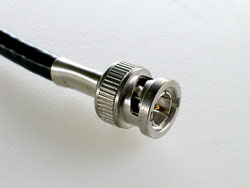
If you order a T3 line or DS3 service, it will be delivered to you on a pair of 75 ohm coaxial cables using BNC connectors. Look at a DS3 router card and you’ll see the connectors, one for receive and one for transmit. Some cards support more than one DS3 connection so you’ll see multiple sets of connectors.

The coaxial cable used to connect your DS3 router can be no more than 450 feet in length (only 225 feet if using small diameter coax). That’s fine for connecting to the telco demarc in your building, but how does the DS3 get to the central office?

The actual provisioning of DS3 services can be via fixed wireless transmission or SONET fiber optic service. DS3 can be easily encapsulated into a SONET STS-1, as they are both telco standards designed to be compatible. An OC-3 service can carry 3 STS-1s for 3 DS3s.

What if you are not in range for fixed wireless and there’s no fiber in the area? Are you stuck with the 1.5 Mbps T1 bandwidth? No, not really. T1 lines can be bonded to create larger bandwidths. This works well up to 10 or 12 Mbps. Bridging the gap between bonded T1 and DS3 is Ethernet over Copper. This technology also uses multiple copper pair instead of fiber strands, but can deliver much higher bandwidth than T1 technology.

Ethernet over Copper (EoC) bandwidth starts at typically 2 Mbps and goes up to 200 Mbps in some areas. This not only gives you a way to grow your bandwidth incrementally beyond T1, but may delay fiber installation indefinitely. The one limitation of EoC is that it is distance limited. How far you are from the office where your copper bundle is terminated determines the bandwidth that is possible. That office also needs to have EoC equipment available.

Have you outgrown your T1 line service or have an immediate business need for bandwidth in the 45 Mbps range? If so get pricing and availability of DS3 bandwidth services, including Ethernet over Copper if available.

Click to check pricing and features or get support from a Telarus product specialist.


Photo of BNC connector courtesy of Wikimedia Commons.


Follow Telexplainer on Twitter

Sunday, June 19, 2011

Pair Bonding and Distance Determine Ethernet Speed

Ethernet over Copper is coming on strong as a competitor to T1, satellite and fractional T3 (DS3) services. It has considerable advantages, such as lower cost and ease of interface. So, just how much EoC bandwidth can you get and where can you get it?

Check out pricing and availablility of Ethernet over Copper solutions.The magic behind Ethernet over Copper is in re-purposing the same twisted pair copper wires that are used to bring in analog business phone lines and T1 lines. There is a huge advantage in making good use of copper that is already in the ground. The installation of that copper has already been paid for. Companies looking to bring in fiber optic service sometimes get a nasty shock when they see what the construction costs are going to be. The technical capability of that copper is also much higher than many assume.

Believe it or not, some carriers are offering 50 Mbps and even 100 Mbps bandwidth over ordinary twisted pair copper. That is enough to forestall fiber installation until even higher bandwidths are required years from now. Typical EoC offerings range from 2 & 3 Mbps on up to 30 Mbps, with steps of 10 Mbps, 15 Mbps, 20 Mbps and 30 Mbps in-between. The bandwidth is highly scalable, but there are tricks in getting it to work.

Many carriers are using terminal equipment provided by Overture Networks, formerly Hatteras Networks. What this equipment does is generate a highly efficient modulation scheme over multiple copper pair. There are variants for 2, 4 and 8 pair setups. One box is at the telephone company office. The other is installed in your building. The hand-off to your network equipment is a standard RJ-45 Ethernet connection. With this arrangement, the telecom circuit looks just like another network link.

What makes this work is the ability of competitive carriers to rent unbundled local loops from the local phone company, also called the Incumbent Local Exchange Carrier or ILEC. Why the ILEC? It’s because by tradition and by law, the ILECs are the owners of all that telephone wire strung on poles and buried in the ground over the last century or so. Since deregulation, competing companies called CLECs or Competitive Local Exchange Carriers have been able to lease just the wires between the phone company office and the service location. That pair of wires is called the local loop.

For EoC to work, multiple pairs of local loop wiring must be available to the business location in question. What’s really desired is just the plain wires between the switching office and the service location with no signals on the line and no equipment installed in-between. Some lines have what is called pair gain equipment in place. This is analog or digital multiplexing circuitry that allows multiple phone conversations to share one physical phone line. Such circuitry is incompatible with the Ethernet over Copper digital signals.

Fortunately most business locations do have 2, 4, 6 or 8 suitable copper pair available. Now it comes down to distance. EoC offers higher bandwidth than bonded T1 lines, but unlike T1 its technology is distance sensitive. If you are more than 15,000 feet or about 3 miles from the telco office serving your location you are probably out of luck for EoC, although T1 is an option. The closer you are to the office and the more pairs of wires employed, the higher your Ethernet bandwidth.

At about a mile, you can probably get whatever maximum service is available. Between 1 and 3 miles, using 2, 4, 6 or 8 pair, you’ll likely get somewhere between 5 and 30 Mbps maximum bandwidth. Bonded T1 lines can reach further but top out at about 12 Mbps using 8 pair.

Obviously, there is no stock answer to exactly how much Ethernet bandwidth you can get at any particular location. It all depends on what facilities have already been installed by the local phone company and which competitive carriers serve your city. You can find out, though, with little effort on your part. Simply request availability and pricing of Ethernet over Copper services for your business location or locations.

Click to check pricing and features or get support from a Telarus product specialist.


Follow Telexplainer on Twitter

Wednesday, June 8, 2011

Ethernet Now Faster and Cheaper Than T1

For years, even a couple of decades, T1 lines have been the go-to professional bandwidth service for small and medium businesses. They are the most popular digital connection for good reasons. T1 lines are available, reliable, secure, dedicated, flexible and relatively inexpensive. What’s not to like?

Compare Ethernet to T1 for speed and cost. Click to get prices for your location.Agreed. There’s a lot to like about T1 services. But how would you like to get even more for your money? If so, then you need to take a close look at Ethernet, especially Ethernet over Copper.

Not everyone is familiar with the newer Carrier Ethernet services. They’ve only been available for a few years and the big rush has been just recently. Ethernet over Copper, EoC, is primarily a service you find in large metropolitan areas and not in smaller towns or out in the country. It has a distance limitation. You need to be within a few miles of the service provider’s office to qualify for service. Even so, there are millions of business locations that could be served by Ethernet instead of T1. So why aren’t they?

Good question. I suspect that it is more a matter of awareness than anything else. Companies that use T1 line services know the pricing and availability. They also know that prices have been coming down so they can get great renewal pricing, especially on 3 year contracts. What they don’t know is that they can get even more bandwidth for the same pricing with Ethernet over Copper.

It’s incredible, but true. Both T1 and Ethernet cost less than $300 a month in many areas. The difference is that T1 bandwidth is fixed at 1.5 Mbps. Ethernet will give you 2 Mbps, known as 2x2 Ethernet, or 3 Mbps, known as 3x3 Ethernet, depending on the service provider for your particular location.

Yes, you can also get T1 service at 3 Mbps to match the 3x3 Ethernet bandwidth. One T1 line will get you 1.5 Mbps only, so the way this is done is to combine or “bind” two T1 lines to get 3 Mbps. The only problem is that you now have to pay twice as much because each T1 line has a cost and there is no economy of scale.

Ethernet is not only lower cost than T1, but it offers more bandwidth that is also more scalable. You can order Ethernet over Copper starting at 1 Mbps. Common speed increments include 2 Mbps, 3 Mbps, 5 Mbps, 10 Mbps, 15 Mbps and 20 Mbps. It’s possible to get other intermediate speeds, too. Binding T1 lines tops out at around 12 Mbps because of both the technology involved and the sheer cost of all those individual lines.

Ethernet keeps on going. You can easily get 10 or 20 Mbps Ethernet service, with 40 Mbps and even 100 Mbps available in some metro areas. Those connections are made over the same type of twisted pair copper wiring that is used to deliver T1. The higher speeds even rival entry level fiber optic services that may be expensive to install.

Are you considering a bandwidth increase or simply want to know if you can get a better bandwidth deal? Get pricing and availability of both Ethernet and T1 line service and see what makes the most sense for your business.

Click to check pricing and features or get support from a Telarus product specialist.


Follow Telexplainer on Twitter

Monday, May 2, 2011

Ethernet over Copper Solutions

Low to moderate business bandwidth solutions have long been served by T1 lines and bonded T1 lines. Now Ethernet over Copper solutions are taking over this space by offering more bandwidth for less money.

Check out pricing and availablility of Ethernet over Copper solutions.The services we’re talking about range from 1 to 20 Mbps and may be either a private line from point to point or a dedicated connection to the Internet. Ethernet standards also make possible a private LAN service to interconnect multiple business locations.

The basic T1 line runs at 1.5 Mbps. It was originally developed by the telephone industry to transport multiple telephone calls between switching centers. A service called T1 PRI or ISDN PRI is still popular for providing up to 23 digital phone lines to a business PBX system using only a single T1 line.

As a digital line, T1 can transport voice, video or data packets. This has led to T1 lines being used to interconnect two company locations with a private line. Some companies expand this by building a network out of T1 lines linking each branch office back to headquarters.

T1 lines have had the advantage of being both affordable and available. Average prices have dropped from over $600 a month just a few years ago to under $300 a month today. T1 lines are provisioned over ordinary twisted pair copper using the same copper bundles that bring in multi-line phone service. As such, T1 service is available just about everywhere you can get a telephone line.

Ethernet over Copper (EoC) is a direct competitor to T1 for a couple of reasons. First of all, EoC uses the very same twisted pair copper wires that are already installed into nearly every business location. The cost for basic Ethernet over Copper service is very similar to T1 lines, except that you get 2 or 3 Mbps rather than 1.5 Mbps for that price. This gives EoC a cost advantage for companies that could use a boost in bandwidth but don’t have extra money in the budget.

Both T1 and EoC can increase the bandwidth they deliver by employing more copper pairs to transport the signal. T1 uses a process called bonding to make two or more T1 lines behave as one larger data pipe. Ethernet over Copper is designed to be easily scalable from 1 to 20 Mbps. Some of the most popular bandwidths are 3 Mbps, 5 Mbps, 10 Mbps, 15 Mbps and 20 Mbps.

Both technologies have limitations. Bonded T1 lines start to become impractical above about 12 Mbps. The technology to go higher isn’t widely deployed and the cost goes up linearly with bandwidth. Ethernet tends to get cheaper per Mbps the more bandwidth you order and can easily support 15 and 20 Mbps levels, in some cases higher. Unlike T1, Ethernet over Copper is distance limited so that you can generally only get service in metropolitan areas. The closer to the nearest telco central office you are, the more bandwidth you can get.

Are you in a quandary over how to maximize your telecom budget dollar? If so or if you’re just curious about getting more Mbps for your money, compare Ethernet over Copper with T1 line service prices and see which makes the most sense for your business applications.

Click to check pricing and features or get support from a Telarus product specialist.


Follow Telexplainer on Twitter

Monday, April 18, 2011

FastE Is The New DS3

Companies that have outgrown their T1 line capacity have traditionally moved up to DS3 bandwidth. Now there’s a faster and cheaper alternative available. It’s Fast Ethernet or FastE.

Get more bandwidth for less money when you order Fast Ethernet instead of DS3. Click for pricing and availability.Even if you are unaware of Fast Ethernet as a Metro or Carrier bandwidth service, you are no doubt familiar with the term. Fast Ethernet is the name given to 100 Mbps Ethernet. It is one of the standard LAN speeds, along with 10 Mbps Ethernet and 1,000 Mbps Ethernet or Gigabit Ethernet. The abbreviation for Gigabit Ethernet is GigE. The next step up is 10 Gigabit Ethernet or 10 GigE.

Nearly all network devices, including PCs, printers, Ethernet switches, routers and servers have NICs (Network Interface Cards) that support Fast Ethernet. In fact, many smaller business LANs run at the Fast Ethernet speed of 100 Mbps. So, why do our WAN (Wide Area Network) connections run at some lower speed?

One reason is cost. WAN network services have tended to be seen as expensive. Part of that is because these are leased line services that are billed by the month, every month. LAN networks have a capital cost of purchase and installation. After that, most smaller networks need relatively little maintenance.

Another reason why we use lower bandwidths on the WAN than the LAN is usage. Most traffic within a company network stays on the LAN. A lot of it is between PCs & servers and for interoffice file transfers. Traffic that leaves the building is mostly Internet access for both websites and email. Companies with multiple business locations often have dedicated lines between them or use an MPLS network to interconnect 3 or more locations. These links get higher traffic, because they are functioning as in-house LAN connections.

A couple of forces are at work to change this situation. First of all, WAN bandwidth is going up simply because files are larger and video is becoming used more in business. A much larger effect is the move from in-house IT services to hosted services, including cloud services. This effectively moves the bulk of the traffic from LAN to WAN. Line speeds have to increase to accommodate this traffic increase, or access will slow to a crawl. Slow access spells lowered productivity in any business process.

Medium and larger companies outgrew their T1 lines long ago. Their upgrade path has been to T3 service, more popularly known as DS3. With DS3, you get 45 Mbps of bandwidth versus 1.5 Mbps over a T1 line. Your lease costs also goes up from hundreds to thousands of dollars a month.

DS3 has been essential for video streaming, ecommerce, large office Internet access, medical image transmissions and other bandwidth intensive operations. As a digital telecom service it has been readily available with costs that have come down over the years. So why not stick with DS3?

The reason, as usual, involves cost and bandwidth. The competing service is now Fast Ethernet at 100 Mbps vs DS3’s 45 Mbps. That’s over twice the bandwidth, but not twice the cost. In fact, you may well be able to get FastE for the same or less than you are paying for a DS3 connection. Consider that Fast Ethernet more closely mirrors the protocol run on the LAN and that both DS3 and FastE are delivered over fiber optic lines, and it’s hard to see why sticking with DS3 makes good business sense.

The one reason that DS3 may still be the right service for your company is that Carrier Ethernet services have not been deployed everywhere just yet. However, competitive carriers are aggressively building out their metro fiber networks and vying for business customers with lowered bandwidth prices.

Are you a DS3 user interested in getting more money for your bandwidth dollar? Or, do you need new installation of high speed line services and want to make sure you are getting the best deal? If so, check out Fast Ethernet vs DS3 pricing and availability now. Once you have the competitive options, you can choose what type and level of service makes the most sense for your operation.

Click to check pricing and features or get support from a Telarus product specialist.


Follow Telexplainer on Twitter

Tuesday, March 1, 2011

Dark Fiber Community Builds Infrastructure

You hear the stories that our infrastructure is crumbling. Not all infrastructure. There’s a big construction project underway now to ring the country with a thousand fiber strands, a high bandwidth nervous system for information technology. Lighting up this dark fiber promises almost unlimited low latency bandwidth for the foreseeable future.

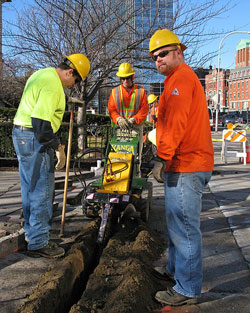
Typical fiber optic cable installation underway.Why the need for this dark fiber infrastructure? It’s not so much that the old infrastructure is crumbling as it is chock full. You remember the great fiber buildout late last century? It seemed to be way overdone when the tech crash came. Indeed, it’s taken over a decade to light up all that excess fiber. There may still be some underutilized fiber rings looking to see the light, the laser light that is. But there is also an enormous additional need coming from business process automation, high frequency financial services, electronic medical records, and 4G wireless, to name a few demanding applications.
Rising to the challenge is Allied Fiber and its Dark Fiber Community. Allied fiber isn’t a carrier. They are an infrastructure builder. They are where the carriers go to get new unlit fiber routes. One of the most prestigious fiber optic carriers, AboveNet, has just joined the Dark Fiber Community to provide expertise in high performance fiber optic networking and be part of this enormous resource.

The Dark Fiber Community is an association of over 60 members that include equipment vendors, carriers, industry technical associations, financing companies and other interested parties. It’s hosted by TMCnet.com as an online resource and educational platform to support Allied Fiber.

Allied Fiber, itself, is the company that is building out and leasing this enormous national dark fiber optic backbone. It will eventually be in the form of a ring linking New York City, Chicago, Seattle, Los Angeles, Phoenix, Dallas, Houston, Jacksonville, Miami, Ashburn, VA and back to NYC. Draw a circle around the lower 48 states and you’ll have the general route for Allied Fiber.

But what if you don’t happen to be located in one of those major cities on the fiber route? Here’s the cleverness of the design. It’s not just a few long haul fiber routes. It’s two parallel routes. One is long haul between the major cities mentioned. The other, running side by side, is broken up into 60 mile segments. These short haul routes terminate in colocation huts where the laser signals are regenerated to boost them for the next segment. Inside the same hut are racks for multiplexing equipment to add and drop network services on the route. This long-haul/short haul arrangement allows Allied to provide low latency fiber between major city pairs while having the flexibility to also serve many other locations along the way and connect to other short haul routes off the major route.

One series of connections will be Fiber to the Tower or FTTT. You may not have heard of FTTT before, but you will hear plenty about it in the near future. The wireless industry is moving into 4G as fast as they can. Unfortunately, their old T1 based copper backhaul infrastructure is maxed out for bandwidth. That means new fiber connections to those cellular base stations in many cases. Allied’s FTTT plan is to provide access to the duct fiber every 1 to 2 miles in order to create lateral extensions from the main fiber route to where the towers are located.

Are you in need of higher bandwidth fiber optic services at highly competitive prices? If so, you may have more options than you think. Find out by getting prices and availability for dark and lit fiber optic bandwidth services now.

Click to check pricing and features or get support from a Telarus product specialist.


Note: Photo of workmen installing fiber optic cable courtesy of Paul Keleher on Wikimedia Commons.


Follow Telexplainer on Twitter

Monday, February 7, 2011

HFC Broadband For Business

Many small businesses don’t fall into the category of “residential” users but don’t need or can’t afford the cost of traditional business telecom services, such as T1 lines or Ethernet over Copper. One possible solution is HFC or Hybrid Fiber Coax broadband services.

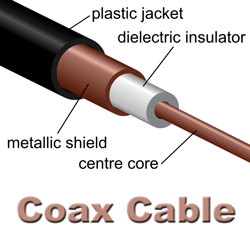
Coax cable as used in Hybrid Fiber Coax systems.Hybrid what? You may have heard of this as Cable broadband for business. A lot of home based businesses successfully use Cable broadband to manage their websites, access information on the Web and send and receive email. But try to order residential service for a business location and you’ll get turned down flat. That’s because residential broadband is priced for single homes and apartments with few people accessing the service and probably no-one online most of the day. Knowing that, some business owners incorrectly assume that you can’t get Cable run into a business. But you can.

So, what’s available and why the funny name? HFC or Hybrid Fiber Coax refers to the technology used to deploy high speed Internet access, telephone service, and Cable television. You know that Cable TV and Cable broadband are called that because of the coaxial cable that provides the connection to the network. When Cable systems were first deployed, they were constructed from various size coaxial cables. What’s happened in recent years is that the long connection from the Cable office or the “head end” where the signals are picked up and run for miles to various neighborhoods has been replaced by fiber optic cable. The last few hundred feet or so are still copper coaxial cable, also called coax. The result is a system that is a hybrid of fiber optic cable and coax cable known as Hybrid Fiber Coax or HFC.

Why go with a hybrid arrangement rather than just make it fiber optics all the way? It’s mostly a matter of cost. While fiber has a far larger capacity, there is a lot of coax already in the ground. The interface connection at the premises, either a Cable modem or set top box, is much less expensive than the termination equipment needed for fiber. Don’t count that coax down and out yet, either. With digital signals, there is more than enough bandwidth for triple-play services to small and medium businesses as well as consumers.

With an already built-out infrastructure and a high number of users to cover costs, you might expect that HFC services are lower in cost than most telecom services available for the SMB. You’re right, they are. But you need to know the performance tradeoffs to make a smart buying decision.

One excellent use for HFC is broadband Internet access when employee use is primarily Web browsing and email. That includes information research, making purchases, doing simple banking, messaging customers, providing a WiFi hotspot and so on. If most of what you do is similar to the way you use a computer at home, HFC should work just fine. You select a bandwidth tier that offers enough speed to work efficiently and still saves you money over other options. Typical bandwidth for smaller businesses goes up to 15 Mbps download and 2 Mbps upload, although some Cable companies are offering speeds as high as 50 or even 100 Mbps.

You’ll likely be able to get a high speed Internet solution that meets your needs with a lot more bandwidth than a T1 line offers and for a lot less money. But beware. T1 lines are dedicated bandwidth that stays a rock solid 1.5 Mbps all the time. Cable bandwidth is shared among all the users on the Cable and can vary all over the place. That’s one way they hold the cost down. If you are running high traffic ecommerce servers or using business processes that expect constant bandwidth, you might find the speed variations not worth the cost savings. Otherwise, you might be quite happy with both the performance and reliability of HFC broadband.

Another service that Cable companies have gotten into is business telephone, essentially VoIP. One big difference between this service and simply running a third party VoIP service over your broadband connection is that the Cable version never transits the Internet. The voice packets travel over the cable network and are then terminated to the public telephone network by the Cable company or a telephone service provider. By doing it this way, the HFC operator has more control of things like latency, packet loss and network congestion to ensure decent voice quality.

Finally, HFC offers Cable TV channels. After all, that’s why the network was built in the first place. Businesses with waiting rooms, like automotive service centers and doctor’s offices, can put business Cable TV service to good use.

Have you been frustrated by your current choices in network services? Why not compare prices, availability and service features of HFC, T1 and Ethernet so you can make the best buying decision? You may be surprised by the range of options available.

Click to check pricing and features or get support from a Telarus product specialist.


Note: Diagram of coaxial cable construction courtesy of Wikimedia Commons.


Follow Telexplainer on Twitter

Tuesday, January 25, 2011

Ethernet over Copper vs Bonded T1

T1 lines have been the gold standard for small and medium business connectivity. Their popularity has grown as pricing has plunged in recent years. Now there’s a newer technology service that gives you even more bandwidth for less money and is even easier to interface. That service is Ethernet over Copper.

Compare Ethernet over Copper to Bonded T1 lines for price and availability. Click to inquire.Ethernet over Copper, or EoC, leverages one of the primary attributes of T1 lines. That’s their ability to be provisioned over ordinary twisted pair telephone wiring. A T1 lines comes into your facility in the same bundle of installed telephone wire that brings in multi-line telephone service. Because it is ordinary telco wire, most every business location in the country is already wired for service and enabled for T1.

T1 lines use two twisted pair versus one pair for an analog telephone line. One pair is used for the upstream connection. The other is used for the downstream connection. This gives you 1.5 Mbps in both directions at the same time, also called full duplex operation. T1 line prices have come down to several hundred dollars per month, although that number varies with location.

For about the same money you can get Ethernet over Copper bandwidth. But your Ethernet link will be running at 3 Mbps rather than 1.5 Mbps. Why the difference? It’s a matter of more efficient modulation technology. T1 was designed by the phone companies right after WWII to transport telephone calls digitally. Thus, it was designed as a synchronized system subdivided into 24 precise channels. It’s a great match for loading phone lines onto a digital trunk, but bears no resemblance to today’s network protocols. Ethernet is based on packets, not channels, and doesn’t need the T1 system for transport. In fact, it takes a protocol conversion to go back and forth from T1 to Ethernet.

T1 lines can compete with Ethernet over Copper by using more lines to increase bandwidth. Add another 2 pair for an additional T1 line and you can double your bandwidth from 1.5 Mbps to 3 Mbps. The process used to couple multiple T1 lines to create one effectively larger line is called bonding. As you might expect, Ethernet over Copper lines can also be bonded to create a larger bandwidth connection. T1 line bonding is practical up to 10 or 12 Mbps. EoC bonding can deliver bandwidths as high as 100 Mbps over very short distances. Standard Ethernet network speed of 10 Mbps is readily available. You can also get 15 or 20 Mbps service without too much trouble. Once bandwidth gets above 45 to 50 Mbps, it generally makes sense to move up to fiber optic connections.

The one rub with Ethernet over Copper technology is that it is distance limited. That’s why EoC is often called a Metro Ethernet service. You’ll find it readily available in major metropolitan areas, but not farther out in sparsely populated areas. EoC delivery is generally limited to a few miles from the central office where the termination equipment is installed. For higher bandwidths, it’s only a matter of blocks away from the nearest point of presence. Downtown that’s no concern because of the concentration of both users and service provider facilities.

T1, on the other hand, has no distance limitation. It was designed from the beginning to have regenerators placed every mile or so in the line to restore the signal to a perfect wave shape. Longer spans require more engineering and construction effort, so cost goes up. Even so, you can get T1 service from coast to coast if you like. Actually, the T1 line is only carried by copper to the nearest telco central office. From there it rides on a fiber optic network to the central office nearest the far location and is then delivered on copper wiring.

Business bandwidth demands are increasing faster than fiber is being trenched to every business. That doesn’t mean you are stuck with a basic 1.5 Mbps of service when you really need 10 or 20 Mbps. Find out what’s available for your business location and compare prices for Ethernet over Copper vs Bonded T1 services now.

Click to check pricing and features or get support from a Telarus product specialist.


Follow Telexplainer on Twitter

Wednesday, January 19, 2011

Gigabit Wireless For TDM and IP Transport

What do you do when you need to get Gigabit bandwidth services into a building that has no fiber connection to your network? If you are XO Communications, you simply add a wireless hop using BridgeWave Communications FlexPort link. No stringing aerial wires on poles. No trenching fiber optic conduit. Just high bandwidth connectivity through the air.

Wireless Gigabit links can extend your WAN network connectiivty options.We’re used to thinking of twisted pair copper and microwave wireless as the right solutions for moderate bandwidth needs. Gigabit bandwidth levels obviously require fiber optic strands, right? Not really. Point to point fixed wireless systems can give you fiber optic performance without the fiber or the optics.

I mention optics because there are laser based solutions designed to connect buildings at Gigabit levels. They are especially well suited for connecting networks between two tall office buildings separated by a freeway or river that makes installing fiber prohibitively expensive if even possible. But that’s maybe a thousand feet or so. How about when you need to link networks over a few miles line of sight?

This is the area where BridgeWave shines, so to speak. Actually, they’re using two-way millimeter wave transmissions in the 60 and 80 GHz radio bands. Those frequencies are high, but nowhere near the infrared or visible portion of the spectrum. Here’s something interesting, though. Oxygen attenuates signals in the 60 GHz band, a property unique to that portion of the spectrum. That limits transmission distance, but it also works to ensure that multiple users on the same frequency are unlikely to interfere with each other. The signal is simply absorbed by the air on either side of the narrow beam and past the receiving antenna.

If you’ve had a bad experience with RF links in the WiFi band or other microwave and UHF frequencies, you can appreciate both the interference avoidance and inherent security of the millimeter wave band. It’s likely that anyone trying to intercept a 60 GHz transmission would have to insert themselves in the path to such an extent that they would affect the strength of the signal at the intended receiver and give themselves away.

The 80 GHz band doesn’t have the oxygen absorption characteristics of the 60 GHz band, so it is better suited to medium haul rather than short haul links despite the higher frequencies. Still, the interference is minimized and security is enhanced due to the narrow beam width of the millimeter wavelength system.

The BridgeWave FlexPort80 link that XO is deploying is available in the 80 GHz millimeter wave band plus the licensed 18 and 23 GHz microwave bands for longer links. One of the attractive aspects of the BridgeWave equipment is that it is an all-outdoor solution. Some competing systems simply have an outdoor antenna with rack mounted transmission gear needed inside the building.

Another feature especially valuable for today’s corporate networks is the ability to transmit both TDM and IP traffic. The TDM capability is also being used by mobile carriers to backhaul their 3G and 4G networks from isolated base stations. It should be noted that FlexPort80 delivers simultaneous TDM + IP connectivity, making it truly a “flex port.”

Do you have a location that has been particularly difficult to supply with high bandwidth telecom services? Perhaps a combination of fiber optics and millimeter or microwave wireless transmission can get you the Gigabit connectivity you need at a cost you can afford. Discuss your situation now with one of our Telarus bandwidth consultants to get pricing and availability for high bandwidth business connectivity solutions.

Click to check pricing and features or get support from a Telarus product specialist.


Note: Graphic based on skyscraper image courtesy of Wikipedia Commons.


Follow Telexplainer on Twitter

Tuesday, December 21, 2010

Find A T1 Line For Your Business

You’re not too happy with your digital connectivity options. DSL and Cable services have attractive pricing, but bandwidth varies all over the place and outages don’t seem to get resolved as fast as you’d like. Perhaps you’ve moved to a location beyond the reach of DSL or Cable broadband. Well, there’s Satellite Internet. It has extensive latency by nature, limited bandwidth, and the signal goes out when the weather gets heavy. Are there any better options?

Get T1 line prices instantly. Click to use the Shop For T1 service...The gold standard for small business wireline services is T1. These lines are available nearly everywhere, offer a rock solid bandwidth with equal speed for both upload and download, are highly reliable and get fast service in the rare event of a problem. They also give you options for secure connection between business locations and digital phone lines for your PBX telephone system that aren’t offered by other types of digital services.

But what about the cost? T1 lines were once the exclusive domain of the telephone companies to connect their switching centers. Later, they were offered to businesses at prices only larger companies could afford. Today, T1 lines are so prolific and there is so much competition between service providers that T1 lines are affordable by nearly all small to medium size businesses that have their own business locations. Home offices and residential users don’t generally qualify for this service.

Let’s have a look at what a T1 line can do for your business and then see how to find providers and prices quickly and easily.

The most popular use for T1 lines today is for dedicated access to the Internet. This is a broadband service that offers 1.5 Mbps for both upload and download. If you need more than that, you can order additional T1 lines and have them bonded together to create one large bandwidth connection.

Note that this is called dedicated access. What that means is that you always have the full bandwidth of the line available for your exclusive use. What many people don’t realize is that DSL and Cable services share their available bandwidth among many subscribers to keep the cost low. Unfortunately, if others are heavily using the Internet your available line speed will slow, sometimes to a crawl. T1 is always available at full bandwidth.

Another configuration for T1 lines is for private point to point connections. This is like having a direct digital wire linking two business locations. There is no connection to the Internet. It’s an empty pipe that is for your exclusive use to upload and download data between locations. This service is particularly popular for linking branch offices to headquarters.

Finally, T1 lines can be ordered in a special configuration called T1 PRI or ISDN PRI. This is a telephone service. A single T1 PRI line can bring in up to 23 separate telephone lines plus Caller ID service. Many call centers, sales offices and medium size office businesses use T1 PRI as a lower cost connection for their PBX telephone systems than bringing in multiple business phone lines.

There is also a special service called Integrated T1 that combines up to 12 telephone lines and broadband Internet service on one T1 line. Small sales offices can often save money by using this service in place of separate telephone and broadband connections.

So, how do you find a T1 line for your business? The best way is to use the Shop For T1 real-time quote engine. It’s an online service that’s available 24/7. You simply enter some basic information about your company and the program will automatically generate a list of T1 line services and their prices for your location. Be sure to specify if you want high speed Internet, dedicated voice service or integrated voice and data by using the drop down menu for service type. If you wish, an expert consultant will be happy to go over the entire range of options available for your location and make recommendations. There’s no charge for this service.

Click to check pricing and features or get support from a Telarus product specialist.


Follow Telexplainer on Twitter

Monday, December 6, 2010

Internet Bandwidth Connections For Business

Internet access can be divided into three categories. Consumer residential broadband, dedicated business bandwidth, and 3G/4G mobile. Mobile broadband serves both individuals and business users. But fixed wireline is either business or consumer, but not truly both.

Find better deals on InWhy is that? There’s as cost vs performance decision that separates the two. Consumer services, and that includes home based businesses, are not even classified as telecom services. They have a designation as “information services.” What that does is keep them relatively unregulated with few commitments to the customer. In return, costs are kept low so that they are affordable by most households.

Business bandwidth is a regulated telecom service with high performance expectations. Unlike consumer connections, your business line services have a dedicated bandwidth level that is available 100% of the time. You can use that line up to its full capacity without bandwidth caps.

Business bandwidth also tends to be symmetrical. That is, you get the same bandwidth in both directions. An example is 10 x 10 Mbps Ethernet. What that means is that you get 10 Mbps in both the upload and download directions. Contrast that with consumer DSL, Cable and wireless services that favor the download direction by a large margin. That’s because most consumers download far more data than they upload. Business use tends to be more balanced.

Business bandwidth services are designed to be highly reliable. After all, the telecom companies and network carriers use the same line services themselves. Many come with an SLA or Service Level Agreement. That document defines the performance and availability of the line. If it goes down, it gets fast attention from the service provider. Most outages are restored in a matter of hours or less. There is no such commitment for consumer services. It’s a “best effort” arrangement with multi-day outages undesirable but not unknown.

Business Internet bandwidth is also called “dedicated” access. The dedicated term means that you and you alone have use of that much bandwidth. That may seem obvious, but do you realize that consumer broadband services are called “shared” and not dedicated? What the service provider does is purchase a large dedicated line service and then share that bandwidth among the user base. How much bandwidth you have at any given time is a function of how much your neighbors are also using. Bandwidth slowdowns during peak usage times are to be expected. This is why consumer bandwidth is sold as “up to” a certain Mbps.

Popular Internet bandwidth connections for business are T-Carrier, SONET and Ethernet. T-Carrier includes the popular T1 lines that offer 1.5 Mbps bandwidth and are available just about anywhere you can get telephone service. SONET is the big brother of T-Carrier. It is a fiber optic service with designations such as OC-3, OC-12, and OC-48. Ethernet can be provided on either copper or fiber. Ethernet over Copper is available in metropolitan areas at bandwidths up to 45 Mbps. Most popular are 3 Mbps and 10 Mbps Ethernet over Copper. They typically offer more Mbps for your bandwidth dollar, where available. Ethernet over Fiber offers near limitless bandwidth, although 100 Mbps Fast Ethernet, 1000 Mbps Gigabit Ethernet and 10 Gbps Ethernet are popular standard line speeds.

Are you frustrated by a poorly performing Internet connection or just want to compare pricing to ensure that you are getting the most for your money? If so, get competitive pricing and availability for business Internet bandwidth services now.

Click to check pricing and features or get support from a Telarus product specialist.


Follow Telexplainer on Twitter

Sunday, November 14, 2010

Fiber Connectivity Options For Business

Fiber optic bandwidth is now well within the reach of most medium and large companies, and even smaller organizations that are bandwidth driven. What’s changed? Lower prices and more options. That’s good news for large bandwidth users. Let’s take a look at what’s available that you may not know about.

Ethernet vs SONET fiber optic service pricing. Click to get quotesFiber optic bandwidth services tend to fall into two categories. There is the traditional time division multiplexed technology that came out of telephone company research. Competing with those legacy services are the newer IP-centric networks being offered by competitive service providers as well as incumbent telecom carriers.

The fiber optic bandwidth service that is most familiar is called OC-3 or Optical Carrier - level 3. It runs at 155.52 Mbps, commonly referred to as 156 Mbps. What you might not realize is that some lower speed services travel part or all of the way from the service provider to your location on fiber optic cabling. These include T1 and DS3, generally thought of as copper-based telecom services. It’s up to the carrier how they want to transport their bandwidth services, but it’s made easier because both T1 and DS3 are easily multiplexed onto OC-3.

Why is that? It’s because T1, DS3 and OC-3 were all developed by the telephone industry for its own use. The smallest element is called a DS0, which is 64 Kbps of bandwidth organized as 8 data bits x 8 Kbps sampling frequency. A DS0 is exactly the size needed to carry one digitized telephone conversation. Package 24 of these DS0 channels together and you have a T1 line running at 1.5 Mbps. Package 28 T1 lines or 672 DS0 channels together an you have DS3 service at 45 Mbps. Now, package 3 DS3 services together and you have OC-3 at 156 Mbps. The device that does the packaging and unpackaging is called an Add/Drop Multiplexer or ADM.

OC-3 fiber optic service is part of an industry standard known as SONET for Synchronous Optical NETwork. SONET is a US standard. The equivalent international fiber optic standard is called SDH for Synchronous Digital Hierarchy. As you probably know, there are higher speed fiber services in the same OCx family. Commonly available services include OC-12 at 622 Mbps, OC-24 at 1.244 Gbps, OC-48 at 2.488 Gbps, OC-192 at 9.953 Gbps and OC-768 at 39.812 Gbps. That last one is primarily used by service providers themselves.

What’s characterized SONET fiber optic services for decades is high cost and very limited availability. Your best bet for connecting to these high bandwidth services has been at a colocation center, also called a carrier hotel. There’s little to no construction cost to get that level of bandwidth in a colo center, because the carriers have a presence within the building. It’s just a matter of getting a fiber optic cable drop from their equipment cage to yours.

SONET services delivered to your door have also come down in price due to increasing demand from business and heavy competition from another service called Carrier Ethernet. This is Ethernet like you have on your LAN, but extended into the metropolitan and wide area networks. The most familiar name for this service is Metro Ethernet. That’s also where you are most likely to find it - in major metropolitan areas.

Metro Ethernet is a packet or IP-based network service rather than a synchronous TDM service. One difference is that you don’t need special interface circuitry to connect to an Ethernet service. After all, it’s Ethernet and it’s delivered to you on an Ethernet connector. The other difference is the scalability of services. Common speeds are 10 Mbps, 100 Mbps and 1000 Mbps to mirror the standard network speeds. You can also get 10 Gbps now. But you are not limited to these particular bandwidth increments. Most carriers offer a wide variety of speeds from 10 Mbps to 10 Gbps. If you install an Ethernet port at the highest speed you expect to use, you can pay for a smaller bandwidth increment to get started and then upgrade to a higher speed when needed. Often, all that is required is a phone call to your service provider to request an increase in bandwidth.

How about fiber optic pricing? You may still find areas where SONET services are the least expensive, but most of the time it’s Ethernet that has the cost advantage. That’s especially true if you are not running at one of the standard SONET speeds. The cost difference can be half or less for the same bandwidth when you replace SONET with Ethernet.

Do you currently use fiber optic bandwidth services or are you considering them for your business? If so, don’t order anything until you get a side by side price comparison of SONET and Ethernet fiber optic bandwidth. You may be surprised by what’s available at a lower cost than you expected.

Click to check pricing and features or get support from a Telarus product specialist.


Follow Telexplainer on Twitter

Tuesday, November 9, 2010

What Makes 10 Mbps Ethernet So Popular?

One of the most popular bandwidth services for business right now is 10 Mbps Ethernet. What’s that about and how can you benefit too?

10 Mbps Ethernet service. Click for availability and pricing.What we’re talking about here is Metro Ethernet or Carrier Ethernet connections running at 10 Mbps. They can be used to connect two business locations in a point to point setup. They can be used to provided a dedicated Internet access connection. They can also be used as an on-ramp to a larger cloud network for national or even international connectivity.

So why 10 Mbps? It’s a bit of a sweet spot in the spectrum of bandwidth choices. T1 lines have been that sweet spot for the last decade. But business applications are getting more and more bandwidth hungry. The 1.5 Mbps provided by a T1 connection isn’t really enough anymore, even though T1 line prices have come down considerably. The Ethernet equivalent is a 3 Mbps connection for about the same money as T1, but offering twice the bandwidth. For many small businesses, 3 Mbps Ethernet may be all that’s needed for the time being.

Companies with more that a few employees or using video conferencing, on-site web hosting and other demanding services find that 10 Mbps Ethernet offers a considerable bandwidth upgrade at a reasonable cost. It’s not that much more expensive than T1 was a contract or two ago.

One technical reason that 10 Mbps Ethernet is in a “sweet spot” of bandwidth pricing is that you can often get it delivered on copper as well as fiber optic cabling. By copper, I mean multiple pair of twisted copper telco wiring. It’s the same bundle that’s used to bring in analog telephone and T1 lines. The service provider leases this already-installed copper from the local telephone company and then connects those pair to special EoC termination equipment. That’s the magic that makes it possible to get such a bandwidth jump without an equivalent jump in cost.

Where is 10 Mbps Ethernet service available? It’s offered now in most metropolitan areas from multiple competitive service providers. Downtown in major cities, you can almost always get 10 to 50 Mbps Ethernet over Copper. The exact speed available is determined by the distance from your location to the nearest carrier point of presence. In suburban areas and smaller cites, you may also find EoC. If not, some carriers are offering Ethernet over DS1 or EoDS1. This is a similar service, but uses T1 line technology with signal regenerators to extend the service range.

What if you need even higher bandwidths? Ethernet is probably still your most cost effective choice, but it will be provisioned on fiber optic cable rather than copper twisted pair. Way out in the boonies, that can be a problem when there are no fiber cables for miles around. In town, construction costs may not be that expensive if you are close to a service provider’s office. If you, or you plus other businesses in your building or industrial park, order enough bandwidth, construction costs may be waived or greatly reduced.

Does this sound like a promising bandwidth service for your organization? The way to find out is to get a summary of availability and competitive pricing for 10 Mbps Ethernet Service. Quotes for higher speeds up to 10 GigE are also available.

Click to check pricing and features or get support from a Telarus product specialist.


Follow Telexplainer on Twitter

Sunday, October 24, 2010

Increasing Bandwidth By Pair Bonding

If you have a bandwidth service, say a T1 line, and are starting to run out of bandwidth, then what is your next logical move? You could bring in a higher level service such as DS3, but that could prove tricky. Your T1 line is delivered over twisted pair copper. DS3 is generally brought in using fiber optic cable. Also, there is a tremendous jump in bandwidth and expense from a T1 line at 1.5 Mbps to a DS3 connection at 45 Mbps. Are there other options?

Pair bonding to increase bandwidth. Click to inquire.Perhaps the easiest move up is to simply add another T1 line if all you need is incrementally larger bandwidth. If you get both your lines from one carrier, they can do what is called “pair bonding” to make the two lines act like they are one larger line. For instance, two bonded T1 lines give you 3 Mbps. That goes to 4.5 Mbps with 3 lines and 6 Mbps with 4 lines. A practical limit to bonding for T1 is somewhere around 10 to 12 Mbps.

There is also another form of pair bonding you should be aware of. Instead of bonding T1 lines with their DS1 signals, dry copper pair can be leased with no signals of any type. They’re just plain copper wires running from a central office to a business location. Using multiple copper pair with special terminal equipment installed at each end, Ethernet over Copper or EoC can be provided by competitive carriers.

Ethernet over Copper uses a completely different form of modulation to transport the digital signals from provider to customer. Advanced techniques such as MIMO (Multiple Input Multiple Output) may be employed to reduce interference between signals on pairs bundled in the same cable. This allows more bandwidth to be transmitted using fewer wires than would otherwise be required.

The result is that Ethernet over Copper can transport higher bandwidth services using pair bonding. You can typically get 3 Mbps to 10 Mbps from EoC services. In some cases, that can be increased to as much as 50 Mbps. The higher the bandwidth, the closer you have to be located to the telco office. That’s because the techniques used to increase bandwidth are affected by distance. The signal fades as you get farther away from the source.

T1 lines don’t have this distance restriction, as the technology was designed to incorporate regenerators every mile or so to boost the signal. If you are located too far from the carrier’s point of presence to get Ethernet over Copper, you may qualify for Ethernet over DS1. That’s a technique that uses the T1 line protocol to transport Ethernet. You are essentially getting an Ethernet signal delivered using one or more T1 lines. In this case T1 pair bonding can be used to increase bandwidth.

Will some form of pair bonding get you the business bandwidth you need at a reasonable price? Find out what business bandwidth services are available for your location now.

Click to check pricing and features or get support from a Telarus product specialist.


Follow Telexplainer on Twitter