Showing posts with label bandwidth connections. Show all posts

Monday, December 19, 2011

Copper Bandwidth Connections Push 1 Gbps

Just when you think they’ve wrung all of the speed possible on ordinary twisted pair telephone wire, clever engineering demonstrates that we haven’t hit a bandwidth ceiling yet. Would you believe 1 Gbps copper business service?

Ethernet over Copper speeds and availability are increasing, while prices are dropping. Check now for your business.It’s not available in your office park yet, but it’s on the way. Chinese networking and telecommunications company, Huawei, has a prototype Giga DSL system that can deliver a combined rate of 1 Gbps line speed within 100 meters of a remote terminal (RT) cabinet. It scales down to 500 Mbps if you can connect within 200 meters of the cabinet.

This follows another Huawei project called SuperMIMO that uses four twisted copper pairs to deliver 700 Mbps over 400 meters. You might recognize MIMO as the WiFi 802.3n antenna technology used to extend range using multiple antennas for both transmitter and receiver. MIMO stands for Multiple Input Multiple Output. The ideas is that radio waves bounce around and interfere with each other and themselves in an effect called multipath distortion. With more than one antenna and some intelligence in the system, you can sort out the wave patterns and recreate a clean signal.

So what does wireless transmission have to do with copper wires buried in the ground? For business telecommunications, such as multi-line telephone, T1 and Ethernet over Copper, the twisted pair lines are not installed individually. Instead, collections of them run together in binder cables with 50 pair or more. The twisted conductors cancel out most electromagnetic interference for low speed transmission, such as analog phone and dial-up Internet access. Higher speed signals, such as EoC or T1, can transfer to other pairs in the cable creating crosstalk interference. This is where MIMO can reduce that interference between wired paths in the cable just like dealing with multiple paths through the air.

Other telecom equipment vendors have been active in this field as well. Alcatel-Lucent has their own approach called DSL Phantom Mode that delivers 300 Mbps over two copper pairs. Over longer distances up to 1 km, it can deliver 100 Mbps. With 1 km spans, this system would work well for Ethernet over Copper in business districts and industrial parks.

Alcatel-Lucent’s breakthrough is something called a phantom circuit. These circuits were used in the early days of wired communications to transmit more telegraph signals or telephone calls. The principle is that two phone lines, consisting of one twisted pair each, will carry two separate telephone calls. But if you connect a circuit between them, that can be used as to carry a third telephone call or telegraph signal. Interference is eliminated by using transformers on each end of the lines and connecting the third circuit between center taps on the transformers. Since the lines are balanced, they don’t notice this third or phantom circuit riding along on the same copper.

Alcatel-Lucent also uses bonded copper pair to increase bandwidth carrying capacity and VDSL2 vectoring to cancel the cross talk between multiple lines in the same bundle. Like MIMO, vectoring employs digital signal processing to analyze the effect of interference on signals among copper pairs on a symbol by symbol basis. This is something that was out of the question before high speed DSP became affordable. By throwing enough mathematics at the signal waveforms, it is now possible to make finer and finer corrections to maximize throughput of any wired or wireless transmission system.

What’s driving such a fury of investigative work into leveraging century old copper connected to telephone company central offices? Bandwidth demand is ramping up exponentially right along with the processing and storage needs of big data. The move from local data centers to the cloud also means that faster network lines are needed for WAN as well as LAN connections. Fiber speeds are increasing, too. But fiber only reaches 75% of business locations, at most, and is expensive and time consuming to install. If existing copper can be made to meet the increasing bandwidth demand, businesses can rapidly increase their MAN and WAN network speeds using connections they have now.

Are you feeling pressed for speed on your network connections? Both copper and fiber solutions are available now that weren’t in place even a short time ago. Check Ethernet over Copper and Fiber bandwidth prices now and see what’s available for your business location.


Click to check pricing and features or get support from a Telarus product specialist.


Follow Telexplainer on Twitter

Sunday, October 2, 2011

Why The Smart WAN Beats A Dumb Pipe

The basic building block in constructing Wide Area Networks has been the “dumb pipe.” This refers to a bandwidth connection between point A and point B. There’s nothing stupid about these connections. They do one thing and one thing well. They get your packets from place to place with no effort on your part. The reason you’d want something smarter is that IT needs are getting more sophisticated. Either you add more smarts within your organization or gain this capability as a service.

Compare managed IT services for cost and performance...Level 3 Communications, a major domestic and international fiber network carrier, has seen the transition from simple to high performance networking requirements and is launching what they call the “Smart WAN.” This is a bundled solution that includes all of the bandwidth services you traditionally associate with the WAN, plus managed services to optimally tie everything together.

Let’s take a look at some of the services you find in this bundle and how they can benefit your organization.

You’ll want a connection to the Internet, of course. This is a dedicated bandwidth line that can range from a T1 or Ethernet over Copper connection on the low end on up to Gigabit Ethernet or 10 GigE for high performance needs. Level 3 can make whatever connection you need, including video transport and content delivery outside but in parallel with the Internet.

Nobody in their right mind would simply plug an Internet port into their company network these days. All the benefits of worldwide connectivity bring along all the problems with bad actors scattered around the globe. Some want to bring down your organization just for fun. Others want to steal your intellectual property for sale to a competitor. Level 3 offers managed security services to keep the threats at bay. These include managed firewalls, intrusion detection and protection, and IPSEC secure remote access. You’ll need this if you employ remote workers or employees that need access to the company LAN while traveling.

Beyond the Internet, you may want a VPN to tie together your business locations in other cities, states and countries. Level 3 has an extensive MPLS network in place that can support any needed protocol. Some of the standard services include EVPL or Ethernet Virtual Private Line, a Layer 2 Ethernet service that replaces long haul dedicated point to point lines and can also provide point to multipoint data service. IP VPN service offers any to any, full mesh WAN connections plus managed routing to simplify your support needs. There’s also VPLS or Virtual Private LAN Service that lets you interconnect your far-flung LANs in to a single company network. WAN optimization ensures that you are making best use of the bandwidth you have without overpaying for unnecessary higher level line services.

You can go out and procure any of these services separately, of course. That’s been the traditional approach to building business WAN networks on an ad-hoc basis. When all you need is a phone line and broadband Internet access, it’s no big deal to handle it yourself. What’s different lately is that companies are embracing cloud services that need high performance secure connections, perhaps shared among many different locations. This puts an additional demand on IT resources, at a time when increasing staff is difficult to impossible.

Level 3’s Smart WAN looks to offload the burden of setting up and running your WAN for maximum effectiveness. In addition to bandwidth and managed services, Level 3 can provide architecture, design, project management, monitoring & measurement and field service.

Are you finding that your WAN needs are getting hard to handle and perhaps costing more than you think they should? Perhaps you need a “smarter” WAN approach. Get competitive quotes for managed WAN services and see if you can get higher network performance at better prices than what you are doing now.

Click to check pricing and features or get support from a Telarus product specialist.


Follow Telexplainer on Twitter

Monday, August 8, 2011

Cost Performance Advantage of Ethernet over Copper

Most businesses have some type of bandwidth connections for credit card verification, email, online searches, location to location data transfers, procurement, research and a host of other needs. These connections run the gamut from information services such as DSL, Cable, satellite and wireless, to telecom services like T1, DS3, OC3 and Ethernet over Fiber. The new player, with cost vs performance advantages you should consider, is Ethernet over Copper.

Check out pricing and availablility of Ethernet over Copper solutions from 2 to 100 Mbps and more.Why Ethernet over Copper? First of all, this is a protocol that most closely matches what is running on nearly all networks today. That is, Ethernet. Most other services were designed back in day when voice was king and the public switched telephone network dominated worldwide communications. That’s no longer the case. The world has not only transformed from analog to digital, but has also moved from telephone conversations to email, texting, video downloads and streaming, search and Websites.

Voice landlines are on the decline. While users increasingly choose cellular calls, businesses are transforming desk phones to enterprise VoIP and carriers are quietly converting their core networks from circuit switched to packet switched architectures. Even the next generation of smartphones may choose VoIP over LTE rather than continue the proprietary GSM and CDMA voice channels. All of this means an increasing stampede toward Ethernet as the universal networking protocol.

Using Ethernet instead of some other telecom protocol improves network efficiency since no conversions are required and interfaces are simpler. It also enables Ethernet strategies such as layer 2 switching vs layer 3 routing to connect geographically separate LANs on one large bridged network. This strategy works not only in the metro area networks, but also nationwide through metro networks and worldwide through Ethernet exchanges. We’re not far from the day when Ethernet will the common denominator and all networks will be IP over whatever’s at the core.

Now you know why it makes sense to run Ethernet rather than some other protocol, such as T-carrier or SONET. But why Ethernet over Copper?

The beauty of Ethernet over Copper (EoC) is that it makes good use of existing infrastructure to avoid construction costs. Business phone lines and T1 line connect using twisted pair copper wire bundles that are routinely installed for every business. Ethernet over Copper uses the very same installed copper. How this works is that the EoC provider installs the EoC equipment at the central office and compatible customer premises equipment at your location. In between, they simply lease the unpowered or “dry” copper pair that is already in place. In most cases two or more pair are utilized.

There’s a correlation between how many copper pair are connected and the speed of your line service. The more pair, from 2 to 8 typically, the higher the bandwidth. The modulation efficiency of this equipment yields higher bandwidths than you get from T1 lines and typical DSL or satellite links. A very popular entry level EoC service is 2 or 3 Mbps. That’s easily increased to 10, 15 or 20 Mbps in most locations. Even 50 and 100 Mbps over copper is not unheard of.

The one tradeoff is speed for distance. The closer you are to the telco office where your copper terminates, the higher that bandwidth you can achieve. In unusual cases, your location is extended more than 2 or 3 miles and EoC service won’t work. In those cases, you may still be able to get Ethernet over DS1 using the same transmission technology as T1 lines.

It’s true that you can get higher download bandwidths using Cable broadband or some wireless services. However, upload bandwidth on these services tends to be maybe a tenth the download speed. Ethernet is symmetrical, meaning that upload and download speeds are the same. This is important if you upload large files or operate on-premises servers.

Beyond technology, pricing is a big advantage for EoC vs T1 and even fiber optic services. Remember that Ethernet over Copper can deliver large bandwidths that delay or even avoid the expensive construction of fiber optic connections. EoC typically delivers twice the bandwidth of T1 for about the same price. At higher bandwidth levels, the cost savings is even more striking.

Could your business benefit from EoC service? Find out by checking prices and availability of Ethernet over Copper bandwidth for your business locations. Sorry, no residential service available.

Click to check pricing and features or get support from a Telarus product specialist.


Follow Telexplainer on Twitter

Sunday, June 5, 2011

Cheaper Connections To The Cloud

Companies often smack their lips as they compare the cost of cloud services to the capital investment and operating expenses of running their own data centers. Then they take another look and see a big gotcha. Oops! What is it going to cost for all this cloud connectivity?

Check the cost of connectivity to the cloud before you make the big move.What you pay for bandwidth now depends a lot on your mix of LAN, MAN and WAN traffic. Companies with data centers in the same building as most of their employees can expect that the lion’s share of their business applications traffic stays on the LAN. Certainly you need a dedicated broadband Internet connection to stay connected with the outside world. But if all you are doing is sending email and accessing Web sites for information, a modest line speed can support a lot of users.

E-commerce is another matter. If most of your traffic is from customers and other users via the Internet, you need a high bandwidth connection for your public facing servers. Your WAN traffic may even be larger than your LAN traffic.

Offsite, but in-town, data centers also require high bandwidth connections even if they are used primarily for disaster backup and recovery or data mirroring. In this case, the majority of your bandwidth may be over the MAN rather than the LAN or the WAN.

Now, here’s how things change when you move to the cloud. You public servers are now rented, not owned, and your bandwidth costs are part of the service fee. You may not need a MAN connection at all if you are buying storage in the cloud. What you will need is a much bigger pipe between your office building or buildings and your cloud service provider.

Companies that kept everything in-house can get some sticker shock when they find out that the cloud savings is offset by the increased cost of higher bandwidth private line services between their location and the cloud. Other companies that now have most of their bandwidth chewed up by Internet accesses may breath a big sigh of relief that the cloud provider is also supplying bandwidth to the Internet. It is well worth your while to build a quick chart that compares LAN, MAN and WAN bandwidth needs between your current setup and what you’ll have when you go to the cloud.

Regardless of how the mix works out, you’ll want to get the most bandwidth you can for your IT dollar. Fortunately, you have much more in the way of options now than even just a few years ago. One reason is heavy competition for higher bandwidth circuits. The other is new technology that adds to the option list.

The newest technology that you may not have investigated yet is EoC or Ethernet over Copper. EoC is a direct competitor for traditional T1 lines and higher bandwidth T1 lines. In some cases it can even be a substitute for fiber optic services.

Ethernet over Copper uses multiple twisted pair copper telco wiring, just like T1. It’s a more efficient modulation scheme, however, and offers higher bandwidths than are generally practical by bonding together T1 lines. Unlike T1, EoC is distance sensitive and requires you to be within 2 or 3 miles of the nearest telco office. For companies located in cities and their suburbs this generally works out fine. Out in the country, you won’t find much service.

Popular Ethernet over Copper bandwidth options include 2, 3, 5, 10 and 20 Mbps. Service equal to 45 Mbps DS3 is available in many metro locations. Some companies even offer 100 Mbps bandwidth using copper instead of fiber.

Even more exciting is the pricing for EoC services. You can often get 2 or 3 Mbps Ethernet service for the price of a T1 line. It’s not unheard of to pay half or less for the higher bandwidth Ethernet services than what you are used to paying for traditional telecom line services.

Are you contemplating a move to the cloud and need to know your bandwidth costs or just want to save money on the line services you have now? You may be pleasantly surprised by what you find when you check pricing and availability of EoC and other bandwidth services for your particular business locations.

Click to check pricing and features or get support from a Telarus product specialist.


Follow Telexplainer on Twitter

Monday, December 13, 2010

Moving on From SONET To Ethernet

Technology change is something we’re all familiar with. Every year, there’s a new bevy of cell phone models that make the old ones look tired and obsolete. Tablets are moving into to take over from netbooks even before netbooks completed taking over from laptop computers. It’s only in the staid world of telecommunications that technology time stands still... or does it?

Are you ready to move from SONET to Carrier Ethernet for your operations? Get prices and availability, then decide.Actually, there’s been a revolution brewing in telecom for decades. It’s all about move from circuit switching to packet switching technologies. Circuit switching got established from the days of Alexander Graham Bell and only became more entrenched as capital investment in central office switches and digital transmission equipment accumulated.

So, what’s wrong with circuit switching? Technically, nothing. It’s a mature technology honed by a century of refinement. So what’s the motivation to move away from a sure thing?

It’s all about computer networks and especially the Internet. While once there were many architectures and protocols, now the lion’s share is Ethernet. Except for a few special situations that still benefit from non-IP network designs, everything is supporting Ethernet. The economy of scale in manufacturing has operated as a positive feedback loop to ensure that you need a very good reason and deep pockets to select anything but off-the-shelf Ethernet interfaces.

The battlefront is at the interface between LANs and the outside world. It’s Ethernet inside and something else outside. That something else is telecom standardized circuit switched wireline and fiber optics. The need to succeed has made the two compatible through specialized interface hardware and software. But how long will this standoff continue?

Not much longer by the looks of things. Competitive carriers have build their new networks with IP cores rather than adapting traditional SONET fiber optic switched circuit services to transport their Ethernet offerings. SONET/SDH is the high end of circuit switching development and likely the end of the line for this technology path. It has a maturity level and deployment that far exceeds the upstart Carrier Ethernet. Ethernet is the future, SONET is the present and, more and more, the past. At some point, the momentum will switch and the Ethernet takeover will ensue en-masse.

That point may be sooner than any of us think. As evidence, a major competitive carrier, XO Communications, has announced that they are not planning to buy any more SONET moving forward. That’s especially significant since XO is rolling out a major network upgrade over the next few years. This should put a smile on the face of product managers in charge of Ethernet switches, routers, multiplexers and the like. It should have the opposite effect on those planning development and production of SONET equipment. If more carriers follow suit, you’ll see Ethernet lines becoming more robust and SONET heading for end-of-life management.

You can see the handwriting on the wall by comparing Carrier Ethernet line services with their SONET equivalents. On a Mbps and Gbps basis, Ethernet is getting cheaper faster than SONET in most areas. As the price gap widens, IT managers will need more and more justification for choosing SONET over Ethernet. Even if there’s capital investment involved in switching over to all-Ethernet networking, it will increasingly be seen as a smart move.

How about your high bandwidth connections? Could you be benefiting from Carrier Ethernet right now and not realize it? Time is money, so don’t wait any longer to find out. Get Carrier Ethernet service prices and availability now. You, too, may become part of the stampede from SONET to Ethernet.

Click to check pricing and features or get support from a Telarus product specialist.


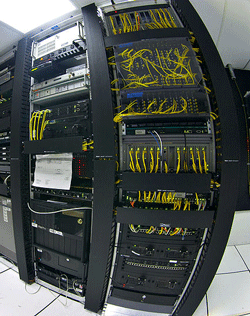
Note: Fisheye photo of data center courtesy of Wikimedia Commons


Follow Telexplainer on Twitter