 The abyss between WAN and LAN became established by they way they came into being. LAN networks are owned by individuals, businesses and organizations and are based on packet switching. At one time, there were competing topographies such as ring, star and buss. Now it’s all Ethernet on the LAN, with some specialized networks used for such things as disk storage. Most networks are based on twisted pair copper, fiber optic cable, or some combination of the two.
WAN standards grew out of the telephone industry, which has a monopoly on twisted pair telco lines used for both voice and data. Until recently fiber optic networks were also primarily owned by or at least developed to telephone company SONET/SDH standards.
Clearly, there was a technological disconnect between packet switched LAN technology and circuit switched WAN technology. That’s not so much the case anymore, but it is true that you need to do a protocol conversion to connect point to point or to the Internet using telco services such as T1 lines, DS3 bandwidth or OC3 fiber optic connections. Both the circuitry and software needed for WAN network interface are off the shelf items. You simply by a T1 interface card for your router if you want to plug in a T1 line.
What this means is that you can generally mix and match WAN network technologies as long as you have the proper interfaces. T1 line prices have plunged in recent years, making them the entry level WAN option of choice. A T1 line can be used to provide a dedicated broadband connection to the Internet or a direct point to point connection between two business locations. Some companies build customized WAN networks by connecting each branch office back to headquarters using T1 lines to form a star network. The router at headquarters manages traffic between all locations.
What’s new in WAN networking is the rise of Carrier Ethernet and MPLS networks. These are very compatible technologies and can be used together or separately. Carrier Ethernet is a native packet switched technology that avoids LAN/WAN interface issues. You can replace point to point T1 lines with Ethernet line services. Ethernet can also be used to provide a last mile connection to the Internet. Unlike T1, there is an Ethernet LAN service that can be used to connect multiple locations together in a mesh network. Ethernet LAN is a direct replacement for private WAN networks based on T1 lines or higher bandwidth services.
MPLS networks provide a many to many WAN networking solution. MPLS is a protocol that can transport nearly any other protocol in a cloud network. You see T1 lines being used for network access. Ethernet service is also used for last mile network access to the same MPLS networks.
What Carrier Ethernet and MPLS networks offer compared to their telco WAN predecessors is a cost savings and the ability to get out from having to manage the WAN yourself. You can treat Ethernet LAN or MPLS network services as a true cloud that provides the bandwidth, latency and class of service controls you need for converged network operations. Competitive carriers own their core networks completely independent of the telephone companies. In major metropolitan areas, they also provide fiber optic access connections at considerable cost savings over legacy solutions.
What are the best WAN network design options for your company? Why not compare several competing architectures and see which offers the best cost savings for the performance required? Check WAN network solution prices and availability now.

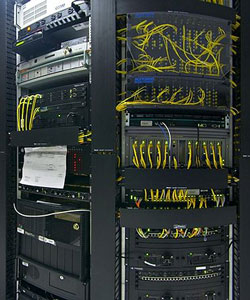
Note: Photo of telecom equipment racks courtesy of Wikimedia Commons.