Showing posts with label PBX phone system. Show all posts

Wednesday, August 17, 2011

Why NOT to Buy a New PBX

For decades, the standard answer to a failing business phone system or one that had run out of capacity was to install a new PBX in a process known as a “fork lift upgrade.” A new PBX is something like a new car. You get higher performance, greater reliability and more capacity. So now that you are in the market for a shiny new PBX or IP PBX, the best one to buy may be none at all.

Before you shell out for a new expensive PBX system, consider a hosted solution and pay by the month...What? You mean hang on to that old junker that’s almost impossible to keep running? No, not at all. Don’t go out and spend a thousand dollars or much more on yet another PBX box. Instead, look at a hosted PBX solution.

Hosted PBX, also called Hosted VoIP or PBX in the cloud, is a service rather than a product. You simply remove your old PBX and don’t put anything in its place.

Oh, then what do the phones plug into?

The phones will plug into your computer network. Nearly every company has a LAN with Ethernet jacks for each desk and office. You are used to having two separate networks in your company. One for the telephones and one for the computers. A hosted solution is based on a converged voice and data network, which is the Ethernet LAN that you have now. Larger companies have long ago converged their voice and data networks to take advantage of enterprise VoIP solutions. Small and medium size businesses can do the same. What’s important in a converged network is that voice packets have priority over data packets so that phone call quality is maintained regardless of the load on the network.

Clearly, you can’t just plug your old telephones into the LAN. The connectors are different sizes. That’s for good reason. Standard analog telephone equipment is completely incompatible with computer networking standards. There are two ways to resolve this. Either put network adaptors on each phone or replace the phones with newer IP phones that already have standard network interface cards built-in. You’ll probably want to use IP phones because they support more features over the network.

What do the phone lines connect to? There won’t be any outside lines connecting to your building like there are now. In other words, no analog business lines and no ISDN PRI. All the outside lines are connected to the hosted PBX at the service provider. You connect to that service provider using a line called a SIP Trunk. This can be a T1 line or Ethernet over Copper configured for SIP Trunking service.

I should mention that SIP Trunking can be setup to support your current analog telephones and wiring directly. In this case, the provider installs a piece of equipment called an IAD or Integrated Access Device. The IAD splits the SIP Trunk into telephone lines and broadband Internet service. In other words, it supports the two separate networks that you have now.

The whole reason you installed a PBX in the first place was to gain control of your internal calls and manage the sharing of multiple outside lines. The hosted PBX does the same thing from afar. Your internal calls stay on the network so that you don’t pay for office to office calls. Outside calls connect to the public telephone network at the cloud service provider.

A hosted PBX does some tricks that your old PBX doesn’t. You can have offices in many different cities all on the same phone system. You can also have local phone numbers in cities where you have customers but no physical office. Callers may dial a local number in Bangor, Maine and you’ll answer it in Phoenix, Arizona.

A major advantage of hosted telephone services is that you don’t have to come up with large amounts of capital to purchase a PBX system nor hire the staff to maintain it. That’s all handled for you by the service provider. They buy a much larger PBX system and have the staff available around the clock to maintain it and handle any problems that arise. You pay by the month for service, which often includes unlimited local and national calling plus a wealth of features to make office operations efficient. Some providers even include the IP phones in your service plan.

Are you getting ready for a telephone system upgrade? Don’t go out for a bank loan yet. Instead, get a quote for cloud hosted PBX telephone service and see if paying by the seat per month rather than making a big investment makes more sense for your business.


Click to check pricing and features or get support from a Telarus product specialist.


Follow Telexplainer on Twitter

Monday, January 3, 2011

Business VoIP Solution Options

You may be considering a move from a traditional analog or PBX business phone system to VoIP or Voice over Internet Protocol telephony. Before you jump into a major “forklift upgrade,” you should know that there are a number of good business VoIP solutions to consider. Which one you pick will depend on your particular situation. Pick the right one and you’ll get the most for your telephony dollar.

Compare costs and features of business VoIP solutions. Click to inquire.Why even consider VoIP in the first place? The reason is to save money, add calling features or both. Let’s start with the needs of very small businesses and work our way up to enterprise solutions.

The smaller businesses will have one to four outgoing phone lines and under 10 handsets. This is typical of small sales offices, retail stores and independent professionals. You may well be using individual analog phone lines and perhaps 2 or 4 line phones that you can buy at office supply stores.

A system this small doesn’t justify a PBX phone system or PRI digital trunking. But you do have the option to change to a broadband phone or SIP trunking solution. Broadband phone is typified by the Phone Power VoIP service. You connect a device called an ATA or Analog Telephone Adaptor to your broadband service, typically Cable Internet, and plug one or two telephones plus your computer or router into the ATA. You no longer need an analog telephone line because your broadband connection is used for both phone and Internet. A typical small office VoIP service plan costs $14.95 a month, but temporary special offers can make this even cheaper.

A step up from single phone number VoIP is called SIP trunking. This service uses a T1 line or other business grade private line to provide multiple line telephone service plus broadband to a small to medium size business. By using dynamic bandwidth management, phone calls have all the bandwidth they require for maximum call quality. Remaining bandwidth is assigned to Internet access. As calls hang up, the bandwidth they were using is automatically or dynamically reassigned for Internet service. This way the full capacity of the line is always put to good use.

Companies large enough to have an in-house key telephone or PBX system generally have many handsets and at least 6 to 10 outside lines. If your system is getting to the end of its useful life, you have the choice of replacing it with a newer IP PBX system or going with a hosted PBX solution. Hosted PBX means that you don’t have any PBX equipment in-house. Your service provider connects to SIP telephones or analog phones with adaptors on your LAN and performs both the internal and external call switching.

Enterprise VoIP telephony also consists of using SIP telephones in place of regular telephone handsets. These SIP phones allow you to converge your telephone and computer networks into a single LAN for both voice and data. You can choose to host an IP PBX system in-house or elect to go with a hosted PBX solution. The tradeoff is capital equipment cost and online maintenance versus paying a monthly fee to a service provider. Think of hosted PBX as a cloud service for business telephony. Even if you install and operate your own IP PBX system, you still have the option to use SIP trunking to connect with a service provider that will terminate outside calls to the public telephone system. The more traditional solution is to use ISDN PRI telephone trunks for the same purpose.

Which VoIP solution, if any, make the most sense for your organization? There are a lot of variables involved and many suppliers. Why not let an experienced Telarus telecom consultant help you compare costs and features of business VoIP solutions? Then make an informed decision to get the most for your telecom budget.

Click to check pricing and features or get support from a Telarus product specialist.


Follow Telexplainer on Twitter

Wednesday, December 8, 2010

What Leased Line Service Providers Offer

Most businesses get their telecommunication services from leased line service providers. That includes telephone, Internet, and point to point line services. You probably have some of these contracts yourself. But do you know about the cost reductions and all of the new services that have become available recently?

WirelineThe nature of telecommunications services has changed dramatically in recent years. The two biggest changes are cost savings that come from a flurry of new competitive service providers and the introduction of new technologies that offer additional services.

You can still get most of the telecom services that were available a decade or so ago. The most popular line service is T-carrier, especially the T1 line. T1 is a telephone company technology and comes in several flavors. The original use was a digital trunk to carry multiple phone calls between telco switching centers or into a multi-line business phone system. An upgraded version of the T1 telephone line is called T1 PRI or ISDN PRI. It gives you up to 23 outside phone lines plus a data channel for dialing, switching and Caller ID. Nearly every PBX phone system and many key telephone systems can be easily configured to use T1 PRI.

Another use for T1 lines is to provide point to point connectivity between two business locations. A point to point T1 line offers 1.5 Mbps in both directions simultaneously. If you need more bandwidth than this, you can get bonded T1 service that combines multiple T1 lines up to about 10 or 12 Mbps total.

A related service is the T1 access line. This is a last mile connection to a larger network. At one time, the larger network was called Frame Relay. Nowadays, MPLS networks have taken over this role of connecting business locations on a regional, national or international basis. MPLS networks have the advantages of nearly unlimited bandwidth that can transport just about any voice, data or video protocol.

T1 Dedicated Internet Access (DIA) is the choice for broadband Internet access for many smaller businesses. The cost is only a fraction of what it was a decade ago. As a professional grade telecom service, you enjoy a reliability and constant bandwidth not typical of consumer oriented services like DSL and Cable.

The new competition to T1 lines is coming from Carrier Ethernet services, including Metro Ethernet. Like T1, Ethernet is a wireline service. Also like T1, it is delivered on multiple twisted pair copper wiring for lower bandwidth services. That copper wiring is generally already installed for multi-line telephone service. Ethernet offers the same point to point and Internet connections you may be using with T1 lines now. But Ethernet can also give you layer 2 switched network service between several or more locations around town or over a wider area, including overseas offices.

Ethernet is gradually taking over from T1 in metropolitan areas where it is most available. A popular service is 3 Mbps Ethernet for about the same price as a 1.5 Mbps T1 line. For more demanding uses, 10 Mbps Ethernet is becoming a popular standard.

Once you get into the higher bandwidths, 45 Mbps and above, fiber optic cabling takes the place of twisted pair copper. DS3 is the T-carrier upgrade to T1. It is now delivered over SONET fiber optic services at 45 Mbps. The Ethernet equivalent is 50 Mbps Ethernet service, although Fast Ethernet at 100 Mbps is an industry standard and the speed of many local networks. Like copper-based Ethernet services Ethernet over Fiber tends to offer much lower costs per Mbps than equivalent traditional SONET telecom services.

You should also know that both T1 and Ethernet services have an option to get both telephone and Internet over the same line. Integrated T1 is the legacy wireline service. SIP trunking is the IP service that gives you VoIP telephony and broadband Internet access.

Have you been wondering if you are paying too much for the wireline services you’ve just kept renewing over the years? Find out by getting up to date quotes for both Ethernet and T1 or SONET wireline services from dozens of competitive service providers. The range of services and their current costs may astound you.

Click to check pricing and features or get support from a Telarus product specialist.


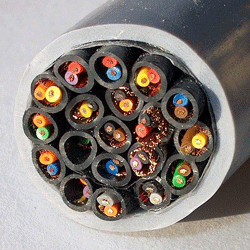
Note: Photo of multipair cable courtesy of Wikimedia Commons


Follow Telexplainer on Twitter