Showing posts with label OC12. Show all posts

Thursday, December 8, 2011

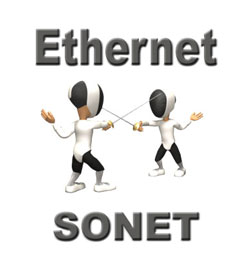
600 Mbps Ethernet vs OC12 SONET

Organizations requiring fractional Gbps bandwidth have traditionally turned to OC12 SONET fiber optic service. It’s still an excellent high speed option, but you should also take a look at 600 Mbps Ethernet service. You may be surprised how the two competing connections compare.

Compare 600 Mbps Ethenret over Fiber with SONET OC12 for cost and availability...OC-12 (622 Mbps) is the next step up from OC-3 (155 Mbps) in the SONET optical carrier hierarchy. You’ll find this service readily available in Metropolitan Area Networks (MAN) and as a dedicated Internet access connection for mid-size Internet service providers. Large organizations also have OC12 bandwidth connections, especially those with thousands of employees on-site or a need to support high bandwidth applications like medical image transmission or video production and distribution.

Not too many years ago, OC12 was considered a good choice for a carrier fiber optic core network. Now, most regional and national carriers have moved up to OC-48 at 2.5 Gbps or OC-192 at 10 Gbps. Long haul and undersea fiber lines are running at OC-768 (40 Gbps) and moving quickly to support 100 Gbps.

OC12 is most often deployed on a protected SONET ring topology, with two counter-rotating fiber rings. If something in one ring fails, either equipment or a cable break, the other ring will pick up 100% of the traffic within 50 mSec.

Note that an OC12 service is probably not the only traffic on a particular fiber strand. At 622 Mbps, OC12 comes nowhere near using available bandwidth of the fiber. SONET is designed as a Time Division Multiplexed (TDM) system that can easily add or drop common OC service levels such as OC3 and OC12. In addition to the electrically multiplexed services on the fiber, each fiber may also be optically multiplexed into a dozen or more wavelengths using Dense Wavelength Division Multiplexing (DWDM) equipment.

Carrier Ethernet over fiber is based on packet switching rather than time division multiplexing. Without the strict synchronized channels of TDM, Ethernet is far more scalable. You can order 600 Mbps Ethernet as a replacement for OC12 SONET. You can also order 500 Mbps if that is all you reasonably need. Even more importantly, you can start increasing bandwidth to 700 Mbps, 800 Mbps, 900 Mbps and 1 Gbps as business requirements dictate.

With SONET, the service provider will install a managed router as Customer Premises Equipment (CPE) that includes an interface module specifically designed for the particular OC service level you have installed. The modules for OC3, OC12, and OC48 will plug into the same port on the router, but they are not interchangeable. You need to match the particular interface to the OC service level. That becomes important when you want to implement a service change. The provider will need to roll a truck to either swap out interface modules or completely replace the CPE router.

With Carrier Ethernet, your service provider will install a managed router that can support a particular port speed. For Ethernet over Copper, this is likely 100 Mbps. For fiber, you are likely looking at 1 Gbps, although you can often get equipment rated to 10 Gbps if you expect to be upgrading to that speed level in the foreseeable future. With a 1 Gbps port, you can order whatever service level you need between, say, 100 Mbps and 1 Gbps, in 100 Mbps or smaller increments. No equipment changes are needed as you change service levels within that range. You simply call your provider and tell them to increase bandwidth and you’ll see it happen within a few days, sometimes within a few hours.

Beyond scalability, Ethernet has a cost advantage over SONET in most situations. Sometimes the cost difference is dramatic, even half the cost, for Ethernet versus SONET of the same bandwidth. The one limitation that you’ll run into is that SONET has been around a lot longer and is more available than Ethernet over Fiber. Even so, competitive carriers have been aggressively building out their IP networks and may have fiber service closer than you think.

Do you require fractional Gigabit bandwidth services? If so, it is worth your while to compare 600 Mbps Ethernet to OC12 SONET for cost and availability. The same advice is true for other service levels from T1 copper bandwidth on up to 10 Gbps and higher.


Click to check pricing and features or get support from a Telarus product specialist.


Follow Telexplainer on Twitter

Thursday, February 3, 2011

WDM Wavelength Services Offer Expandability

If your need is for high bandwidth, security and flexibility, you should take a look at wavelength services. This is more than the typical fiber optic bandwidth service. It’s almost like owning the network facilities yourself.

Wavelength division multiplexing gives you multiple color beams on a single fiber optic strand. Click for pricing and availability.The thing about fiber optic transmission is that it offers almost limitless bandwidth. That’s a foreign concept to anyone who’s been tied to copper wireline services. It’s also an odd notion for those who pick a fiber optic service level and sign a contract for it. If you order OC3 SONET service, what you get is a line that runs at 155.52 Mbps with a payload of 148.608 Mbps. You don’t have to fill the pipe continuously, but the capacity is there all the time. If you need more bandwidth, you only recourse is to add an additional service or upgrade to something like OC12 or Gigabit Ethernet.

What you are using with fiber optic services is not the entire bandwidth of the fiber. In fact, you may be totally unaware that your signals are multiplexed with lots of others all traveling on the same fiber strand. If there is only one laser beam with a single color or wavelength shining through that fiber, it likely has a capacity of at least 10 Gbps. Chances are, though, that there are many different color beams all riding simultaneously down the fiber. They don’t interfere because they are different colors of light, called Lambdas, all in the infrared region of the spectrum. Each Lambda or wavelength has a carrying capacity as high as 10 Gbps. You can think of these as equivalent to individual high capacity lines. If the fiber optic strand were made of copper, each wavelength would be a separate pair of wires.

What if you could lease a wavelength instead of a copper wireline or a fixed bandwidth service on a fiber optic cable? The wavelength doesn’t care what modulation or data pattern you use. It’s just a pure light beam of one wavelength. There’s no fancy footwork required to convert between one protocol and another just to be compatible with what’s running on the line. That opens some interesting possibilities. You could use your leased wavelength to carry Gigabit Ethernet or Fast Ethernet, SONET OC3, OC12 or OC48, Fibre Channel, or ESCON.

Need to transport a variety of high bandwidth protocols? OK. Just lease multiple wavelengths and give each protocol its own Lambda. The won’t interfere. In fact, they won’t even known the other wavelengths exist.

This type of network transport is no longer a pipe dream. All you need to do is lease WDM Wavelength Services from a fiber optic network carrier such as AboveNet. What AboveNet has done is install a base of dark fiber in many metropolitan areas. It’s called dark because it hasn’t already be put into service with a particular fiber optic service in mind. It’s like a blank canvas ready to become any work of art. AboveNet “lights” the fiber as needed using WDM equipment to create their wavelength services.

WDM stands for Wavelength Division Multiplexing. It’s the technology that creates multiple wavelengths on a single fiber strand. This is a standardized process that ensures there is enough separation between the wavelengths that they won’t interfere and that different brands of networking equipment will work together. There are two flavors of WDM: CWDM or Coarse Wavelength Division Multiplexing and DWDM or Dense Wavelength Division Multiplexing. The difference is that DWDM squeezes more wavelengths, up to 160, onto a given fiber but at a higher cost than CWDM.

Is this affordable? AboveNet says that their CWDM service becomes competitive at the OC-3 service bit-rate. If you can use more bandwidth than that, you’ll save money with CWDM. Typical applications include connecting corporate headquarters with branch offices and data centers, or connecting multiple hospitals and medical centers for exchange of medical images and other health service records.

Has your business or organization become limited by the network services available? Perhaps it’s time to move up to wavelength services. Find out by getting prices and availability of fiber optic wavelength services for your locations. Complementary consulting by bandwidth experts is also available for serious applications.

Click to check pricing and features or get support from a Telarus product specialist.


Note: Image of light spectrum from prisms courtesy of Marcellus Wallace on Wikimedia Commons.


Follow Telexplainer on Twitter

Wednesday, June 23, 2010

USA Digital Offers Comprehensive Call Center Services

Call centers and company contact centers have special requirements for the high volume telephony services they use. USA Digital serves this market with a suite of high performance cost effective telecom services.

Find cost savings on call center telecom services. Click to find.USA Digital Communications Inc., often called USA Digital for short, is a licensed, certified carrier in all 50 states. Since founding in 1991, their business has been known for rapid growth and customer retention. Wouldn’t a lot of companies like to claim that? The secret to USA Digital’s success may be summed up as excellent customer service combined with an extensive range of services to support both voice and data needs.

Call center operations are a special focus for USA Digital. It starts with digital line services from T1 through OC12. T1 is a popular service and provided by many carriers. However, not all of those T1 services are optimized for cost on high volume calling. For instance, USA Digital offers initial six second billing minimum. That’s typical in the industry. But then USA Digital billing switches to one second increments. That alone can save you 30% in the cost of the minutes you use.

Another big saver is 4 digit versus 2 digit rounding. Those decimal points might seem arcane, but in high volume calling minor fractions of a second add up to big money. That’s especially true if 4 digital rounding is combined with low dedicated interstate rates on T1 service.

USA Digital has a service team experienced in provisioning voice lines, PRI’s, CO meet-point circuits, cross connects and SS7 links. That same experience is applied as you move up the circuit class to DS3 (T3) trunks and into the fiber optic services from OC3 to OC12. These OCx connections are truly business carrier class services needed by the largest call center operations and requiring the highest levels of expertise for support. An OC3 gives you the capacity of about 3 DS3’s and OC12 is the bandwidth of 4 OC3’s or 12 DS3’s. USA Digital can deliver OC3s in the form of 3 DS3’s that may be separated into individual T1 services.

In addition to bandwidth, dedicated outbound services are a specialty of USA Digital. They offer FTC telemarketing sale rule and do not call services to make sure you are in compliance with government regulations for outbound call centers. Their do not call services are capable of blocking 100% of calls registered to both state and national do-not-call lists. In addition, USA Digital provides customized Caller ID Service so that you can communicate appropriate caller information over your service lines.

USA Digital’s services are appropriate for in-house customer service contact centers up through major independent call centers and carriers, including ILEC, CLEC and wireless. Beyond traditional switched circuit voice trunks, they also support VoIP (SIP, H3223), point to point dedicated lines, and MPLS networks for linking multiple business locations.

Can you benefit from business telecom services like these? If so, you’ll want to get customized telecom service pricing and consultation for USA Digital and other competitive service providers as soon as possible. You could be looking a major cost savings.

Click to check pricing and features or get support from a Telarus product specialist.


Follow Telexplainer on Twitter

Monday, June 21, 2010

Fiber Ethernet WAN Bandwidth Advantages

Large businesses and other larger organizations generally require more bandwidth than is available through T1 lines or other broadband services that can be provisioned over copper twisted pair. Fiber optic connections can provide nearly unlimited bandwidth, but what is the most cost effective service?

Check Fiber Ethernet prices and availability. Fast service on fast Etherent services.If you are a current user of fiber optic bandwidth, you are probably leasing a SONET/SDH service such as OC3, OC12, or OC48 for your wide area networking needs. These are traditional telecom services that were originally developed for the telephone companies to carry large numbers of telephone calls. They are circuit switched channelized networks that have been adapted to transport today’s demand for high data bandwidth connections.

A newer service that is offering serious competition to the legacy telco services is Ethernet over Fiber or EoF. It’s a packet-switched network that transports Ethernet at the layer 2 switching or layer 3 routing level. Within metropolitan areas, this service is known as Metro Ethernet. Over long distances, it is called Carrier Ethernet or Long Haul Ethernet. Just about all bandwidths are available, but generally you’ll find fiber Ethernet being used to carry 100 Mbps Fast Ethernet, 1 Gbps Gigabit Ethernet, 10 Gbps 10 GigE. Even high bandwidths, including 40 Gbps and 100 Gbps, are used for carrier backbone networks.

One advantage of fiber Ethernet is that it is scalable. You may start out with 100 Mbps service but quickly find out that you need more bandwidth. With traditional SONET services, there can be long delays in upgrading your service to the next level. There may also be a big jump in bandwidth and cost to get to that next level. OC3 gives you 155 Mbps. But OC12, the next readily available increment, runs at 622 Mbps.

Fiber optic Ethernet can easily scale up to the limit of the installed port. For instance, if you have a port that is capable of 1,000 Mbps, you don’t necessarily have to buy that much bandwidth. It’s common to order a fraction of the port’s capability, say 100 Mbps and then upgrade to 200 Mbps when demand justifies such a move. Often this can be done with only a phone call to your Ethernet service provider. Only when your demand exceed the 1,000 Mbps capacity of the port will new equipment need to be installed.

Perhaps the biggest advantage of fiber Ethernet services is cost savings. In additional to the traditional telephone companies, there are numerous competitive carriers that have their own regional or nationwide fiber optic networks and points of presence. These carriers can build-out a fiber connection to your building. It may not be that expensive if you can guarantee a high enough bandwidth level to justify the construction. You’ll find the monthly lease rate attractive, too. They are often only a fraction of what you’d pay for equivalent OCx services.

How can you determine if fiber Ethernet services are the best option for your business or organizational needs? You can get a quick answer with multiple vendor quotes and recommendations now using the Fiber Ethernet Services Inquiry form that you’ll find at Ether Rabbit. It’s fast service on fast Ethernet services.

Click to check pricing and features or get support from a Telarus product specialist.


Follow Telexplainer on Twitter

Sunday, April 4, 2010

Fiber Optic ISP

Not so long ago, Internet service came through the telephone as a collection of audible beeps and squeaks. That evolved into dedicated landline and wireless broadband. The next step has already been taken by the largest companies. Now, medium size businesses are also looking for a fiber optic Internet service provider.

Fiber optic Internet service for residential users is the domain of Verizon’s FiOS. Google will soon enter the market on a test basis with a new benchmark of performance: 1 Gbps. But business broadband connections have moved past the Gbps upper limit, with 10 Gbps service becoming more common for major organizations. The technology is proven. The question is how much bandwidth do you need and where do you need it?

The key to fiber optic levels of telecom service is the “lit” building. That’s a location where fiber optic cable has been pulled into the facility and connected to terminal equipment. Once the fiber is lit by a service provider, the building is considered to be “on net” and able to select from a wide variety of service options. This facility can also be a jumping off point to provide fiber optic service to other nearby buildings. The most expensive and time consuming aspect of fiber optic service is the initial fiber construction.

What types of fiber optic bandwidth services are available? They typically fall into two categories. The first is traditional SONET / SDH telecom services. These are the original telco standards for voice and data over fiber optic strands. The most basic service is OC-3 or Optical Carrier, level 3. This is a 155 Mbps bandwidth service based on the same TDM or Time Division Multiplexing technology as copper based T1 and T3 lines. In fact, DS3 bandwidth at 45 Mbps is most often delivered as part of an OC-3 signal that can transport 3 of these DS3 services.

The SONET standard fiber optic services include OC-12 at 622 Mbps, OC-48 at 2.5 Gbps, OC-192 at 10 Gbps and OC-768 at 40 Gbps. This highest levels are most often used by carriers, themselves, as their backbone networks.

The other category of fiber optic service is Carrier Ethernet or Metro Ethernet. Ethernet services are standardized at the same levels seen in LAN networks. These are 10 Mbps standard Ethernet, 100 Mbps Fast Ethernet, 1000 Mbps GigE, and 10 Gbps or 10 GigE service. Intermediate service levels are generally available, as Ethernet is readily scalable.

How do you decide between SONET and Ethernet Internet connections? Both are reliable, proven technologies that can deliver the bandwidth you desire. What often differs is availability and price. The best approach is to get a complete selection of fiber optic service quotes from a telecom broker and compare pricing on the services available for your business location. You may be surprised at how affordable the higher bandwidths have become.

Click to check pricing and features or get support from a Telarus product specialist.


Follow Telexplainer on Twitter