Showing posts with label GSM. Show all posts

Monday, July 25, 2011

4G Wireless Broadband Options

Wireless broadband is on an upward path to take over many of the applications that have long been the domain of wireline technologies. Wireless has the convenience of portability and mobility. What’s held back deployment and more powerful applications is the limited availability and speed of wireless connections. The move to 4G wireless looks to be a potential solution.

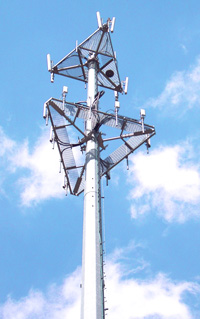
Wireless towers deliver 3G and 4G broadband for mobile and fixed applications...4G or fourth generation wireless doesn’t have a strict definition, but it is roughly stated as the bandwidth typical of Cable broadband or Ethernet over Copper business connections. With this level of transmission speed and a city-wide reach, 4G wireless can take over service for desktop as well as mobile devices.

One might throw WiFi into the 4G category. The bandwidth for a, b, g, and n WiFi technologies fall into the right bandwidth category. However, WiFi is a short distance system. It works well within and nearby particular locations, such as homes, offices, restaurants, hotels, airports and even park benches. But you can’t get in your car and drive away with a WiFi connection. It will disappear as soon as you leave the parking lot. In a way, WiFi is more of a PAN or Personal Area Network like Bluetooth.

The higher power wireless technologies, including 2G & 3G are associated with cellular phone service. These are based on using networks of fixed transmitters and receivers arranged as cells with signals that fill-in the coverage between towers. The trick of turning this system into a metropolitan or wide area network is to coordinate the handoff of an existing wireless connection as the user moves from cell to cell.

The most popular wireless technology right now is 3G. It offers bandwidths similar to T1 lines and basic DSL of around 1.5 Mbps on average in metropolitan areas. You may get two or more times this speed if you happen to be near a tower with few users. This is more than adequate for many mobile uses, such as Web browsing, email and viewing video clips on smartphone screens.

Beyond limited speed, 3G also suffers from limited bandwidth availability. It shares channels with cellular telephone on the same towers. Those channels were originally sized to support expected voice traffic. They’ve been overwhelmed by the higher bandwidth requirements of Internet data traffic. That’s why carriers are so insistent on bandwidth caps.

There are a couple of different approaches to 4G wireless. The one taken by the cell phone companies is to view 4G as an upgrade to their 3G systems. There are two differing cellular system that co-exist. One is a US-centric system called CDMA that is used by Verizon, Sprint and others. The other is a more global standard called GSM that is used by AT&T and T-Mobile.

Right now, AT&T and T-Mobile have upgraded their 3G networks to a faster version of the same thing called HSPA+ that delivers up to 6 to 8 Mbps. Verizon has moved to a 4G technology called LTE that offers downloads of 5 to 12 Mbps. Sprint has gone with another 4G technology called WiMAX that delivers downloads in the 3 to 6 Mbps speed range.

As wireless continues to evolve, 4G is expected to move into two camps. LTE is the technology most discussed as a truly universal standard. WiMAX deployment actually predated LTE and has installations worldwide. Both LTE and WiMAX have technical upgrade paths that can boost download speeds to over 100 Mbps and even 1000 Mbps. This is competitive with many fiber services and ensures that 4G wireless will be with us for a long time.

One thing we’re also seeing with 4G wireless is the use of lower frequency bands that can more easily penetrate buildings. These bands came from the re-deployment of those channels from UHF TV as part of a federal auction. Clear offers 4G fixed and mobile wireless service with a telephone option over WiMAX in over 80 cities nationwide. Right now, this service offers unlimited broadband service.



Follow Telexplainer on Twitter

Friday, May 13, 2011

DROID 2 Global is a World Phone

What would you call a smartphone with a 1.2 GHz processor that can make and receive calls from over 200 countries? You’d call it the DROID 2 Global.

DROID 2 Global for Verizon. Click for discount pricing.Just a second. This is a phone for Verizon and yet it works worldwide? How to they do that?

Verizon has excellent coverage in the United States and is the preferred carrier for tens of millions of users. The one little hiccup is that most of the world operates on the GSM standard and Verizon works on CDMA. It’s pretty much a VHS/Betamax argument. The two standards are mutually incompatible. So how does a Verizon phone work overseas?

Ah, the trick is to make it two phones in one. The Motorola DROID 2 has built in support for multiple networks. It covers WCDMA 850/1900/2100, CDMA 800/1900, GSM 850/900/1800/1900, HSDPA 10.2 Mbps (Category 9/10), CDMA EV-DO Release A, EDGE Class 12, GPRS Class 12, and HSUPA 1.8 Mbps. That’s pretty much everything you can use for telephone calls, Internet access and messaging.

Your DROID 2 comes with CDMA international roaming, but you’ll need to activate a pre-installed SIM card and a Global Service plan or feature to enable roaming outside of the US when using GSM and UTMS networks. You’ll want a global data plan so you can message and access the Web in those 200 countries, with 3G speeds in 125 countries. Why, it’s all the comfort of home!

Oh, by the way. The GSM feature doesn’t work on AT&T or T-Mobile networks here in the States. Verizon isn’t about to have any part of that.

Multiple network access may be the future of cell phones, at least in the near term. The idea of multiple incompatible networks is an idea who’s time has come and gone. Technology has advanced to the point where you can have both CDMA and GSM access designed into the same device. Look for this idea to spread to tablets and other 3G/4G devices.

The way things are going, it looks like most 4G wireless data networks are going to be LTE in a few years. Yet, WiMAX is enjoying popularity too. Next we need LTE/WiMAX dual-mode transceivers for smartphones and computing devices.

What other tricks does the DROID 2 Global have up its sleeve? A slide-out QWERTY keyboard for one. That makes high speed messaging and email a lot easier. The camera is a 5 Megapixel model with a dual LED flash and DVD-D1 video capture.

You also have the ability to make your DROID 2 Global a 3G mobile hotspot so you can share your data connection with up to 5 other devices.

This is truly a breakthrough smartphone design with a lot of advanced features for the Android user. Did you catch the 1.2 GHz processor? That should make your apps scream!

Are you interested in owning a cutting-edge phone with international capability? If so, learn more and order your Motorola DROID 2 Global for Verizon Wireless now. You can also browse the extensive selection of Android and other smartphones and feature phones, all at significant discounts and some even free.


Follow Telexplainer on Twitter

Thursday, October 7, 2010

T-Mobile G2 With Google is 4G

T-Mobile has upped the ante on smartphone performance with the introduction of the G2. The “G” in G2 stands for Google. That means integrated access to Google Voice, which can automatically transcribe voice mails to text so you can read them like an email or text message.

T-Mobile G2 Android phoneThe G2 is also an Android phone, running Android 2.2. It has a 3.7 inch full touch screen with 7 customizable home panels. You can download thousands of apps and widgets from the Android Market to customize your smartphone. It’s just one click away.

Here are some more interesting features about the T-Mobile G2. Unlike a certain other smartphone that will remain nameless (think: it keeps the doctor away), the G2 is enabled with an Adobe Flash Player. It also comes with a slide out full QWERTY keyboard that opens and closes using unique “z-hindge”. That means real keys for fast and sure text entry rather than tapping on the glass to write your messages.

But what about the 4G? Is that WiMAX or LTE? Neither one. T-Mobile is leapfrogging the other 4G players by rolling out HSPA+ (High Speed Packet Access). It’s a GSM technology that has been evolving for years rather than something completely new. As such, T-Mobile expects to have it available in 100 major markets serving 200 million people by the end of the year.

But is it fast? It screams. Theoretical peak download speeds are up to 21 Mbps, with peak upload speeds up to 5.7 Mbps. In actual service, you probably won’t see that much bandwidth, perhaps a third of those peak values, but it is enough of an advance from 3G to deserve the 4G designation.

What else does the T-Mobile G2 have that’s eye-opening? The digital camera is a 5.0 Megapixel model that includes auto-focus and HD video capability. You can record HD videos in 720 resolution. Send and receive picture and video messages using multimedia messaging. Or, stay with SMS text messaging, IM, or email, as your fingers fly on that QWERTY keyboard.

There are, of course, the usual multimedia niceties that we’ve come to expect in smartphones. The MP3 player supports MP3, AAC, eAAC+, WMA, MPEG4, WAV and MIDI formats. There’s an FM radio on-board in case you tire of your tunes collection or want to catch the latest news and sports scores. Social networks are easily accessible. You can get to Twitter, Facebook and MySpace quickly. After all, quick is the name of the game in social networking. If you must work, then you’ll have attachment viewing of Word, Excel and PowerPoint files with Word and Excel editing possible with apps from the Android Market.

Is G2 the one for you? If so, learn more and order your T-Mobile G2 Android phone with service at a terrific online discount.

Of course, you can shop to your heart’s content for Android and other smartphones plus standard cell phone models. They’re all available discounted or even free at Cell Phone Plans Finder now.


Follow Telexplainer on Twitter

Thursday, September 30, 2010

Xperience the Sony Ericsson Xperia X10

The Xperia X10 could be the smartphone experience you’ve been wanting. Consider the 8.1 Megapixel digital camera and 4 inch touchscreen. Do you really need to be carrying another camera? Do you?

Sony Ericsson Xperia X10. Check discount now.Before you answer, note that the Xperia camera has flash, 16x zoom, touch focus, geo-tagging, smile detection and a send to Web feature. Optimize for landscape, portrait, night shooting, beach scenes and more. You can edit your photos right in the phone using apps from the Android Market. Capture video wherever you happen to be and share it with whomever you please via multimedia messaging. Here’s something else unique. The face detection software recognizes up to 5 faces in a photo and stores them in your contacts.

Yes, this is an Android smartphone. It runs version 1.6 of the Google Android operating system on a 1 GHz Qualcomm Snapdragon processor. Combine that processing power with AT&T’s 3G/UMTS HSPA network and download at up to 7.2 Mbps. You can choose to connect to personal and corporate WiFi networks and have free access to AT&T hotspots nationwide.

This is also a world phone running on the GSM bands. You’ll be compatible with nearly every cellular tower worldwide on the 800, 850, 1800 and 1900 voice bands and the UMTS/HSPA 800, 850, 1900 and 2100 data bands. This phone is already a success overseas and now available for users in the US.

The Xperia X10 has been designed with social networking in mind. Sony Ericsson Timescape puts all of your status updates from your social networking sites in one place. The equally impressive Mediascape brings all of your music, videos and photos together. You can surf the Web, check email and chat using instant messaging with the full HTML browser. Enjoy streaming multimedia with real-time video streaming support for YouTube and AT&T Radio.

Could this be the new smartphone you’ve been waiting for? If so, you can get it at a terrific online discount right now. Learn more and order your Sony Ericsson Xperia X10 for AT&T.

Of course, there are many more smartphones you can choose from, including a number of Android models. All are available at deep discounts, with many free. Check out today’s specials at Cell Phone Plans Finder.


Follow Telexplainer on Twitter

Thursday, September 2, 2010

BlackBerry Torch Fires Up Mobile Business

Like the torch that heralds the start of a new Olympics, the blackBerry Torch heralds the introduction of a new approach to mobile business communications.

BlackBerry Torch 9800 for AT&T. Click for more info.The two big changes you see in this smartphone are the combination of touch screen and slide-out QWERTY keyboard, plus introduction of the new BlackBerry 6 operating system. Some of BlackBerry’s claims for the new OS are the ability to see all your social and RSS feeds in one place, faster Web browsing with multiple pages open, universal search for everything on your BlackBerry smartphone, improved multimedia with a build-in YouTube app, simple setup and personalizing, an intuitive fluid design.

If it sounds like BlackBerry has gone social, it has. This simply reflects the fact that social networking is now an important element in business, especially customer service and new customer acquisition. Of course you want easy and fast access to Twitter, FaceBook, YouTube, Linkedin and your other social networks. You need those interactions on an impromptu if not continuous basis.

Other key features of the BlackBerry Torch 9800 for AT&T include the impressive 5 Megapixel digital camera with flash, continuous auto-focus, digital zoom, face detection integrated GPS location tagging and video capture. The GPS services support also works for location-based services like AT&T Navigator.

The full touch screen features a full HTML Web browser with pinch-to-soom and tabbed browsing. You’ll be able to access email, read important documents or surf the Web while you are on a call, thanks to the AT&T network that has this multitasking ability enabled. Others don’t. You’ll be able to download view Microsoft Word, Excel and Powerpoint documents on the go. The next generation messaging capability allows you to send group messages and maps. Visual voicemail lets you listen to your voicemail messages in any order and easily manage your inbox without calling in.

By the way, this is not just a BlackBerry device but a 220 country world phone as well. It is compatible with the GSM 850,900,1800 and 1900 bands and UTMS 800, 850, 1900 and 2100 bands. That pretty much covers the globe. You’ll have 3G data speeds where available and WiFi that autoconnects at AT&T HotSpots. Don’t worry about running out of storage for everything you carry with you on your BlackBerry. The Torch lets you expand up to 36 GB using a microSD memory card.

Are you a BlackBerry user that’s ready to move up to the latest technology? Or have you been eyeing BlackBerry devices with envy? Here’s your chance to get a leg up on your colleagues at a tremendous online discount. Learn more and order your BlackBerry Torch 9800 for AT&T now.

Of course, you’ll also find excellent deals on free and heavily discounted smartphones at Cell Phone Plans Finder. Be sure to check the today’s special deals.


Follow Telexplainer on Twitter

Thursday, July 22, 2010

HTC Aria Social Networking Smartphone

Need a friend on the cellular networks? Don’t get a dog. Get FriendStream. It let’s you stay in touch over Facebook, Twitter and Flickr. You’ll be connecting with the HTC Aria, one of the newest and hottest Android smartphones.

HTC Aria Smartphone for AT&TIt starts with a single block of jet black aluminum that forms the smooth and seamless case of the Aria. Small enough to fit in your shirt pocket. Powerful enough to use for both business and personal needs. Its large 3.2 inch touchscreen features pinch-to-zoom, which automatically reflows text for easy reading as you zoom in and out of websites.

Yes, this is an Android smartphone. It runs Google’s Android 2.1 operating system and HTC Sense user interface. You can create and save multiple customized home screen layouts. You’ll be able to access thousands of apps and widgets on the Android Market. The Aria comes to you preloaded with Google Maps, Gmail, Google Talk, search and YouTube video access. Being on the AT&T 3G network, you’ll be able to surf and talk at the same time. That’s not true on all cellular networks.

The HTC Aria is set-up for messaging. The Email client accesses and syncs your corporate Email, Push Gmail and POP/IMAP regular email accounts. Or use your Web-based email account. There’s an HTML Web browser that gives you PC-like viewing and navigating of the Web with pinch and zoom capability. Multimedia messaging lets you send and receive picture and video messages. You’ll take some nice ones with the built-in 5 Megapixel autofocus digital camera that doubles as a camcorder.

The Aria is loaded with connectivity. It works on the worldwide GSM standard networks at 850, 900, 1800 and 1900 MHz. It also supports UMTS on 850 and 1900 MHz. You’ll be downloading at 3G speed over the AT&T HSDPA network. Want even more speed or to save your data plan? Use the WiFI capability with AT&T HotSpot support.

Mind you, this is a small phone that weighs-in at just 3.9 ounces. Dimensions are 4.1 x 2.3 x 0.5 inches. Yet it sports 384 MB of RAM and expandable to 32 GB using plug-in microSD memory cards.

Like Music? you can stream stereo music to and from A2DP compatible Bluetooth devices. The MP3 player supports AAC, MP3 and WAV formats. It’s also a high performance streaming multimedia phone. Watch full length TV shows with AT&T Mobile TV and stream music and videos.

Does this sound like the kind of high performance phone you’ve been looking for but not sure you can afford? Relax. You can get the HTC Aria for AT&T for FREE when you order it with new cellular service online.

Of course, there are many more free and low cost cell phones available to you right now. Check out the current specials and see what meets your needs. You’ll probably have a hard time picking just one.


Follow Telexplainer on Twitter