Travelling to a country in Winter on holiday is not exactly my idea of an ideal holiday. I prefer to travel light and dress light - no fuss about winter clothing or extra extra layers. Plus, who doesn't like some sunshine..
Beijing is one of my top destinations to visit in China but it won't be a Winter visit, mind you. Nowadays, there is no shortage of travel agencies selling packages for china tours. The other day, I was going through some sites for guided Beijing tours and was pleasantly surprised to find so many choices and packaged tours with varied destinations. I wonder what is the best time to travel to Beijing.
Italy is another country topping my travel list. I have no doubt should I start checking out on italy tours, there will be lots of choices. Watching Astro's TLC is a delight especially when they show Venice and Vatican City. They just showed one last night. Did you know that policemen in Rome are wearing uniform designed by Giorgio Armani? How cool is that! Italy is indeed the fashion capital of the world!
If you like history and art, Europe is a fabulous place to visit. Escorted tours are aplenty. You would be spoilt for choice for europe tours. I stumbled upon a travel site online that offers not only tours to Europe, but to other interesting parts of the world including Panama, the Land between the Seas, as it is called. Collette Vacations is offering some great discounts currently, so if you are looking for a good travel deal, Collette Vacations is where you could pick up some great savings and they do have lots of discounted packages and special offers, left, right and center. Check them out. You won't regret it.
Showing posts with label Europe. Show all posts
Sunday, May 29, 2011
Sunday, January 30, 2011
DIA and VPN For Europe
Level 3 Communications, a Tier 1 Internet networking services company with a global fiber optic footprint, is bringing its Dedicated Internet Access (DIA) and Virtual Private Network (VPN) services portfolio to European markets, including France, Germany and the United Kingdom. As the worldwide business climate improves, international connectivity will become more and more important for business success in a global marketplace.
Major multinational corporations and larger Internet Service Providers may operate their own Autonomous System (AS) networks that give them the ability to peer with other networks and purchase IP transit services to get to the Internet backbone. But many businesses don’t have or want the level of investment that it takes to operate an International private network. These companies still need high quality, reliable Internet access for e-commerce, communication with their customers, and private connections between far-flung company locations.
Dedicated Internet Access is the service of choice for most business users. What dedicated means is that you have exclusive use of the bandwidth that you purchase to connect to the Internet. But isn’t that always the case? Not really. Residential users and smaller businesses get by with shared bandwidth arrangements such as DSL, Cable broadband, two-way high speed satellite Internet, and 3G or 4G wireless.
The motivation behind bandwidth sharing is that costs are shared as well. The cost of shared bandwidth broadband services is usually well below equivalent speed dedicated bandwidth services. The price you pay is acceptance of not having a guaranteed bandwidth. Indeed, the bandwidth at any given time is a function of how many other users are sharing the service and what they are doing. Just a few people download huge software, database or video files can bring a speedy line to a crawl.
You don’t experience this with Dedicated Internet Access. You have the full T1 line speed of 1.5 Mbps or E1 line speed of 2.0 Mbps available in both upload and download directions at all times. Ethernet access connections are becoming popular as replacements for legacy T1/E1 lines. Ethernet is highly scalable from 1 Mbps on up to 10 Gbps. The lower line speeds can be provisioned over twisted pair copper, while higher speeds require fiber optic connections.
The VPN or Virtual Private Network is a way to take advantage of the universal reach of the Internet while adding a layer of security to protect your data during the time it is traversing the Internet.
Many companies have private point to point connections to securely link multiple business locations within a metropolitan areas or in nearby states. International private lines are also available, but they are pretty expensive for smaller companies to connect with sales offices overseas.
The Virtual Private Network makes it possible for businesses of all sizes to interconnect their domestic or global facilities. Another popular use for VPNs is to provide access to company networks for employees working from home or on the road. Without VPN capability, the organization would have to install a dedicated line between the corporate data center and they employee’s home at considerable cost.
The way a VPN works is that it encrypts the data packets so that they can’t be decoded by anyone who happens to gain access to them along the way. The process is said to create a “tunnel” through the Internet. There a two popular ways to do this. One is IPSec, which requires special client software at each end to perform the encryption and decryption of the data. Another approach is SSL or Secure Socket Layer. This technique requires only a standard Web browser for access. It uses the same encryption employed by ecommerce sites so that visitors can make online purchases securely.
Do you have need for Dedicated Internet Access or Virtual Private Network service to support your business or organization? If so, get prices and availability for DIA and VPN services to meet your requirements.

Note: Physical map of Europe courtesy of Wikimedia Commons

Major multinational corporations and larger Internet Service Providers may operate their own Autonomous System (AS) networks that give them the ability to peer with other networks and purchase IP transit services to get to the Internet backbone. But many businesses don’t have or want the level of investment that it takes to operate an International private network. These companies still need high quality, reliable Internet access for e-commerce, communication with their customers, and private connections between far-flung company locations.Dedicated Internet Access is the service of choice for most business users. What dedicated means is that you have exclusive use of the bandwidth that you purchase to connect to the Internet. But isn’t that always the case? Not really. Residential users and smaller businesses get by with shared bandwidth arrangements such as DSL, Cable broadband, two-way high speed satellite Internet, and 3G or 4G wireless.
The motivation behind bandwidth sharing is that costs are shared as well. The cost of shared bandwidth broadband services is usually well below equivalent speed dedicated bandwidth services. The price you pay is acceptance of not having a guaranteed bandwidth. Indeed, the bandwidth at any given time is a function of how many other users are sharing the service and what they are doing. Just a few people download huge software, database or video files can bring a speedy line to a crawl.
You don’t experience this with Dedicated Internet Access. You have the full T1 line speed of 1.5 Mbps or E1 line speed of 2.0 Mbps available in both upload and download directions at all times. Ethernet access connections are becoming popular as replacements for legacy T1/E1 lines. Ethernet is highly scalable from 1 Mbps on up to 10 Gbps. The lower line speeds can be provisioned over twisted pair copper, while higher speeds require fiber optic connections.
The VPN or Virtual Private Network is a way to take advantage of the universal reach of the Internet while adding a layer of security to protect your data during the time it is traversing the Internet.
Many companies have private point to point connections to securely link multiple business locations within a metropolitan areas or in nearby states. International private lines are also available, but they are pretty expensive for smaller companies to connect with sales offices overseas.
The Virtual Private Network makes it possible for businesses of all sizes to interconnect their domestic or global facilities. Another popular use for VPNs is to provide access to company networks for employees working from home or on the road. Without VPN capability, the organization would have to install a dedicated line between the corporate data center and they employee’s home at considerable cost.
The way a VPN works is that it encrypts the data packets so that they can’t be decoded by anyone who happens to gain access to them along the way. The process is said to create a “tunnel” through the Internet. There a two popular ways to do this. One is IPSec, which requires special client software at each end to perform the encryption and decryption of the data. Another approach is SSL or Secure Socket Layer. This technique requires only a standard Web browser for access. It uses the same encryption employed by ecommerce sites so that visitors can make online purchases securely.
Do you have need for Dedicated Internet Access or Virtual Private Network service to support your business or organization? If so, get prices and availability for DIA and VPN services to meet your requirements.

Note: Physical map of Europe courtesy of Wikimedia Commons
Tuesday, January 4, 2011
More Ultra Low Latency Bandwidth For Europe
If you’ve harbored any hope that the speed of business would slow down to a leisurely pace, consider one of the hottest new technology offerings. It’s the ultra low latency WAN network connection. If you are involved in the financial services industry, you need to keep a keen eye on what your competitors are implementing in the way of higher bandwidth/lower latency connections. If you are involved in any other business field, expect that latency will be important to your business sometime soon.
Level 3 Communications is a leader in the field of low latency transport services. Once of their niche services is fiber optic lines optimized to reduce latency between financial centers. They’ve just added London to Madrid and Frankfort to Madrid routes with circuit speeds up to 10 Gbps. These join the existing routes of Chicago to Washington DC, Chicago to New York, New York to London, and London to Frankfurt. The newly added European connections will improve latency on the Madrid to New York and Madrid to Chicago routes also.
Why is low latency such a hot topic as opposed to, say, bandwidth? Actually both latency and bandwidth are important characteristics of long haul fiber optic networks. What’s given latency the spotlight in recent years is the rise of high speed financial trading. This is a process where computers generate market trades far faster than humans are capable of. With thousands of trades executing in milliseconds, even very small moves in a market can result in huge profits or losses. If your trading platform is running even a fraction of a second behind your competitor’s, you could be on the losing end of those trades.
Latency can be minimized, but not eliminated. That’s because latency is nothing more than the length of time that elapses between when a signal is sent and when it is received. The fastest that an optical or electrical signal can propagate is set by the speed of light at 186,000 miles per second or 300,000 kilometers per second. If two locations are separated by 186 miles, you’ll never get below 1 millisecond of latency. A 1,860 mile route can do no better than 10 milliseconds. However, it can be much, much worse.
What sort of characteristics can slow down a speeding laser pulse? The mere fact that the data modulated light beam is traveling through a glass fiber rather than the vacuum of space will slow it down. According to Level 3, the propagation delay in optical networks is approximately 4.9 microseconds per kilometer. In free space the delay would be about 3.3 microseconds. That 4.9 microseconds can be degraded further by electronics that can’t keep up with the speed of the traffic. In other words, any bandwidth limitation will manifest itself as an additional delay as packets queue up in a buffer chip. Even with the fastest electronics, fiber routes must be as straight as possible. Any meandering through the countryside or to pick up other cities adds fiber length and, thus, latency.
Global trading has been increasing in volume at the rate of 30 to 50% annually. It is expected that automated trading will soon account for fully two-thirds of equity trades. Level 3 Communications has carved out a position as a key provider of high bandwidth ultra low latency connections to serve the financial industry. Unprotected Ethernet Private Line services are available at 100 Mbps. Unprotected Wavelength services are available at 1 GigE, 2.5 Gbps, 10 Gbps, 10 GigE and 40 Gbps. They can also provide customized global latency solutions for specific physical routing and diversity.
Are you in need of ultra low latency connections or merely low latency for time sensitive applications? If so, you should check out the availability and pricing of latency sensitive high bandwidth connections for your needs.

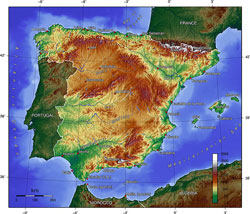
Note: Map of Spain graphic courtesy of Wikimedia Commons.
Level 3 Communications is a leader in the field of low latency transport services. Once of their niche services is fiber optic lines optimized to reduce latency between financial centers. They’ve just added London to Madrid and Frankfort to Madrid routes with circuit speeds up to 10 Gbps. These join the existing routes of Chicago to Washington DC, Chicago to New York, New York to London, and London to Frankfurt. The newly added European connections will improve latency on the Madrid to New York and Madrid to Chicago routes also.Why is low latency such a hot topic as opposed to, say, bandwidth? Actually both latency and bandwidth are important characteristics of long haul fiber optic networks. What’s given latency the spotlight in recent years is the rise of high speed financial trading. This is a process where computers generate market trades far faster than humans are capable of. With thousands of trades executing in milliseconds, even very small moves in a market can result in huge profits or losses. If your trading platform is running even a fraction of a second behind your competitor’s, you could be on the losing end of those trades.
Latency can be minimized, but not eliminated. That’s because latency is nothing more than the length of time that elapses between when a signal is sent and when it is received. The fastest that an optical or electrical signal can propagate is set by the speed of light at 186,000 miles per second or 300,000 kilometers per second. If two locations are separated by 186 miles, you’ll never get below 1 millisecond of latency. A 1,860 mile route can do no better than 10 milliseconds. However, it can be much, much worse.
What sort of characteristics can slow down a speeding laser pulse? The mere fact that the data modulated light beam is traveling through a glass fiber rather than the vacuum of space will slow it down. According to Level 3, the propagation delay in optical networks is approximately 4.9 microseconds per kilometer. In free space the delay would be about 3.3 microseconds. That 4.9 microseconds can be degraded further by electronics that can’t keep up with the speed of the traffic. In other words, any bandwidth limitation will manifest itself as an additional delay as packets queue up in a buffer chip. Even with the fastest electronics, fiber routes must be as straight as possible. Any meandering through the countryside or to pick up other cities adds fiber length and, thus, latency.
Global trading has been increasing in volume at the rate of 30 to 50% annually. It is expected that automated trading will soon account for fully two-thirds of equity trades. Level 3 Communications has carved out a position as a key provider of high bandwidth ultra low latency connections to serve the financial industry. Unprotected Ethernet Private Line services are available at 100 Mbps. Unprotected Wavelength services are available at 1 GigE, 2.5 Gbps, 10 Gbps, 10 GigE and 40 Gbps. They can also provide customized global latency solutions for specific physical routing and diversity.
Are you in need of ultra low latency connections or merely low latency for time sensitive applications? If so, you should check out the availability and pricing of latency sensitive high bandwidth connections for your needs.

Note: Map of Spain graphic courtesy of Wikimedia Commons.
Subscribe to:
Posts (Atom)