Showing posts with label DS1. Show all posts

Thursday, October 14, 2010

Gaining Ethernet Internet Access

You’ve no doubt heard by now that access to the Internet for business locations offers cost and bandwidth advantages over traditional telecom connections. So, how do you gain Ethernet Internet access? That’s easy. Just use this handy Ethernet Internet Finder.

Use the Ethernet Internet Finder to locate Ethernet Internet Providers. Click to access.


You’ll likely find that there are a number of options for Ethernet Internet service, although not all of them are available at every business address. Note that this is a business service only. If you need residential or home office broadband, try “Can I Get DSL?” for DSL, cable, satellite, wireless 4G, and fiber to the home.

Your least expensive option for Ethernet Internet access is probably Ethernet over Copper, where available. That’s generally in metropolitan and suburban areas with dense populations. EoC, as it is called, offers bandwidths typically from 3 to 20 Mbps. You’ll pay about as much for a 3 Mbps Ethernet connection as you’d pay for a 1.5 Mbps T1 line. A very popular service is 10 Mbps Ethernet access, which is the standard Ethernet network speed.

Of course, local area network bandwidth has increased dramatically since Ethernet was first introduced. Most LANs are now operating at the Fast Ethernet speed of 100 Mbps or Gigabit Ethernet at 1000 Mbps. Would you be surprised to know that Ethernet WAN connections are also available at 100 and 1000 Mbps? That includes dedicated broadband Internet access with Ethernet in the first mile. These services require a fiber optic connection over SONET or native IP network.

Even if your business is located a bit beyond the service footprint for EoC or fiber optic delivery, it may still be possible for you to get Ethernet over DS1. Bonding T1 lines together may give you the Ethernet bandwidth you need at a reasonable price.

Does Ethernet Internet Access offer advantages for your business? Use the Ethernet Internet Finder to run a quick check and see.

Click to check pricing and features or get support from a Telarus product specialist.


Follow Telexplainer on Twitter

Tuesday, July 20, 2010

Covad and ADTRAN Make Everything Ethernet

The age of Carrier Ethernet is upon us. All the excitement these days is directed at IP core networks and Ethernet access solutions. So, does that mean that legacy TDM services must be abandoned in place? Not at all. With the right equipment, DS1 and DS3 circuits can be repurposed for Ethernet transport. Carrier Covad and equipment maker ADTRAN are doing just that.

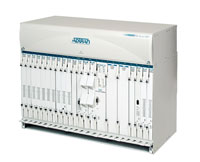
ADTRAN Total Access 5000Covad is now deploying ADTRAN central office and network termination equipment to expand their Ethernet service area. Covad currently serves 44 states and 235 major markets with a core network that spans the nation. Their specialties have included business DSL, data T1, high bandwidth fixed wireless, bonded T1, and integrated voice and data with SIP, PRI and analog handoff. All of these are designed to serve the small and medium size business market. Ethernet is a natural addition to the Covad portfolio.

What’s special about the ADTRAN Carrier Ethernet solutions? It’s that they can pretty much press any existing line service into transporting Ethernet from the service provider to the end user. A service aggregation unit is installed at the central office to connect with the carrier’s Metro Ethernet and IP Core networks. For Covad, this is the Total Access 5000 MSAP (Multi-Service Access Platform). The aggregation unit brings in GigE or 10 GigE carrier bandwidth connections and apportions it to subscribers.

What makes this system so flexible is that the transport from CO to subscriber can be any of the common circuits already in place. These include DS3 and bonded DS3 bandwidth, T1 and bonded T1 lines, e.SHDSL bonded pairs. DS3 and T1 (DS1) are legacy service that are been used by many businesses for years. Ethernet over TDM or EoTDM allows service provider to keep those circuits in place and use them to provide Metro Ethernet or Carrier Ethernet services over an extensive area.

EoC or Ethernet over Copper has become very popular recently because it offers higher bandwidths and lower prices than traditional digital line services. The e.SHDSL technology can boost speed to 5.7 Mbps per e.SHDSL loop compared to 1.5 Mbps for T1. However, this is a distance limited technology that is typically extends no further than 9 km from the carrier’s point of presence.

An appropriate network termination unit is installed at the customer location. The companion product is the NetVanta 800 Series. These are configured for 2, 4, or 8 bonded e.SHDSL pairs, up to 3 bonded DS3 circuits for a maximum of 134 Mbps, or 2, 4 or 8 four-wire T1/E1 loops. In many cases, bonding multiple copper pair can bring in the bandwidth needed by businesses without the high cost of pulling-in fiber optic cable for a new installation. In many cases, fiber isn’t available nearby and isn’t really an option. Even so, 10 or 12 Mbps and up to 45 Mbps over existing copper wiring offers the requisite bandwidth at very reasonable costs.

Is your business straining at the limit of your current T1 line or dissatisfied with business DSL service? If so, you may find that Ethernet service from Covad and other top carriers is just what you need. Why not find out how much bandwidth you can get for your telecom dollar? It takes just a second to inquire and a knowledgeable consultant will be in contact quickly with prices and install times. Inquire about Carrier Ethernet for your business now.

Click to check pricing and features or get support from a Telarus product specialist.


Follow Telexplainer on Twitter

Wednesday, March 10, 2010

The DS1 DS3 Relationship

If you are involved with business telecommunications networking or need to be, you have probably heard the terms DS1 and DS3 bandied about. But what do these terms really mean and where did they come from?

The DS in DS1 and DS3 stands for Digital Signal level. It is a designation that is used to specify the capacity of a digital line in the T-carrier system. You know the most popular T-carrier service as T1. Another popular service is T3. In simple terms, DS1 goes along with T1 and DS3 goes along with T3.

Find the DS1 or DS3 bandwidth you need in your business.Now, let’s see what’s behind these DS levels and T-carriers. The history of this system goes back to the 1950’s, when Bell Labs recognized the advantage of changing from an all-analog telephone system to digital connections between telephone company offices. Digital transmission carries many conversations on few wires and eliminates the noise and cross-talk that were commonly heard on long distance calls at that time.

The most basic service is one two-way telephone conversation. That was made the most basic element of the T-carrier system and given the designation DS0 or Digital Signal level zero. A DS0 signal is the digital representation of a single voice call. It has a bandwidth of 64 Kbps formed by sampling the audio conversation at a rate of 8 Kbps with 8 bits of data. Those numbers are critical, because they represent the minimum bandwidth needed to give the same audio quality as an equivalent analog phone line.

If a DS0 is one phone call and consumes 64 Kbps of bandwidth, then what is a DS1? DS1 is a collection of 24 DS0 “channels” packed together in a bundle. That’s 24 separate telephone conversations. The bandwidth for this bundle is 1.536 Mbps. When you add 8 Kbps for synchronization, the total bandwidth is 1.544 Mbps. It’s commonly referred to as 1.5 Mbps. A T1 line is a DS1 digital signal package carried on a very specific physical network consisting of 2 pair of twisted pair telco wires with a defined voltage and waveform characteristic.

That’s what DS1 means. Now, how about DS3? If you bundle 28 DS1 signals, the equivalent of 672 DS0 voice channels, you get a DS3. The bandwidth of this signal is 44.736 Mbps, often referred to as 45 Mbps. A T3 line carries a DS3 signal on coaxial cable, although T3 service may also be sent by microwave.

Now, here’s where things get interesting. You can generate the DS digital signal protocol but not necessarily use a T1 line or T3 line for transport. In a process called multiplexing, multiple DS1 and DS3 signals can be combined and transported over fiber optic cable. The SONET fiber optic services were designed to directly accommodate this. The lowest bandwidth SONET service generally available is OC3, which carries 3 multiplexed DS3 signals with a total bandwidth of 155.52 Mbps. When the signals get to where they are needed, they are separated or demultiplexed to get back the 3 DS3 signals, which might be constructed of 28 DS1 signals each.

When used to transport data packets instead of telephone calls, the individual channels are generally invisible to the end user, although they exist within the T-carrier and SONET systems. DS1 and T1 can be said to have a bandwidth 1.5 Mbps. DS3 and T3 can be said to have a bandwidth of 45 Mbps. It is these numbers that you can use to compare pricing with competing telecom services , such as Metro Ethernet.

Click to check pricing and features or get support from a Telarus product specialist.


Follow Telexplainer on Twitter